White House Champions Year-Round Patriotism After July 4
Synopsis
Two days after Independence Day, the White House posted on X asserting that its patriotism is not confined to a single annual holiday. The message, using colloquial social media language, signals a sustained civic identity push from the Executive Office of the President.
Key Takeaways
The White House posted on X on July 6, 2026 , two days after Independence Day .
The post read: 'Imagine only being patriotic one day a year.
Couldn't be us.' The message signals that the administration frames its patriotism as a year-round commitment, not a single-day observance.
U.S. administrations have historically used official channels to promote sustained national identity messaging beyond holiday cycles.
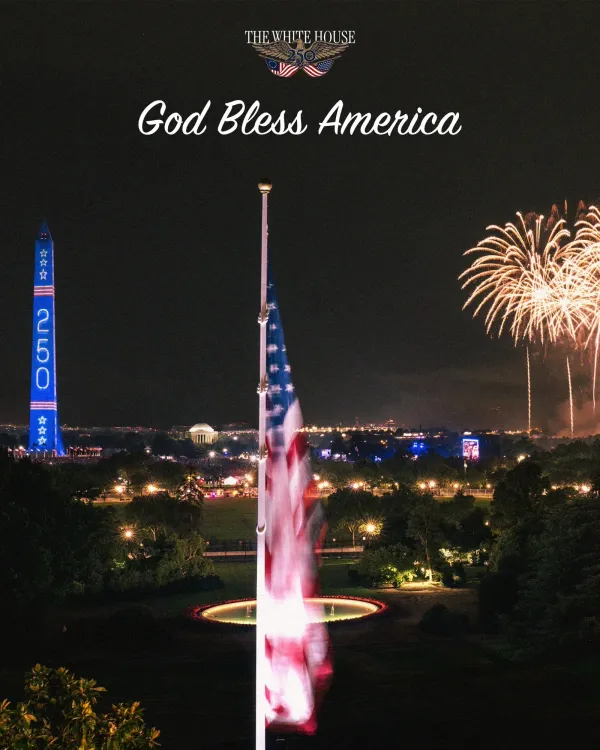
The post was accompanied by an image and published at 7:40 PM UTC , reaching a global audience still in the post- July 4 news cycle.
Subsequent White House posts on national symbols and civic values will indicate whether this is part of a broader communications strategy.
The White House, the official communications account of the Executive Office of the President of the United States, posted a pointed message on X on Monday, July 6, 2026, two days after Independence Day, asserting that its commitment to American patriotism extends well beyond a single annual celebration.
The post read: 'Imagine only being patriotic one day a year. Couldn't be us.' The message was accompanied by an image and was published at 7:40 PM UTC, reaching a wide audience still in the afterglow of the July 4 holiday weekend.
Context
The timing of the post — two days after Independence Day — carries deliberate weight. Rather than marking the end of patriotic observance, the White House used the moment to signal that national pride is a continuous, year-round commitment. The phrase 'Couldn't be us' is a colloquial expression commonly used on social media to distance oneself from a described behaviour, here implying that the administration views its patriotism as constant rather than seasonal. The July 4 holiday traditionally features flag displays, fireworks, parades, and presidential addresses, making it the most visible single day of national celebration in the United States. The White House post implicitly contrasts this one-day peak with a broader, sustained civic identity.Policy Backdrop
U.S. administrations have long used official communication channels to promote expressions of national identity that extend beyond calendar holidays. Official social media accounts regularly highlight symbols such as the American flag, military service, and civic milestones throughout the year — not only around July 4, Veterans Day, or Memorial Day. This approach reflects a broader pattern of messaging designed to reinforce civic cohesion across partisan divides and holiday cycles. By posting in the days immediately following Independence Day, the White House reinforces a narrative that patriotism is an ongoing institutional value, not a performative annual gesture.Stakeholders and Impact
The primary audience for such messaging is the American public — U.S. citizens who engage with official government communications on social media. The post's casual, conversational tone is characteristic of how modern executive offices have adapted their digital voice to connect with broader, younger demographics on platforms like X. For observers outside the United States — including audiences in India, where American political messaging is closely watched — the post signals the continued use of social media as a tool for soft civic diplomacy and identity reinforcement. The White House's official account commands significant global reach, and even culturally specific posts carry international visibility.What's Next
The weeks following July 4 typically see a gradual wind-down of patriotic public events, but the White House's messaging suggests an intent to keep national identity themes active in the public conversation. Subsequent posts on national symbols, military service, or civic values in the coming weeks will indicate whether this is part of a sustained communications strategy or a standalone post-holiday message. As official social media increasingly shapes public discourse on national identity, the White House's choice to post pointedly on a non-holiday date underscores how executive communications are evolving — using brevity and internet vernacular to make ideological statements that resonate far beyond the moment.Point of View
Digitally native audiences while delivering a pointed message about the administration's self-image.
NationPress
5 Oct 2026
Frequently Asked Questions
What did the White House post on July 6 2026?
The White House posted on X on July 6, 2026, saying 'Imagine only being patriotic one day a year. Couldn't be us,' asserting that its patriotism extends beyond the July 4 Independence Day holiday.
Why did the White House post about patriotism after Independence Day?
The post came two days after July 4 to signal that the administration views patriotism as a year-round commitment rather than a single-day observance, continuing a pattern of sustained civic identity messaging from U.S. executive offices.
What does 'Couldn't be us' mean in the White House post?
'Couldn't be us' is a colloquial social media phrase used to distance oneself from a described behaviour. Here, the White House used it to imply that unlike those who are patriotic only on Independence Day, the administration maintains patriotism continuously.
How does the White House use social media for patriotism messaging?
The White House regularly uses its official X account to highlight national symbols, military service, and civic milestones throughout the year, not only around major holidays like July 4, Veterans Day, or Memorial Day.
What is the significance of the White House posting on a non-holiday date?
Posting on a non-holiday date like July 6 underscores how executive communications are evolving — using brevity and internet vernacular to make ideological statements about national identity outside of the traditional holiday news cycle.