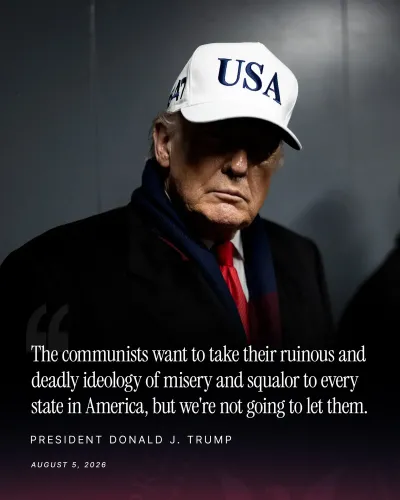
White House Declares US Will Never Be a Communist Country
Synopsis
The White House posted on X on 23 July 2026 that the United States will 'NEVER' be a communist country. The emphatic declaration echoes a long tradition of American anti-communist rhetoric, most recently recalled in Donald Trump's 2019 State of the Union, and arrives amid ongoing domestic debates over the boundaries of government authority.
Key Takeaways
The White House posted on X on 23 July 2026 that the United States will never be a communist country.
The word 'NEVER' was capitalised in the original post, signalling rhetorical emphasis from the administration.
The statement echoes Donald Trump's February 2019 State of the Union declaration that America will never be a socialist country.
US political rhetoric rejecting communism is rooted in Cold War -era containment policies and domestic anti-subversion measures.
The declaration is directed at the US electorate and carries symbolic weight in the context of Washington 's geopolitical rivalry with communist-governed states.
Follow-up legislative or executive action will determine whether the post reflects a broader policy strategy.
The White House, the official communications account of the Executive Office of the President of the United States, posted a stark ideological declaration on X on 23 July 2026, stating that the United States of America will never become a communist country.
Context
The post, consisting of a single emphatic sentence — 'The United States of America will NEVER be a communist country' — was shared without additional elaboration. The use of capitalisation on 'NEVER' signals the administration's intent to project firmness on the question of the country's ideological identity.
The statement arrives amid ongoing partisan debates in the United States over the scope of government authority, economic regulation, and national identity — debates that have intensified in recent years as competing visions of the state's role in the economy have sharpened political divisions.
Policy Backdrop
Explicit rejections of communism and socialism have a long history in American political rhetoric, rooted in Cold War-era policies of containment and domestic anti-subversion measures that defined much of 20th-century US governance. Such declarations have periodically resurfaced in conservative discourse whenever perceived expansions of government authority enter public debate.
A notable recent precedent came in February 2019, when then-President Donald Trump, in his State of the Union address, declared that 'America will never be a socialist country' — a formulation that drew wide attention and became a rallying point for the political right. The White House's latest post echoes that rhetorical tradition, escalating the framing from 'socialist' to 'communist.'
Stakeholders and Impact
The primary audience for such a declaration is the US electorate, particularly voters attuned to debates over government intervention in healthcare, energy, housing, and financial markets. For the American right, invoking communism functions as a boundary-marker distinguishing preferred economic policy from what it characterises as statist overreach.
Internationally, the statement carries symbolic weight at a time when Washington's geopolitical competition with Beijing and Moscow — both governed under communist or authoritarian-statist frameworks — remains a defining feature of global affairs. For observers in India and across the Indo-Pacific, the declaration reinforces the United States' self-positioning as the leading liberal-democratic counterweight to communist-governed powers.
What's Next
Congressional debates on economic and regulatory legislation are expected to serve as the immediate arena in which this rhetorical posture is tested against policy specifics. Analysts will watch for follow-up official statements that translate the declaration into concrete legislative or executive priorities.
Whether the post signals a broader communications strategy ahead of domestic political contests or is a standalone affirmation of ideological identity will become clearer in the coming weeks as the administration's policy agenda develops.
Point of View
' the administration signals a sharper ideological edge, likely calibrated to energise a specific segment of the electorate. For global audiences, particularly in the Indo-Pacific, the post reinforces Washington's self-image as the ideological anchor of liberal democracy against authoritarian-statist rivals. The absence of any policy specifics, however, leaves the declaration in the realm of rhetoric until concrete legislative or executive follow-through is demonstrated.
NationPress
21 Oct 2026
Frequently Asked Questions
Why did the White House say the US will never be a communist country?
The White House posted the declaration on 23 July 2026 as an affirmation of American ideological identity, a form of rhetoric that has recurred in US conservative political discourse, particularly during debates over government economic intervention.
What did Trump say about socialism in 2019?
In his February 2019 State of the Union address, President Donald Trump declared that 'America will never be a socialist country,' a statement widely seen as a predecessor to the White House's 2026 post using the term 'communist.'
What is the difference between the White House calling the US 'not socialist' versus 'not communist'?
'Socialist' and 'communist' represent different points on the spectrum of state-controlled economic systems; 'communist' is generally regarded as the more extreme characterisation, suggesting the 2026 framing adopts a sharper rhetorical stance than the 2019 declaration.
How does US anti-communist rhetoric relate to Cold War history?
US opposition to communism was institutionalised during the Cold War through policies of containment and domestic anti-subversion measures; that legacy continues to shape American political identity and is periodically invoked in contemporary policy debates.
What impact does the White House's anti-communist statement have on India?
For India and the broader Indo-Pacific region, the statement reinforces the United States' positioning as the leading liberal-democratic counterweight to communist-governed powers such as China , which has implications for ongoing strategic and diplomatic alignments.