Assembly Election Results 2025: Counting Begins in West Bengal, Tamil Nadu, Kerala & Assam
Synopsis
Five states, 25 crore votes, and one question: who governs India's most politically charged regions? From Mamata Banerjee's do-or-die fourth-term bid in West Bengal to the LDF's unprecedented third-term attempt in Kerala and a disruptive new force in Tamil Nadu, the 2025 assembly election results could redraw the national political map by nightfall.
Key Takeaways
Counting of votes for Tamil Nadu, Kerala, West Bengal, Assam , and Puducherry began on 4 May 2025 ; results expected by end of day.
West Bengal recorded a historic 92.93% voter turnout; Mamata Banerjee's TMC is fighting for a fourth consecutive term against a resurgent BJP .
In Tamil Nadu , the DMK is projected between 120–145 seats , but Vijay's TVK has emerged as a significant third force with an estimated 30% urban vote share .
Kerala's LDF under Pinarayi Vijayan is attempting a historically unprecedented third consecutive term ; the UDF is projected near 72 seats .
Assam's BJP-NDA , led by Himanta Biswa Sarma , is projected to win 85–100 seats in the 126-member Assembly , eyeing a hat-trick.
Counting of votes for the 2025 assembly elections in Tamil Nadu, Kerala, West Bengal, Assam, and Puducherry began on Monday, 4 May 2025, with final results expected before the end of the day as trends emerge through multiple counting rounds. Collectively, nearly 25 crore voters across these four states exercised their franchise in what analysts are calling one of the most consequential state election cycles in recent memory.
West Bengal: A High-Stakes Battle for a Fourth Term
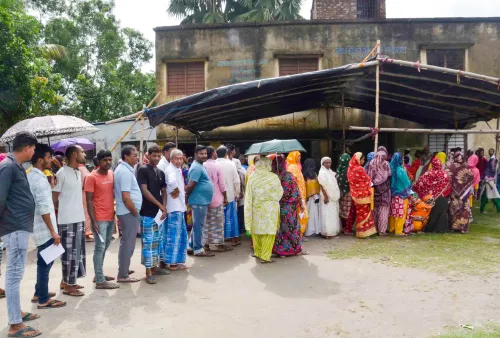
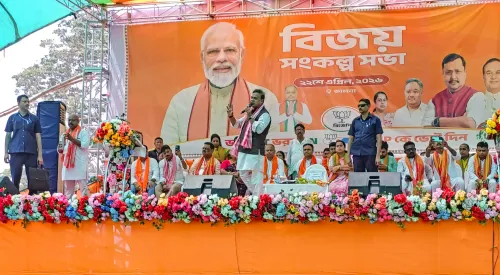
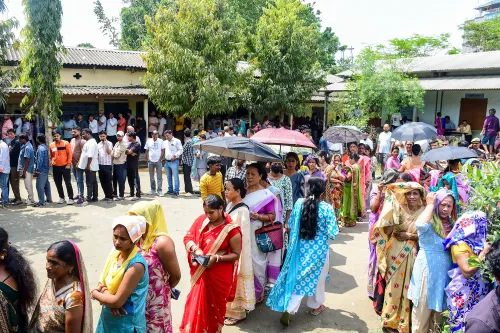
West Bengal recorded a historic 92.93 per cent voter turnout, the highest among all states in this cycle, signalling the extraordinary intensity of the contest. Chief Minister Mamata Banerjee and the All India Trinamool Congress (TMC) are fighting for an unprecedented fourth consecutive term, while the Bharatiya Janata Party (BJP) — which has transformed from a marginal player to a formidable challenger over the past decade — is mounting its most serious bid yet for power in the state.
The campaign was dominated by the fallout of the RG Kar Medical College tragedy, which galvanised public sentiment around women's safety and systemic accountability. The TMC relied on its grassroots network and welfare schemes such as Lakshmir Bhandar, while the BJP focused on anti-incumbency and administrative lapses. Exit polls reportedly suggested a razor-thin margin, where even a fraction of vote share could determine whether Banerjee retains her stronghold or the BJP registers its first-ever victory in the East — an outcome that would fundamentally reshape the national Opposition's leadership structure.
Tamil Nadu: DMK Leads, but TVK Emerges as a Third Force
Tamil Nadu posted an 85.1 per cent voter turnout, another record for the state. The traditionally bipolar contest between Chief Minister M.K. Stalin's Dravida Munnetra Kazhagam (DMK)-led alliance and the All India Anna Dravida Munnetra Kazhagam (AIADMK) has been disrupted by the entry of actor Vijay's Tamilaga Vettri Kazhagam (TVK).
Internal surveys and exit projections indicate the DMK-led alliance remains the frontrunner, with seat projections ranging between 120 and 145 in the 234-member Assembly. The TVK, according to available data, could capture around 30 per cent vote share in urban pockets such as Chennai and Madurai. Should the DMK secure a second consecutive term, it would be seen as a validation of the Dravidian Model of social justice; a strong TVK showing, however, could mark the beginning of tri-polar politics in a state long resistant to political disruption.
Kerala: LDF Attempts a Historic Third Consecutive Term
In Kerala, the Left Democratic Front (LDF) under Chief Minister Pinarayi Vijayan is attempting a feat no ruling coalition has achieved in the state's modern history — a third consecutive term in the 140-member Assembly. The Congress-led United Democratic Front (UDF) is projected to hover around 72 seats, according to exit poll estimates, making the contest tight.
The election was fought on structural issues, particularly the widening gap between high literacy rates and low entry-level wages, which has driven significant youth migration to foreign labour markets. A UDF revival in Kerala would not only be a state-level win but a crucial signal for the Congress nationally — demonstrating its capacity to lead a major alliance to victory independently.
Assam: BJP-Led NDA Eyes a Hat-Trick
In the Northeast, the BJP-led National Democratic Alliance (NDA), steered by Chief Minister Himanta Biswa Sarma, is reportedly positioned for a third consecutive term in the 126-member Assam Assembly. Exit polls projected the NDA securing between 85 and 100 seats, reflecting a successful blending of ethnic identity politics with centralised development narratives.
The Congress-led six-party Opposition front has struggled to dismantle the BJP's organisational machinery despite forming a broad coalition. As counting progresses, the results across all five territories will offer a real-time barometer of whether Indian voters are rewarding visible governance or signalling a shift driven by concerns over safety, migration, and economic aspiration.
Point of View
But it would also expose the limits of the TMC's welfare-first model as a national Opposition template. In Tamil Nadu, the real story is not whether the DMK wins, but how large the TVK footprint is — because a 30% urban vote share for a first-time party signals a generational fracture in Dravidian politics that no alliance arithmetic can paper over. Kerala's contest, meanwhile, is the most structurally honest: voters there are not choosing between ideologies but between two parties that have both failed to fix the youth employment crisis. The results will be read nationally, but the real verdict is local — and far more granular than any exit poll captures.
NationPress
19 Sept 2026
Frequently Asked Questions
When will the 2025 assembly election results be declared?
Counting began on Monday, 4 May 2025, and final results are expected to be declared by the end of the day as trends emerge through multiple counting rounds across Tamil Nadu, Kerala, West Bengal, Assam, and Puducherry.
What is at stake in the West Bengal assembly election 2025?
Chief Minister Mamata Banerjee and the TMC are seeking a fourth consecutive term against a BJP that has grown into a major challenger. A BJP victory would mark its first-ever win in West Bengal and significantly alter the national Opposition's dynamics.
How did Tamil Nadu's Tamilaga Vettri Kazhagam perform in the 2025 election?
Actor Vijay's TVK emerged as a significant third force, reportedly capturing around 30% vote share in urban areas like Chennai and Madurai. The DMK-led alliance is still projected as the frontrunner with 120–145 seats, but the TVK's rise signals a potential shift toward tri-polar politics in the state.
Is the LDF attempting a historic win in Kerala in 2025?
Yes. The Left Democratic Front under Chief Minister Pinarayi Vijayan is attempting a third consecutive term, a feat no ruling coalition has achieved in Kerala's modern political history. The Congress-led UDF is projected near 72 seats in the 140-member Assembly.
What are the exit poll projections for Assam in 2025?
Exit polls projected the BJP-led NDA, steered by Chief Minister Himanta Biswa Sarma, to win between 85 and 100 seats in the 126-member Assam Assembly, positioning it for a third consecutive term.