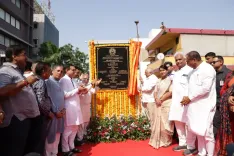
Bihar cabinet expansion: 32 NDA ministers sworn in at Gandhi Maidan
Synopsis
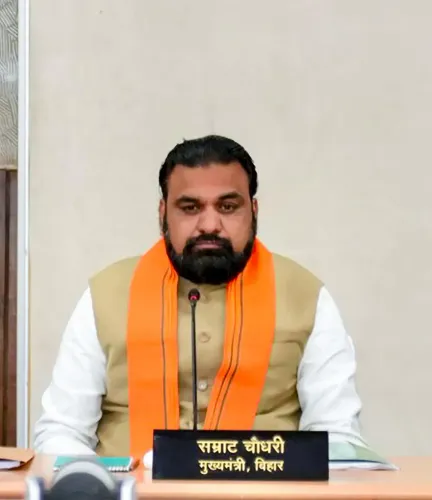
In a meticulously choreographed show of NDA strength, 32 ministers were sworn into the Samrat Chaudhary cabinet at Gandhi Maidan with PM Modi and Amit Shah in attendance. The cabinet's caste arithmetic — 10 EBC, 7 Dalit, 6 OBC, 9 Savarna, 1 Muslim — reads less like a governance roster and more like a Bihar electoral blueprint.
Key Takeaways
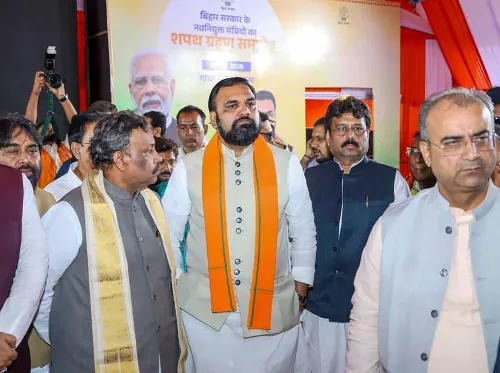
32 NDA leaders were sworn in as ministers of the Samrat Chaudhary cabinet at Gandhi Maidan, Patna on 7 May .
Cabinet seats split as: 15 BJP , 13 JD(U) , 2 LJP (Ram Vilas) , 1 Hindustani Awam Morcha , 1 Rashtriya Lok Morcha .
Social composition: 10 EBC , 6 OBC , 7 Dalit , 9 Savarna , and 1 Muslim minister.
The cabinet includes 5 women ministers , with JD(U) contributing the most at 3 .
PM Narendra Modi , Home Minister Amit Shah , and Defence Minister Rajnath Singh attended the swearing-in ceremony.
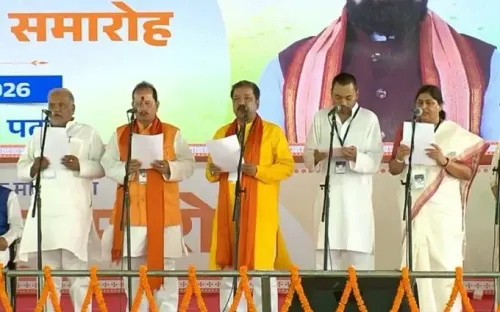
Governor Syed Ata Hasnain administered the oath of office to all 32 ministers.
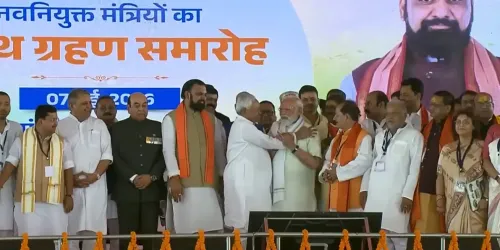
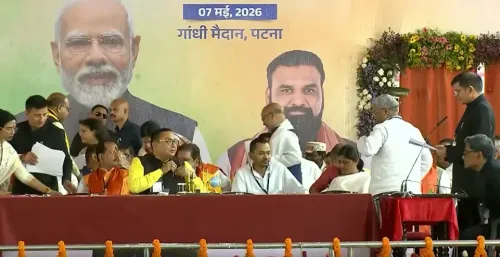
Patna, 7 May — In a sweeping display of political muscle, 32 leaders from the ruling National Democratic Alliance (NDA) were sworn in as ministers of the Samrat Chaudhary cabinet at a grand ceremony held at Gandhi Maidan in Patna on Thursday. The event drew thousands of supporters and was attended by some of the country's most powerful political figures, underscoring the NDA's bid to consolidate its hold over Bihar ahead of future electoral contests.
High-Profile Attendance
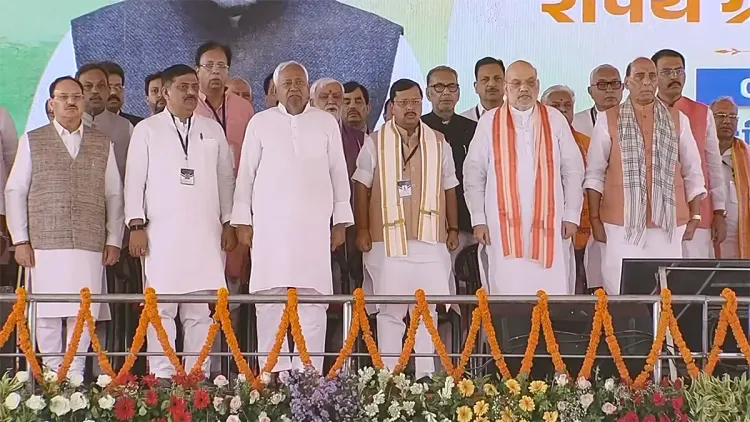
The swearing-in ceremony was graced by Prime Minister Narendra Modi, Union Home Minister Amit Shah, Defence Minister Rajnath Singh, and former Chief Minister Nitish Kumar, along with several other senior NDA leaders. The presence of the top Central leadership at a state cabinet expansion is widely seen as a signal of the alliance's intent to project unity and strength in Bihar's politically charged landscape.
Alliance Arithmetic and Cabinet Composition
The expanded cabinet reflects a carefully negotiated distribution of portfolios among NDA partners. Of the 32 ministers, 15 berths have gone to the Bharatiya Janata Party (BJP), 13 to the Janata Dal (United), two to the Lok Janshakti Party (Ram Vilas), one to the Hindustani Awam Morcha (Secular), and one to the Rashtriya Lok Morcha led by Upendra Kushwaha. The allocation is designed to maintain cohesion within a coalition that spans multiple parties and competing interests.
The social engineering embedded in the cabinet is equally deliberate. The composition includes 10 ministers from the Extremely Backward Classes (EBC), six from Other Backward Classes (OBC), seven from Dalit communities, nine from Savarna (upper caste) groups, and one Muslim minister. Political observers note that this caste arithmetic mirrors Bihar's complex social fabric, where community representation in government is a key electoral variable.
Fresh Faces and Women's Representation
One of the most discussed aspects of the expansion is the induction of several first-time ministers. The JD(U) brought in three new faces — Nishant Kumar, Bulo Mandal, and Shweta Gupta — with the inclusion of Gupta specifically seen as a move to strengthen women's representation. The BJP, meanwhile, inducted four first-timers: Mithilesh Tiwari, Ramchandra Paswan, Nand Kishore Ram, and Engineer Shailendra, broadening its outreach across social groups.
Overall, the new cabinet includes five women ministers, with JD(U) contributing the highest number at three. Political analysts view this as a deliberate attempt to project the government as supportive of greater female participation in governance.
Order of Oath-Taking
Governor Syed Ata Hasnain administered the oath of office to the ministers in batches. The first group comprised Shravan Kumar, Vijay Kumar Sinha, Dilip Jaiswal, Nishant Kumar, and Leshi Singh. They were followed by Ram Kripal Yadav (BJP), Nitish Mishra (BJP), Damodar Rawat (JD-U), Sanjay Singh 'Tiger' (BJP), and Ashok Chaudhary (JD-U).
Subsequently, Bhagwan Singh Kushwaha (JD-U), Arun Shankar Prasad (BJP), Madan Sahani (JD-U), Santosh Kumar Suman (Hindustani Awam Morcha), and Rama Nishad (BJP) took their oaths, followed by Ratnesh Sada (JD-U), Kumar Shailendra (BJP), Sheela Kumari (JD-U), Kedar Prasad Gupta (BJP), and Lakhendra Kumar Roshan (BJP). The final batch included Sunil Kumar (JD-U), Shreyasi Singh (BJP), Jama Khan (JD-U), Nandkishore Ram (BJP), Shailesh Kumar alias Bulo Mandal (JD-U), Pramod Kumar (BJP), Shweta Gupta (JD-U), Mithilesh Tiwari (BJP), Ramchandra Prasad (BJP), Sanjay Kumar Singh (LJP-Ram Vilas), Sanjay Kumar (LJP-Ram Vilas), and Deepak Prakash (RLM).
What Comes Next
With the expanded cabinet now in place, the NDA faces the harder task of converting political optics into governance delivery. Bihar's development challenges — infrastructure, employment, and public services — will test whether the carefully calibrated coalition can function as an effective administration. Attention will now shift to the allocation of portfolios and the rollout of development schemes across the state.
Point of View
Shah, and Rajnath Singh at a state cabinet swearing-in is unusual and deliberate — it signals that Bihar remains central to the NDA's national calculus. The caste matrix embedded in the 32-member cabinet is a near-perfect mirror of Bihar's vote arithmetic, but governing Bihar requires more than representation optics. The state consistently ranks near the bottom on human development indices, and previous coalition cabinets have struggled to translate alliance management into policy coherence. The real test for Samrat Chaudhary's expanded government is whether the same precision applied to caste balancing will be applied to budget allocation and scheme delivery.
NationPress
24 Sept 2026
Frequently Asked Questions
Who were sworn in as ministers in the Bihar cabinet expansion on 7 May?
A total of 32 NDA leaders were sworn in as ministers of the Samrat Chaudhary cabinet at Gandhi Maidan, Patna on 7 May 2025. The list includes ministers from BJP, JD(U), LJP (Ram Vilas), Hindustani Awam Morcha, and Rashtriya Lok Morcha.
How are cabinet seats distributed among NDA allies in Bihar?
Of the 32 ministerial positions, 15 went to the BJP, 13 to JD(U), 2 to LJP (Ram Vilas), 1 to Hindustani Awam Morcha (Secular), and 1 to Rashtriya Lok Morcha led by Upendra Kushwaha.
What is the caste composition of the new Bihar cabinet?
The expanded Bihar cabinet includes 10 ministers from Extremely Backward Classes (EBC), 6 from Other Backward Classes (OBC), 7 from Dalit communities, 9 from Savarna (upper caste) groups, and 1 Muslim minister — reflecting Bihar's complex social fabric.
How many women ministers are in the new Bihar cabinet?
The new Bihar cabinet includes 5 women ministers. JD(U) contributed the highest number with 3 women ministers, including first-timer Shweta Gupta, whose inclusion is seen as a move to strengthen female representation in government.
Why did PM Modi and Amit Shah attend a state cabinet swearing-in ceremony?
Prime Minister Narendra Modi and Home Minister Amit Shah attended the Bihar cabinet expansion ceremony at Gandhi Maidan, Patna, alongside Defence Minister Rajnath Singh and former CM Nitish Kumar. Their presence is widely interpreted as a show of NDA unity and a signal of Bihar's strategic importance to the alliance ahead of future elections.