Major Bust: 6 Pak Nationals Get 20 Years for Rs 384 Cr Heroin Haul

Synopsis
A Bhuj court has sentenced six Pakistani nationals to 20 years in prison for smuggling nearly 77 kg of heroin worth Rs 384.68 crore through Indian waters in December 2021. The court called it a deliberate strategy to weaken India by targeting its youth — framing a drug bust as a national security threat.
Key Takeaways
Six Pakistani nationals from Karachi were convicted by the Sixth Additional Sessions and Special NDPS Court, Bhuj for maritime heroin smuggling.
The seized contraband weighed 76,936 grams of heroin , valued at Rs 384.68 crore — one of Gujarat's largest maritime drug seizures.
The interception was carried out jointly by the Gujarat ATS and Indian Coast Guard on December 20, 2021 , in the Arabian Sea near the Jakhau coast .
Each accused was sentenced to 20 years of rigorous imprisonment and fined Rs 2 lakh under the NDPS Act .
The court described the operation as a "well-planned strategy to weaken India's national structure" by targeting its youth through addiction.
The prosecution presented 203 documentary pieces of evidence and examined 13 witnesses during the trial.
A special NDPS court in Bhuj, Gujarat has convicted six Pakistani nationals and sentenced each to 20 years of rigorous imprisonment for attempting to smuggle 76,936 grams of heroin — valued at Rs 384.68 crore — into Indian territorial waters. The verdict, delivered by Judge V.A. Badhu of the Sixth Additional Sessions and Special NDPS Court, marks one of the most significant drug trafficking convictions in Gujarat's maritime history.
How the Joint Operation Unfolded
The case traces back to December 2021, when the Gujarat Anti-Terrorist Squad (ATS) received credible intelligence from Deputy Superintendent of Police Bhavesh Rojiya about a Pakistani vessel named "Al Husseini" transporting a heroin consignment from Karachi. The delivery was reportedly planned at approximately 35 nautical miles off the Jakhau coast in the Arabian Sea.
Acting swiftly, the ATS coordinated with the Indian Coast Guard to launch a joint surveillance operation spanning December 18 to 20, 2021. At approximately 2:30 a.m. on December 20, radar systems detected a suspicious vessel in the Arabian Sea. Coast Guard teams intercepted and surrounded the boat, finding six individuals on board, all identified as Pakistani fishermen from Karachi.
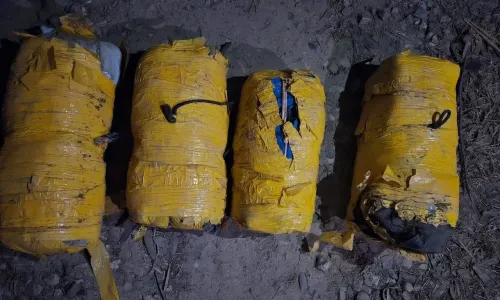
A thorough search of the vessel yielded five large bags containing the heroin, seized without any valid authorisation. A formal complaint was filed by ATS Police Inspector M.C. Nayak, and the investigation was subsequently conducted by Police Sub-Inspector R.R. Rathod.
Identity of the Convicted Accused
The six convicted individuals are: Mohmad Imran Mohammad Tariq Vaghera (31), Danish Mohammad Husen Kachchi Vaghera (24), Sagar Mohammad Kachchi Vaghera (23), Ismail Ibrahim Badala (45), Mohmad Sajid Mohammad Husen Yakublala Kungara (24), and Ashfaq Mohammad Ishaq Vaghera (26) — all residents of Karachi, Pakistan.
All six were charged under Sections 8(c), 22(c), 25, and 29 of the Narcotic Drugs and Psychotropic Substances (NDPS) Act at the ATS Police Station.
Court's Observations and Verdict
The court's ruling went beyond mere conviction. Judge V.A. Badhu observed that the smuggling operation was a deliberate attempt to "target the youth of India and push them towards serious addiction." The judgment further described it as a "well-planned strategy to weaken the nation's structure through large-scale supply of narcotic substances."
The court also noted that drug abuse is "not merely an individual issue but can become a national crisis" with direct implications for internal security. This framing elevates the case from a routine drug bust to a matter of national security significance.
The prosecution, represented by Chief District Government Pleader H.B. Jadeja, presented 203 documentary pieces of evidence and examined 13 witnesses during the trial. Each accused was sentenced to 20 years of rigorous imprisonment along with a fine of Rs 2 lakh.
Broader Pattern: Pakistan-Origin Maritime Drug Trafficking
This conviction is not an isolated incident. India's western maritime corridor — particularly the stretch from Gujarat's Kutch coast to the Arabian Sea — has emerged as a key route for narcotics flowing from Pakistan and Afghanistan. The Gujarat ATS and Indian Coast Guard have intercepted multiple consignments along this route over the past five years, reflecting a sustained and organised trafficking network.
Notably, India's drug enforcement agencies have increasingly reported that heroin shipments originating from Karachi are often linked to larger transnational narcotics networks. Critics and security analysts argue that the scale and frequency of such operations suggest state-level complicity or at minimum, systemic failure to prevent trafficking from Pakistani ports.
This case also underscores the effectiveness of intelligence-driven joint operations between the ATS and Coast Guard — a model that security experts have called for replicating more broadly across India's 7,500-km coastline.
Impact and What Comes Next
The conviction sends a strong deterrent signal to cross-border narcotics networks operating through maritime routes. With Rs 384.68 crore worth of heroin off the streets, the ruling also prevents what could have been widespread addiction-related harm across multiple Indian states.
Legal experts note that the 20-year sentence under the NDPS Act reflects the judiciary's increasingly stringent stance on large-scale drug trafficking — particularly when it carries national security implications. The fine of Rs 2 lakh per accused, however, has drawn some criticism as being disproportionately low relative to the scale of the crime.
As India continues to strengthen its maritime surveillance infrastructure, this case is likely to be cited as a precedent in future NDPS prosecutions involving foreign nationals. Security agencies are expected to intensify patrolling along the Jakhau-Kutch coastline in the months ahead.
Point of View
The Rs 2 lakh fine per accused is almost laughably inadequate against a Rs 384 crore operation, exposing a gap in India's punitive framework. More critically, the frequency of such maritime interceptions demands a harder political question: why does Karachi continue to serve as a launchpad for narcotics bound for India, and what diplomatic pressure is New Delhi applying to Islamabad beyond press releases?
NationPress
26 Sept 2026
Frequently Asked Questions
What was the Gujarat heroin smuggling case involving Pakistani nationals?
In December 2021, the Gujarat ATS and Indian Coast Guard intercepted a Pakistani vessel in the Arabian Sea carrying 76,936 grams of heroin worth Rs 384.68 crore. Six Pakistani nationals on board were arrested and subsequently convicted by a Bhuj court in April 2025.
What sentence did the six Pakistani nationals receive?
All six accused were sentenced to 20 years of rigorous imprisonment each, along with a fine of Rs 2 lakh per person, by the Sixth Additional Sessions and Special NDPS Court in Bhuj, Gujarat.
Which law was used to prosecute the Pakistani drug smugglers?
The accused were charged under Sections 8(c), 22(c), 25, and 29 of the Narcotic Drugs and Psychotropic Substances (NDPS) Act. The case was registered at the ATS Police Station in Gujarat.
How did Indian agencies intercept the heroin-laden Pakistani vessel?
The Gujarat ATS acted on intelligence from DSP Bhavesh Rojiya and coordinated a joint operation with the Indian Coast Guard between December 18–20, 2021. The vessel was detected on radar at 2:30 a.m. on December 20 and intercepted in the Arabian Sea, about 35 nautical miles off the Jakhau coast.
Why did the court call the drug smuggling a national security threat?
Judge V.A. Badhu observed that the operation was a deliberate attempt to target India's youth and weaken the nation's social structure through large-scale narcotics supply. The court noted drug abuse can escalate from an individual issue to a national crisis with direct internal security implications.