Digital arrest fraud: 9,400+ WhatsApp accounts banned since January 2026
Synopsis
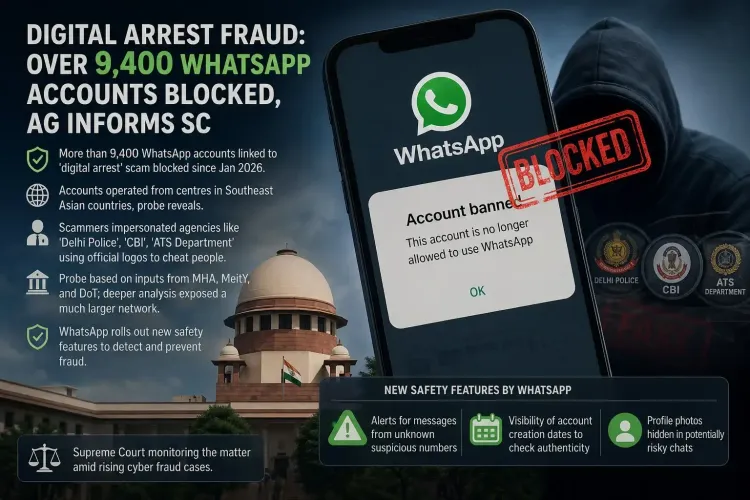
More than 9,400 WhatsApp accounts — far exceeding the 3,800 initially flagged by government agencies — have been banned in connection with India's digital arrest scam since January 2026. Operated from Southeast Asia and disguised as Delhi Police, CBI, and ATS, the network's scale, now disclosed before the Supreme Court, reveals just how industrialised cross-border cyber fraud targeting Indians has become.
Key Takeaways
Over 9,400 WhatsApp accounts linked to the digital arrest scam have been banned since January 2026 , as disclosed before the Supreme Court on 28 April .
Venkataramani submitted the details via a note to the apex court, which is hearing the matter suo motu .
Government agencies had initially identified around 3,800 fake accounts; WhatsApp's deeper investigation uncovered a far larger network.
Many fraudulent accounts were operated from Southeast Asian countries , outside India's direct jurisdiction.
Scammers impersonated Delhi Police , CBI , ATS Department , and other agencies using official-looking logos to extort money.
WhatsApp is rolling out new safety features including account creation date visibility , suspicious-number alerts, and automatic profile photo hiding in risky chats.
More than 9,400 WhatsApp accounts linked to India and involved in the so-called 'digital arrest' scam have been banned since January 2026, Attorney General R. Venkataramani informed the Supreme Court on 28 April. The disclosure came through a note submitted before the apex court, which is hearing the matter suo motu amid a sharp rise in digital arrest fraud cases across the country.
Scale of the Crackdown
According to the Attorney General's note, the accounts were identified and removed by WhatsApp as part of an internal investigation into organised scam networks targeting Indian users. While government agencies had earlier flagged around 3,800 fake accounts linked to such fraudulent activities, WhatsApp's deeper forensic analysis exposed a significantly larger network, leading to action against thousands more accounts. The company's enforcement, the note stated, was triggered by inputs from multiple central agencies.
Who Was Behind the Scam
The probe revealed that many of the fraudulent accounts were operated from centres located in Southeast Asian countries, placing them outside India's direct jurisdiction. Scammers used misleading display names such as 'Delhi Police', 'Mumbai Headquarters', 'CBI', and 'ATS Department' in their WhatsApp profiles, and displayed official-looking government logos as profile pictures to deceive unsuspecting users. The 'digital arrest' scam involves fraudsters impersonating law enforcement and government officials to intimidate victims and extort money.
Government Agencies Involved
The investigation was initiated based on inputs from the Indian Cyber Crime Coordination Centre (I4C) under the Ministry of Home Affairs, the Ministry of Electronics and Information Technology (MeitY), and the Department of Telecommunications (DoT). The coordinated inter-agency effort underscores the Centre's escalating response to cross-border cyber fraud networks that have proliferated rapidly in recent years.
New Safety Features by WhatsApp
WhatsApp told the court it is introducing several new user safety features to curb such scams. These include alerts for first-time messages from unknown numbers flagged as suspicious, visibility of account creation dates to help users assess authenticity, and measures to automatically hide profile photos in potentially risky chats. The company emphasised that its enforcement approach focuses on dismantling entire scam infrastructures rather than merely acting on individual complaints.
What the Supreme Court Is Watching
The Supreme Court is continuing to monitor the issue closely, amid growing concerns over the increasing sophistication and cross-border nature of cyber frauds targeting Indian citizens. This is not the first time the apex court has taken suo motu cognisance of a systemic online fraud pattern — it reflects a broader judicial recognition that regulatory and law enforcement frameworks have struggled to keep pace with evolving cyber crime tactics. Further hearings are expected as the court assesses whether existing safeguards are sufficient to protect citizens from such organised digital deception.
Point of View
800 accounts and WhatsApp's final tally of over 9,400 is telling — it suggests that India's cyber crime detection infrastructure is still catching up to the industrial scale of these operations. The fact that the scam networks are based in Southeast Asia, beyond Indian jurisdiction, exposes a structural limitation: domestic enforcement alone cannot dismantle cross-border fraud ecosystems. The Supreme Court's suo motu intervention is a signal that the judiciary sees a systemic failure, not a one-off incident. The real question is whether WhatsApp's platform-level action and inter-agency coordination can evolve fast enough to outpace scammers who are clearly innovating faster than regulators.
NationPress
19 Sept 2026
Frequently Asked Questions
What is the digital arrest scam in India?
The digital arrest scam involves fraudsters impersonating law enforcement officials — such as CBI, Delhi Police, or ATS officers — via WhatsApp video or voice calls to falsely accuse victims of crimes and extort money under the threat of 'digital arrest'. Victims are coerced into transferring funds to avoid fabricated legal consequences.
How many WhatsApp accounts have been banned in the digital arrest scam?
More than 9,400 WhatsApp accounts linked to the digital arrest scam have been banned since January 2026, according to a note submitted by Attorney General R. Venkataramani before the Supreme Court on 28 April. This is significantly higher than the 3,800 accounts initially identified by government agencies.
Where were the digital arrest scam operators based?
The investigation revealed that many of the fraudulent WhatsApp accounts were operated from centres in Southeast Asian countries, placing them outside India's direct legal jurisdiction and complicating enforcement efforts.
Which government agencies were involved in identifying the scam accounts?
The Indian Cyber Crime Coordination Centre (I4C) under the Ministry of Home Affairs, the Ministry of Electronics and Information Technology (MeitY), and the Department of Telecommunications (DoT) provided inputs that triggered WhatsApp's internal investigation.
What new safety features is WhatsApp introducing to tackle such scams?
WhatsApp is rolling out alerts for first-time messages from suspicious unknown numbers, visibility of account creation dates to help users verify authenticity, and automatic hiding of profile photos in potentially risky chats. The company says its focus is on dismantling entire scam networks rather than responding to individual complaints.