Act East Policy transforms Arunachal into India's strategic gateway, says CM Khandu
Synopsis
Arunachal Pradesh CM Pema Khandu's letter to PM Modi on his 12-year anniversary reads as much as a progress report as a tribute — cataloguing a fourfold jump in national highways, five new hydropower projects worth ₹52,000 crore, and 100% household water coverage. The subtext: a frontier state that was strategically neglected for decades is now being positioned as India's eastern anchor.
Key Takeaways
CM Pema Khandu wrote to PM Modi on 10 June congratulating him on 12 years and more than 4,399 consecutive days in office.
Arunachal Pradesh's National Highway network has grown from under 1,000 km pre-2014 to more than 4,060 km , with nearly 14,000 km of roads under construction.
Five hydropower projects — Tato-I , Heo , Tato-II , Kamala , and Kalai-II — will together generate 3.9 GW and attract nearly ₹52,000 crore in investment.
The 2,880 MW Dibang Multipurpose Project , India's largest hydropower project, is on track for completion by February 2032 .
Nearly two lakh families are covered under Ayushman Bharat , and 100% of households now have piped drinking water under the Jal Jeevan Mission .
A dedicated Buddhist Circuits scheme for six Northeastern states was announced in Union Budget 2026-27 .
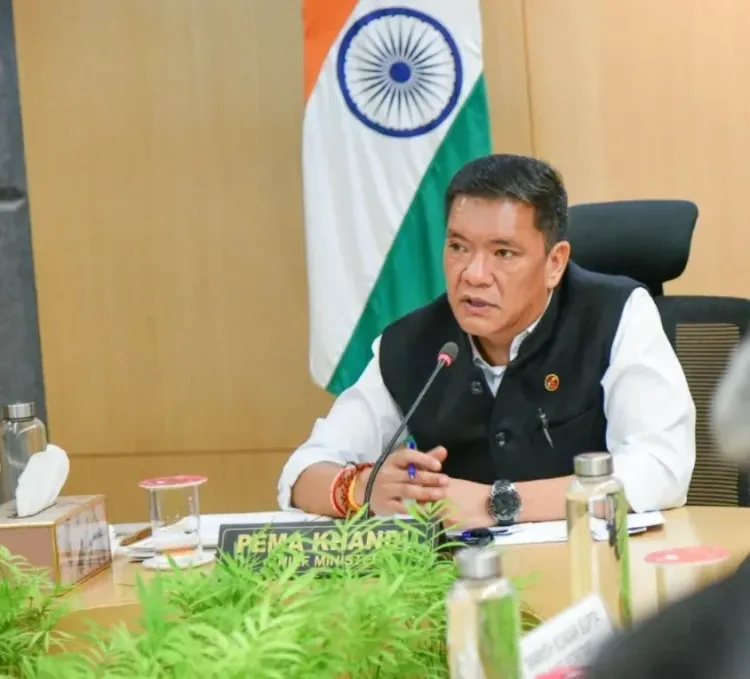
Arunachal Pradesh Chief Minister Pema Khandu on Wednesday, 10 June praised Prime Minister Narendra Modi's 'Act East Policy', asserting that it has fundamentally repositioned the state from a perceived remote border region into a strategic gateway to Southeast Asia and a vital civilisational frontier of India. The remarks came as Khandu wrote to the Prime Minister on behalf of the people of Arunachal Pradesh, congratulating him on completing 12 years and more than 4,399 consecutive days in office — a record that makes Modi the longest-serving elected head of government in the history of independent India.
Arunachal's Strategic Shift Under Act East Policy
Chief Minister Khandu said the Act East Policy has brought Arunachal Pradesh to the centre of India's connectivity, development, and geopolitical vision for the eastern region. He noted that the state, sharing international borders with Tibet, Bhutan, and Myanmar and possessing more than 1,080 km of international boundary, has emerged as a key pillar of India's strategic and developmental vision.
Khandu described the past twelve years as an 'era of transformative governance, visionary leadership and unprecedented development that has fundamentally changed the trajectory of Arunachal Pradesh and the entire Northeast region.'
Infrastructure Leap: Highways, Tunnels and Bridges
The Chief Minister underscored the dramatic expansion of connectivity infrastructure since 2014. 'Prior to 2014, Arunachal Pradesh had less than 1,000 km of National Highways. Today, the state has more than 4,060 km of National Highways, while nearly 14,000 km of roads, including innumerable bridges, are under construction across the state,' Khandu said.
Landmark projects cited include the Trans-Arunachal Highway, Frontier Highway, Sela Tunnel, and Nechiphu Tunnel, each of which has improved year-round connectivity to remote, border, and forward areas. The Bogibeel Bridge, inaugurated by the Prime Minister in December 2018, has reduced travel time to Guwahati to five to six hours, significantly integrating Arunachal with the national mainstream. Air connectivity has also expanded, with the operationalisation of Donyi Polo Airport and flight services from airports at Ziro, Tezu, and Pasighat.
Hydropower Potential and Major Projects
Khandu highlighted Arunachal Pradesh's estimated hydropower potential of more than 58,000 MW, noting renewed policy support for several long-pending projects. The 2,000 MW Lower Subansiri Hydroelectric Project, stalled for years, has been revived and partially commissioned. The 2,880 MW Dibang Multipurpose Project — described as India's largest hydropower project — is progressing towards completion by February 2032.
The Union Cabinet also approved the Tato-I, Heo, and Tato-II Hydroelectric Projects in 2024, followed by the Kamala and Kalai-II Hydroelectric Projects in April 2026. Together, these five projects are projected to generate 3.9 GW of hydropower capacity and attract investments of nearly ₹52,000 crore into the state.
Welfare Schemes and Border Village Development
On the social infrastructure front, Khandu noted that nearly two lakh families in the state are covered under the Ayushman Bharat–Pradhan Mantri Jan Arogya Yojana, with health insurance coverage of ₹5 lakh per family. A State Cancer Hospital at Itanagar is under construction with Union government support.
Under the Pradhan Mantri Awas Yojana and Swachh Bharat Mission, nearly 50,000 houses and toilets have been constructed. The Jal Jeevan Mission has achieved piped drinking water coverage for 100 per cent of households, while the Saubhagya scheme has electrified all villages in the state.
The Chief Minister also credited the Vibrant Villages Programme for bringing infrastructure, banking services, and livelihood opportunities to strategically important border villages including Kibithoo, Tuting, and Zemithang. He additionally welcomed the Union Budget 2026-27 announcement of a dedicated scheme for Buddhist Circuits in six Northeastern states, which he said would strengthen conservation of monasteries and promote cultural heritage tourism.
What Comes Next
With hydropower investments, highway construction, and border village programmes all in active phases, Arunachal Pradesh is poised to deepen its role as both an economic contributor and a security buffer for India's northeastern frontier. The pace of project commissioning over the next five years will be the real measure of whether the strategic repositioning translates into sustained development on the ground.
Point of View
But the infrastructure numbers it cites are independently significant — a fourfold expansion of national highways in a decade is not routine. The harder question is whether connectivity alone translates into economic self-sufficiency for a state that remains heavily dependent on central transfers. Arunachal's hydropower story is compelling on paper: 58,000 MW of potential, with major projects now greenlit. Yet the Dibang project's 2032 deadline and the history of stalled projects like Lower Subansiri counsel caution. The Act East Policy has undeniably shifted India's strategic gaze eastward, but for border communities in Kibithoo or Zemithang, the proof will be in livelihoods, not just road lengths.
NationPress
19 Sept 2026
Frequently Asked Questions
What is India's Act East Policy and how does it affect Arunachal Pradesh?
The Act East Policy is India's strategic framework for deepening economic and diplomatic engagement with Southeast Asia, with Arunachal Pradesh — which shares over 1,080 km of international boundary with Tibet, Bhutan, and Myanmar — positioned as a key connectivity and geopolitical hub. CM Khandu says the policy has shifted the state's image from a remote border region to a strategic gateway.
How has road and highway connectivity in Arunachal Pradesh changed since 2014?
National Highway coverage in Arunachal Pradesh has grown from under 1,000 km before 2014 to more than 4,060 km today, with nearly 14,000 km of additional roads and bridges under active construction. Key projects include the Trans-Arunachal Highway, Frontier Highway, Sela Tunnel, and Nechiphu Tunnel.
What are the major hydropower projects planned for Arunachal Pradesh?
Five projects — Tato-I, Heo, Tato-II, Kamala, and Kalai-II — will together add 3.9 GW of capacity and attract nearly ₹52,000 crore in investment. The 2,880 MW Dibang Multipurpose Project, India's largest hydropower project, is targeted for completion by February 2032.
How many families in Arunachal Pradesh benefit from Ayushman Bharat?
Nearly two lakh families in Arunachal Pradesh are covered under Ayushman Bharat–Pradhan Mantri Jan Arogya Yojana, receiving health insurance coverage of ₹5 lakh per family. A State Cancer Hospital at Itanagar is also under construction with Union government support.
What is the Vibrant Villages Programme mentioned by CM Khandu?
The Vibrant Villages Programme is a central government initiative focused on expanding infrastructure, connectivity, banking services, and livelihood opportunities in strategically important border villages. In Arunachal Pradesh, villages such as Kibithoo, Tuting, and Zemithang are among the beneficiaries.