Did PM Modi's Critique Spark a Debate on Nehru's Role in Vande Mataram?
Click to start listening
Synopsis
In the wake of PM Modi's sharp critique of Nehru regarding 'Vande Mataram', Congress leader Gaurav Gogoi defends Nehru's contributions and highlights the historical significance of the song in India's freedom struggle. This debate ignites discussions on national identity and political legacies.
Key Takeaways
- Vande Mataram is a symbol of India's freedom struggle.
- Gaurav Gogoi defends Nehru's legacy.
- PM Modi's critique highlights ongoing political tensions.
- The 1937 CWC meeting played a key role in spreading Vande Mataram.
- Historical context is vital for understanding current debates.
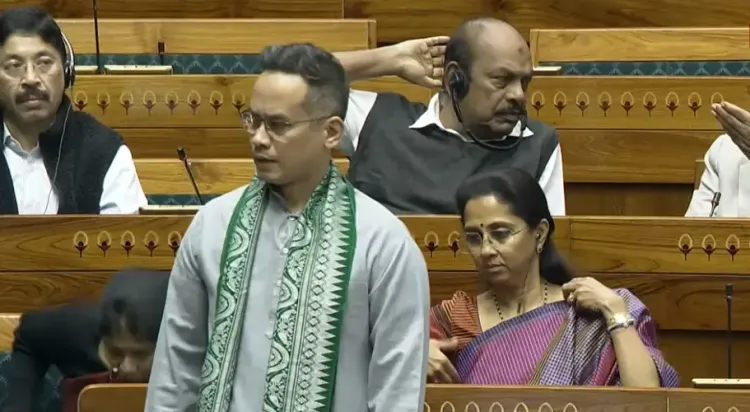
Guwahati, Dec 8 (NationPress) In response to Prime Minister Narendra Modi’s strong criticism of Jawaharlal Nehru regarding Vande Mataram, Congress Lok Sabha MP Gaurav Gogoi asserted on Monday that the BJP, despite its relentless attempts, cannot tarnish the legacy of India’s first Prime Minister.
Gogoi highlighted that during a Congress Working Committee (CWC) meeting in 1937, it was resolved to promote mass awareness of Vande Mataram among the citizens of India. “This pivotal 1937 meeting was graced by numerous esteemed thinkers, including Rabindranath Tagore.
In his address, Tagore emphasized that the initial two stanzas of Vande Mataram encapsulate the essence of the song,” he remarked.
The Congress MP further noted that it was Jawaharlal Nehru who underscored the necessity for Vande Mataram to be widely disseminated as a symbol of the freedom struggle.
“The phrase Vande Mataram evolved into a powerful rallying cry that motivated our people and serves as a reminder of our fight for independence,” Gogoi pointed out.
The opposition leader reiterated the need for a thorough examination of the historical significance of Vande Mataram. He stated, “Originally composed in West Bengal, the song spread throughout the nation within a year, uplifting the spirits of freedom fighters.”
Gogoi continued, “Prime Minister Modi highlighted the role of the gramophone in popularizing Vande Mataram across various regions of India. Nevertheless, pamphlets were also crucial in ensuring the song reached not just freedom fighters but also everyday citizens.”
Earlier, while commemorating the 150th anniversary of Vande Mataram in the Lok Sabha, PM Modi launched a scathing attack on the Congress, accusing the party of having once compromised the national song under pressure from the Muslim League and “submitting to them.”
“Why was Vande Mataram subjected to injustice?” PM Modi questioned. He recalled that following Mohammed Ali Jinnah’s objections in 1937, Jawaharlal Nehru wrote to Subhas Chandra Bose, cautioning that the song’s background might provoke anger among Muslims. Consequently, Congress convened a meeting in Kolkata to reassess its usage.
Despite widespread protests, PM Modi remarked that the party yielded in October 1937, confining the hymn to its first two stanzas under the pretext of secularism and communal harmony. “Historical records show that Congress capitulated to the Muslim League’s demands, demonstrating a pattern of appeasement. Because Congress acquiesced to the division of Vande Mataram, it later accepted the division of India,” PM Modi stated, asserting that the party continues the same appeasement politics today.
Point of View
It is imperative to present an unbiased perspective on this debate. The discussions surrounding 'Vande Mataram' and its historical context are crucial for understanding India's political dynamics. Both sides highlight significant points, yet it is essential to consider the broader implications for national unity and identity.
NationPress
09/12/2025
Frequently Asked Questions
What is the significance of Vande Mataram?
Vande Mataram is a national song that played a vital role in India's struggle for independence, embodying the spirit of nationalism and unity among diverse communities.
Why did PM Modi criticize Nehru?
PM Modi criticized Nehru for allegedly compromising the integrity of Vande Mataram under pressure from the Muslim League, claiming it was a politically motivated decision.
What was Gaurav Gogoi's response?
Gaurav Gogoi defended Nehru's legacy, emphasizing his role in promoting Vande Mataram as a symbol of the freedom movement and arguing against the BJP's attempts to tarnish Nehru's image.
How did Vande Mataram spread across India?
Vande Mataram spread through various means including gramophones and pamphlets, reaching both freedom fighters and the general populace, thus becoming a rallying cry for independence.
What was the outcome of the 1937 CWC meeting?
The 1937 CWC meeting resolved to promote Vande Mataram widely, with notable figures like Rabindranath Tagore emphasizing its importance in the freedom struggle.