Akhilesh Yadav tears into Yogi's 1.27 cr voter-deletion claim
Synopsis
Samajwadi Party president Akhilesh Yadav has accused UP Chief Minister Yogi Adityanath of manufacturing a defeat alibi by claiming 1.27 crore Hindus were deleted from voter rolls, calling the figure a BJP self-indictment one day before a major opposition rally.
Key Takeaways
SP president Akhilesh Yadav posted a detailed rebuttal on 1 November 2026 of CM Yogi Adityanath 's claim that 1.27 crore Hindus were deleted from UP's voter rolls.
Yadav argued the figure — mathematically implying a loss of 31,514 votes per assembly seat — was reverse-engineered from BJP's declining vote share in recent MLC elections.
He demanded to know whether the data was leaked from the Election Commission , saying if so, Yogi himself should join calls to remove 'someone' at Ramlila Maidan.
Yadav alleged the absence of 55 lakh scheme beneficiaries from voter rolls constitutes a multi-billion-rupee scam implicating both central and state governments under the 'double engine' model.
The post called BJP the 'Harti Janta Party' and flagged the disclosure coming one day before the 'Delhi Chalo' opposition rally as politically suspicious.
The row intensifies pre-poll positioning ahead of the 2027 Uttar Pradesh assembly elections .
A single statistic has detonated into a full-blown political grenade in Uttar Pradesh — and Samajwadi Party president Akhilesh Yadav is holding the pin. On Sunday, 1 November 2026, Yadav posted a sharp, multi-layered counter-offensive on X, dismantling Uttar Pradesh Chief Minister Yogi Adityanath's assertion that 1.27 crore Hindus have been struck off the state's voter rolls — and arguing the claim reveals far more about BJP's fears ahead of the 2027 assembly elections than it does about any electoral conspiracy.
The math Akhilesh did — and what it implies for BJP
Yadav's post opens with arithmetic, not rhetoric. He notes that 1.27 crore divided across 403 assembly constituencies equals roughly 31,514 votes per seat — and he frames this as a self-inflicted confession by the Chief Minister. 'मतलब मुख्यमंत्री जी ने लड़ने से पहले ही हथियार भी डाल दिया है' ('It means the Chief Minister has surrendered his weapons even before the fight has begun'), Yadav writes. The argument is pointed: a sitting chief minister broadcasting a specific vote-loss figure is not sounding the alarm — he is pre-constructing the alibi.
Yadav anchors the figure to the recent MLC (Legislative Council) elections, alleging that the 1.27 crore number was reverse-engineered from the proportional drop in BJP's traditional vote share in those polls. The implication is surgical — the Chief Minister, in Yadav's telling, did not discover a voter-list anomaly; he extrapolated a projected defeat and clothed it in the language of electoral fraud.
Leak from the Election Commission — or a 'transfer order' from Delhi?
The post sharpens into a direct institutional challenge. If the figure came from the Election Commission of India, Yadav asks, then the Chief Minister should join protesters at Delhi's Ramlila Maidan and demand accountability from 'someone' — a pointed, thinly-veiled reference to the BJP leadership in the capital. The logic is designed to wedge the 'double engine' government narrative that BJP has built its UP campaigns around: if the Centre controls the Election Commission and the voter rolls are corrupt, then both engines share the blame.
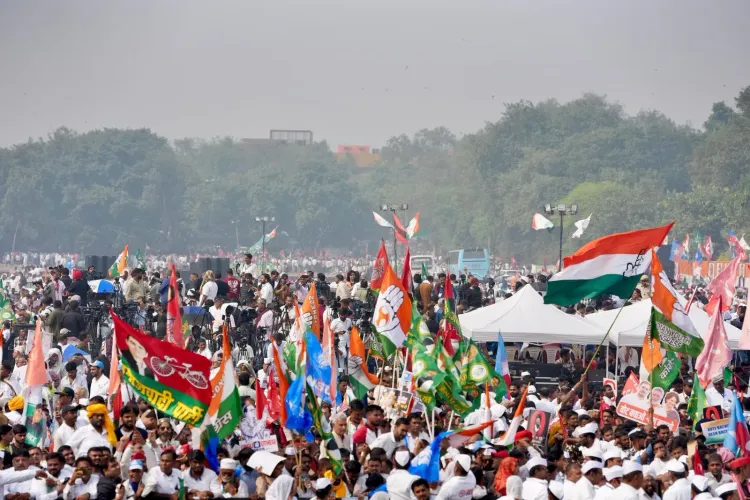
Yadav goes further, speculating in barely-coded language whether the timing — coming immediately after the MLC defeat and on the eve of a 'Delhi Chalo: Vote Bachao-Desh Bachao' mega-rally — signals that the Chief Minister may have received a quiet signal about his own political future. 'कहीं ऐसा तो नहीं कि 'इनकी' भी बदली की पर्ची पकड़ा कर कोई वापस लौट गया है' ('Could it be that someone handed him his own transfer slip and headed back?'), the post muses.
The 55-lakh beneficiary gap — and who was cashing in
Yadav reserves a separate broadside for the 55 lakh scheme beneficiaries the Chief Minister said are absent from voter rolls. He flips the accusation: if these names were not on the list, who was receiving their welfare payments? He calls it an 'arbon ka scam' — a scandal worth billions — unfolding under BJP's watch. 'When there is a double-engine government,' he writes, 'both engines share responsibility for this mega-scam.'
The youth angle lands last and just as hard. By acknowledging that lakhs of young voters are missing from the rolls, Yadav argues, the Chief Minister has inadvertently admitted that UP's youth — a decisive demographic — is drifting away from the party. Every concession the Chief Minister makes, in Yadav's framing, becomes a brick in the opposition's case.
One day before the 'Delhi Chalo' rally — the timing question
The kicker of Yadav's post is the question of timing. The disclosure arrived exactly one day before the 'Delhi Chalo' opposition rally, and Yadav asks why — pointedly, repeatedly — before landing on his verdict: BJP, he declares, has become 'Harti Janta Party' ('the party that keeps losing'). The phrase is a deliberate play on the full form of BJP — Bharatiya Janata Party — crafted for maximum traction on social media ahead of the rally.
With 2027 drawing closer by the week, both sides are now fighting not just over votes, but over who controls the narrative of how those votes will be counted — and lost.
Point of View
He weaponises the act of disclosure itself to put the ruling party on trial. By attributing the figure to MLC vote-share arithmetic and questioning an Election Commission 'leak,' he simultaneously raises institutional accountability concerns and deepens the BJP's internal centre-state fault line. The 'double engine' reversal — where a BJP slogan becomes evidence of shared culpability — is especially dexterous. With the 2027 UP election already casting shadows, this exchange signals that voter-roll integrity will be a central, bruising battleground, not a footnote.
NationPress
1 Nov 2026
Frequently Asked Questions
What did CM Yogi Adityanath claim about the UP voter list?
Chief Minister Yogi Adityanath claimed that 1.27 crore Hindus have had their names removed from Uttar Pradesh's voter rolls, raising concerns about electoral manipulation ahead of the 2027 assembly elections.
What is Akhilesh Yadav's response to the 1.27 crore voter deletion claim?
Akhilesh Yadav argued the figure was calculated by extrapolating BJP's declining vote share from recent MLC elections, calling it a pre-emptive alibi for future electoral defeat rather than a genuine data finding.
What is the 'double engine' government controversy Akhilesh raised?
Yadav pointed out that if the voter rolls are corrupt, the BJP government in both Delhi and Lucknow — its own 'double engine' — must share responsibility, effectively turning BJP's campaign slogan against itself.
What is the 'Delhi Chalo' rally Akhilesh Yadav mentioned?
The 'Delhi Chalo: Vote Bachao-Desh Bachao' rally is a major opposition mobilisation at Ramlila Maidan in Delhi. Yadav flagged that Yogi's voter-list disclosure came suspiciously just one day before the rally.
What are the 55 lakh beneficiaries missing from UP voter rolls?
CM Yogi reportedly stated that 55 lakh scheme beneficiaries are absent from the voter list. Akhilesh Yadav responded by asking who was receiving the welfare payments in their name, calling it a potential multi-billion-rupee scam.