Assam CM Himanta announces ₹9 lakh relief for flood victims' kin

Synopsis
The Assam government has announced ₹9 lakh in financial relief — combining a ₹4 lakh ex-gratia and ₹5 lakh from the Chief Minister's Relief Fund — for families of each person killed in the recent floods, with phased support also promised to families of missing persons.
Key Takeaways
₹9 lakh total will be paid to the next of kin of each flood fatality in Assam.
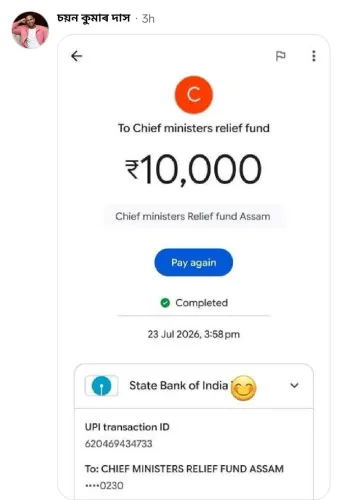
The package combines a ₹4 lakh ex-gratia payment with ₹5 lakh from the Chief Minister's Relief Fund (CMRF) .
Families of missing persons will also receive similar assistance, to be disbursed in a phased manner.
The announcement was made by the Chief Minister's Office of Assam on July 30, 2026 , under CM Himanta Biswa Sarma .
The relief structure supplements standard central SDRF norms under the Disaster Management Act, 2005, with additional state funds.
When the Brahmaputra rises, it takes everything — and this year, the Assam government is moving to put a number on the loss. Chief Minister Himanta Biswa Sarma's office announced on Thursday, July 30, 2026, that the Government of Assam will provide a total financial assistance of ₹9 lakh to the next of kin of each individual who has died in the recent floods sweeping the state.
₹9 lakh per family: how the package is structured
The relief is not a single payment — it is a two-part disbursement. Families will receive ₹4 lakh as ex-gratia and a further ₹5 lakh from the Chief Minister's Relief Fund (CMRF). The CMRF component is a direct state-level top-up, giving the government flexibility to move faster and higher than standard central norms alone would allow.
Crucially, the package does not stop at confirmed deaths. The government has committed to extending similar financial assistance to families of missing persons, to be rolled out in a phased manner as cases are documented and verified.
Why CMRF matters alongside central SDRF norms
Under the Disaster Management Act, 2005, state governments disburse relief through the State Disaster Response Fund (SDRF), which sets baseline ex-gratia rates for flood fatalities. The CMRF addition is a deliberate augmentation — a signal that the state considers the standard central allocation insufficient for the scale of this year's disaster. This combination of SDRF-linked ex-gratia and CMRF top-up has become a recurring feature of Assam's flood response architecture under Chief Minister Sarma, who has led the government since May 2021.
Assam's annual reckoning with the Brahmaputra
Assam's floods are not a surprise — they are a calendar event. The Brahmaputra river system, fed by Himalayan snowmelt and monsoon rain, inundates large swathes of the state every year, displacing hundreds of thousands and claiming lives across districts. What changes year to year is the severity, the reach, and the government's response bandwidth. The inclusion of missing persons in this relief framework is a notable step — these families typically wait the longest for any formal recognition or support.
The phased rollout for missing-persons' families will be the detail to watch: the pace and completeness of that process will determine whether the announcement translates into timely relief on the ground.
Point of View
But the 'phased manner' qualifier leaves room for delays that historically plague such disbursements. For CM Himanta Biswa Sarma, flood response is an annual governance test in a state where the Brahmaputra's behaviour is both a humanitarian crisis and an electoral variable. The real measure of this announcement will be the speed and coverage of actual disbursement, not the headline figure.
NationPress
13 Sept 2026
Frequently Asked Questions
How much financial relief will Assam give to flood victims' families?
The Assam government will provide ₹9 lakh in total to the next of kin of each person who has died in the floods — comprising ₹4 lakh as ex-gratia and ₹5 lakh from the Chief Minister's Relief Fund (CMRF) .
Will families of missing persons also get flood relief in Assam?
Yes. The Assam government has stated that similar financial assistance will be extended to families of missing persons as well, to be rolled out in a phased manner.
What is the Chief Minister's Relief Fund (CMRF) in Assam?
The CMRF is a state-level discretionary fund used by the Assam government to provide additional disaster assistance and welfare payments beyond what central SDRF norms mandate.
Who announced the Assam flood relief package in 2026?
The announcement was made by the Chief Minister's Office of Assam on July 30, 2026 , under Chief Minister Himanta Biswa Sarma .
What is the SDRF and how does it relate to Assam flood relief?
The State Disaster Response Fund (SDRF), established under the Disaster Management Act, 2005, sets baseline ex-gratia rates for disaster victims. Assam's package supplements SDRF norms with additional CMRF funds to provide higher total relief.