Assam CM Himanta launches Orunodoi 3.0 for 3.7 million women
Synopsis
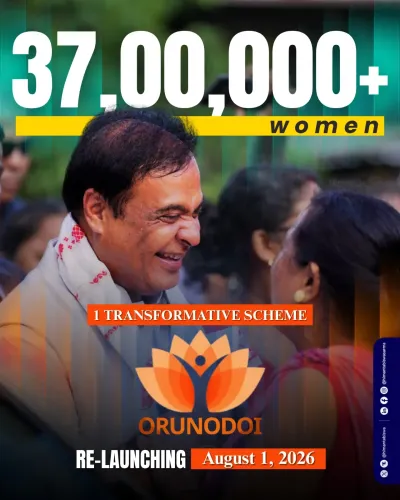
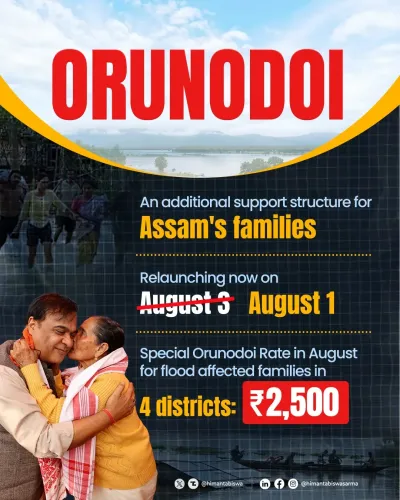
Assam's Orunodoi 3.0 launches on 1 August 2026, channelling direct financial assistance to over 3.7 million women. Women in flood-hit Sivasagar, Charaideo, Golaghat and Jorhat receive an additional ₹2,500. CM Himanta Biswa Sarma attends the state-level ceremony at Srimanta Sankardev Kalakshetra in Guwahati.
Key Takeaways
Orunodoi 3.0 launches on 1 August 2026 , reaching over 3.7 million women across Assam through direct bank transfers.
Women in the flood-affected districts of Sivasagar, Charaideo, Golaghat and Jorhat receive an additional ₹2,500 as special relief.
The scheme originated in December 2020 with a monthly assistance of ₹1,250 for eligible low-income women beneficiaries.
CM Himanta Biswa Sarma attends the state-level launch at Srimanta Sankardev Kalakshetra , Guwahati.
The flood relief top-up is embedded within the same disbursement pipeline, reflecting Assam's practice of integrating disaster response into routine welfare delivery.
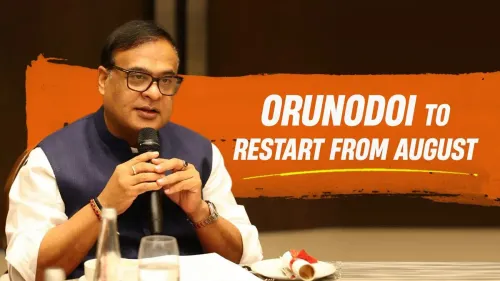
Millions of women across Assam woke up on Saturday, 1 August 2026 to a direct deposit they have been waiting for. The Chief Minister's Office of Assam announced that Orunodoi 3.0 — the latest phase of the state's flagship cash transfer programme — goes live today, sending financial assistance straight into the bank accounts of over 3.7 million women beneficiaries.
What Orunodoi 3.0 delivers — and to whom
The programme, which has been Assam's primary direct benefit transfer vehicle for women from low-income households since its launch in December 2020, now enters its third phase. The original scheme began with a monthly assistance of ₹1,250 per eligible woman; each successive phase has expanded both the beneficiary base and the support architecture around it.
Today's rollout carries an additional dimension: women in the four flood-affected districts of Sivasagar, Charaideo, Golaghat and Jorhat will receive a special relief top-up of ₹2,500 over and above the regular disbursement. It is a pointed acknowledgement that these Brahmaputra valley districts — which face near-annual inundation — need more than routine welfare cycles when disaster strikes.
Guwahati's Kalakshetra as the launch stage
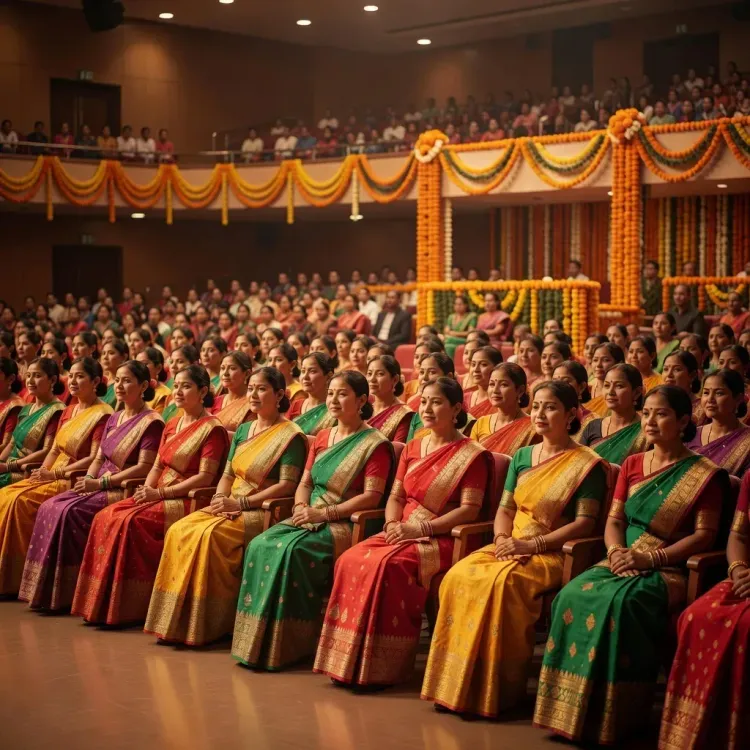
Chief Minister Dr. Himanta Biswa Sarma will attend the state-level launch ceremony at Srimanta Sankardev Kalakshetra, the landmark cultural auditorium in Guwahati that has become the preferred venue for the BJP-led government's major programme rollouts. The choice of venue — named after Assam's most revered saint-reformer — lends the occasion a distinctly Assamese cultural register.
Sarma, who has helmed the state since May 2021, has positioned direct cash transfer schemes for women as a cornerstone of the government's social security agenda. Orunodoi's expansion across three phases is the clearest evidence of that commitment at scale.
Flood relief woven into welfare delivery
The ₹2,500 special relief for flood-hit districts is not an emergency sidebar — it is built into the same disbursement pipeline. That integration matters. Assam's experience with annual flooding has pushed the state to fold disaster response into existing welfare delivery mechanisms rather than running separate, slower relief channels. For a family in Sivasagar or Charaideo whose home has been under water, receiving both regular assistance and flood relief in a single bank transfer is the difference between waiting and acting.
What the government has not yet confirmed is the revised monthly assistance amount under Orunodoi 3.0 — a number to watch as district-level disbursement reports emerge in the coming days.
Three phases, six years, and now 3.7 million women: Orunodoi has grown from a welfare experiment into one of India's larger state-run direct transfer programmes — and today's launch is its biggest chapter yet.
Point of View
The Assam government is testing a model that collapses the gap between routine welfare and emergency response — a gap that has historically cost lives and credibility in disaster-prone states. The 3.7 million beneficiary figure, if sustained, would place Orunodoi among the larger state-run women's cash transfer programmes in India, giving the BJP-led administration a tangible social sector credential ahead of future electoral cycles. The still-unconfirmed revised monthly amount will be the real measure of whether the 3.0 label signals substance or optics.
NationPress
1 Aug 2026
Frequently Asked Questions
What is Orunodoi 3.0 in Assam?
Orunodoi 3.0 is the third phase of Assam's flagship direct benefit transfer programme for women from low-income households. Launched on 1 August 2026, it extends financial assistance directly into the bank accounts of over 3.7 million eligible women across the state.
How much money will women get under Orunodoi 3.0?
The post confirms that direct financial assistance will be credited to beneficiaries' accounts, with women in flood-affected districts of Sivasagar, Charaideo, Golaghat and Jorhat also receiving an additional ₹2,500 as special relief. The revised regular monthly amount under the 3.0 phase has not yet been officially confirmed.
Which districts get extra flood relief under Orunodoi 3.0?
Women beneficiaries in four flood-affected districts — Sivasagar, Charaideo, Golaghat and Jorhat — will receive an additional ₹2,500 as special relief on top of the regular Orunodoi disbursement.
When was the Orunodoi scheme first launched in Assam?
The Orunodoi scheme was first launched in December 2020 by the Assam government, providing a monthly assistance of ₹1,250 to eligible women from economically weaker households.
Where is the Orunodoi 3.0 state-level launch event being held?
Chief Minister Himanta Biswa Sarma is attending the state-level launch of Orunodoi 3.0 at Srimanta Sankardev Kalakshetra, a major cultural auditorium and convention centre in Guwahati, Assam.