Assam flood relief: Chief Secretary Ravi Kota reviews rehab in 4 districts
Synopsis
Assam's Chief Secretary has set hard deadlines — field assessments by 14 August, sector reports by 18 August — and directed banks to reach flood victims within two weeks. The multi-agency push across four of the state's worst-hit districts is the most structured rehabilitation push this flood season, with simplified documentation rules for those who lost records in the deluge.
Key Takeaways
Chief Secretary Ravi Kota reviewed flood relief on 7 August across Jorhat , Sivasagar , Charaideo , and Golaghat .
Technology-enabled damage assessments must be completed by 14 August ; sector-wise reports due by 18 August .
Banks directed to contact affected borrowers within two weeks and offer loan moratoriums, restructuring, and fresh credit.
Insurance companies ordered to launch dedicated helplines and expedite claim settlements.
Simplified documentation rules introduced for flood victims who have lost original records.
District-wise insurance nodal officers already designated for all four districts.
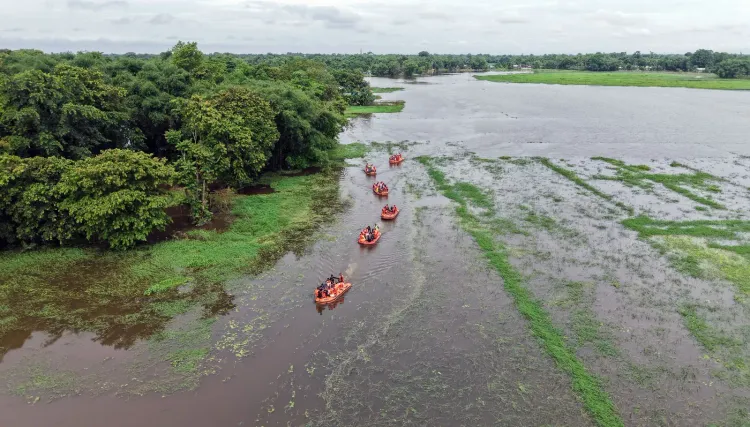
Assam Chief Secretary Ravi Kota on Friday, 7 August chaired a high-level review of flood relief and rehabilitation progress across four of the state's worst-hit districts — Jorhat, Sivasagar, Charaideo, and Golaghat — directing officials to fast-track damage assessments, financial aid, and livelihood restoration through coordinated action among government departments, banks, and insurance companies.
Key Developments from the Review
The meeting, conducted via video conference under the District Consultative Committee (DCC) framework, brought together district commissioners, bank representatives, insurance officials, and line department heads. Discussions centred on closing gaps in damage assessment, financial assistance disbursal, and insurance claim settlement — three areas where delays have compounded distress for flood-affected families.
Kota underscored the need for a multi-agency approach backed by daily monitoring, instructing officials to eliminate procedural bottlenecks and ensure relief reaches beneficiaries without further delay.
Assessment Deadlines and Sector Coverage
A sector-by-sector review was conducted covering losses in agriculture, livestock, fisheries, housing, MSMEs, and other livelihood activities. Officials have been directed to complete technology-enabled, field-verified damage assessments by 14 August. Sector-wise reports must be submitted to respective committees by 18 August to enable timely processing of rehabilitation assistance.
Notably, district-wise insurance nodal officers have already been designated for all four districts, and dedicated review mechanisms are in place to monitor claim processing and resolve operational issues in coordination with district administrations.
Relief for Document-Loss Victims
Acknowledging a recurring challenge in flood rehabilitation, Kota directed authorities to simplify documentation requirements for victims who have lost identity or property records. Alternative verification methods are to be permitted wherever original documents have been damaged or destroyed — a practical concession that could unblock assistance for a significant share of claimants.
Banks and Insurers Directed to Act
Banks were advised to proactively contact affected borrowers within the next two weeks and extend measures including loan moratoriums, restructuring of existing credit, fresh loans, and consumption credit to address immediate financial needs. Insurance companies were separately directed to operationalise dedicated helplines and accelerate claim settlements without waiting for claimants to approach them.
What Comes Next
The state government has framed this coordinated exercise as a commitment to 'transparent, compassionate, and efficient rehabilitation.' With assessment deadlines set for mid-August and sector reports due by 18 August, the coming fortnight will be a critical test of whether the multi-agency framework translates into on-ground relief. Assam's annual flood cycle has historically strained rehabilitation machinery; the emphasis on technology-enabled verification and daily monitoring signals an attempt to break that pattern.
Point of View
And the explicit directive to simplify documentation for record-loss victims addresses a real bottleneck that has historically excluded the most vulnerable claimants. But the proof will be in disbursement data, not meeting minutes. If banks treat the two-week outreach window as a compliance checkbox rather than a genuine reach-out, the credit relief component — often the fastest lifeline for small farmers and MSME owners — will arrive too late to matter.
NationPress
7 Aug 2026
Frequently Asked Questions
Which districts were reviewed in the Assam flood rehabilitation meeting on 7 August?
The review covered four of Assam's worst flood-affected districts: Jorhat, Sivasagar, Charaideo, and Golaghat. Chief Secretary Ravi Kota chaired the meeting via video conference under the District Consultative Committee framework.
What are the deadlines set for flood damage assessment in Assam?
Officials have been directed to complete technology-enabled, field-verified damage assessments by 14 August 2025. Sector-wise reports covering agriculture, livestock, fisheries, housing, MSMEs, and livelihoods must be submitted to respective committees by 18 August.
What relief has been directed for flood-affected borrowers in Assam?
Banks have been advised to proactively contact affected borrowers within two weeks and offer loan moratoriums, restructuring of existing loans, fresh credit, and consumption loans. Insurance companies have been directed to set up dedicated helplines and fast-track claim settlements.
How will flood victims who lost documents access rehabilitation assistance?
Chief Secretary Ravi Kota has directed authorities to simplify documentation procedures and allow alternative verification methods for victims whose original records were damaged or destroyed in the floods. This is intended to prevent document loss from blocking relief eligibility.
What is the District Consultative Committee and why was it convened?
The District Consultative Committee (DCC) is a multi-stakeholder body that brings together district administration, banks, insurance companies, and line departments to coordinate relief efforts. It was convened via video conference to review and accelerate rehabilitation in Assam's four worst-hit flood districts.