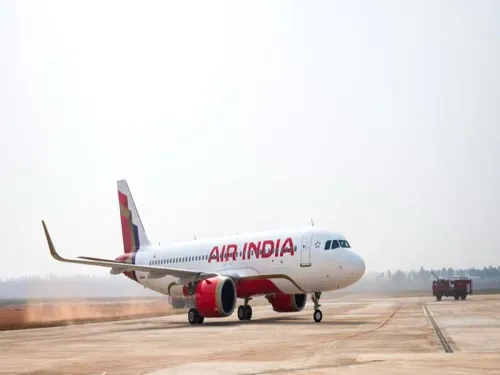
ATF prices for foreign airlines rise 5% for 2nd straight month in May
Synopsis
Foreign airlines flying to and from India are now paying 5.33% more for aviation turbine fuel — the second straight monthly increase — while domestic carriers remain shielded. With Iran-linked geopolitical tensions driving global fuel prices, India's oil marketing companies are staggering the impact, but the question is how long domestic airlines can stay insulated.
Key Takeaways
ATF prices for foreign carriers rose by 5.33% or $76.55 per kilolitre effective 1 May 2025 .
New benchmark price for international airlines in New Delhi stands at $1,511.86 per kilolitre .
This is the second consecutive monthly increase for international carriers; domestic airline rates remain unchanged.
On 1 April , domestic ATF prices were raised sharply by 25 per cent to ₹1,04,927.18 per kilolitre .
Rising geopolitical tensions, particularly the Iran conflict , are cited as the key driver of elevated global fuel prices.
Indian Oil Corporation and other state-run oil marketing companies revise ATF rates at the start of every month.
Aviation turbine fuel (ATF) prices for foreign carriers operating in India were raised by approximately 5 per cent on 1 May 2025, marking the second consecutive monthly increase, even as domestic airlines were shielded from any revision. State-run oil marketing companies, including Indian Oil Corporation (IOC), revised the rates in line with elevated global energy prices.
What Changed and by How Much
In New Delhi — which serves as the benchmark for ATF pricing across India — fuel for international airlines rose by $76.55 per kilolitre, or 5.33 per cent, taking the price to $1,511.86 per kilolitre. The hike applies exclusively to international operations and foreign carriers; ATF prices for domestic airlines remain unchanged.
This follows a significant revision on 1 April, when ATF prices for domestic carriers were sharply raised by 25 per cent to ₹1,04,927.18 per kilolitre. The differential treatment between domestic and international carriers this month underscores the calibrated approach that authorities are reportedly adopting amid volatile global energy markets.
Why International Carriers Are Being Charged More
According to industry sources, rising geopolitical tensions — particularly those linked to the Iran conflict — have pushed up global fuel prices. Rather than passing on the entire increase immediately, oil marketing companies and the government are reportedly staggering the impact. As a result, international carriers are being charged market-linked rates, while domestic airlines continue to benefit from moderated pricing to cushion cost pressures.
ATF prices in India have been deregulated for over two decades and are linked to international benchmarks under an agreed pricing mechanism between airlines and oil companies. Oil marketing companies revise ATF prices at the start of every month based on prevailing global trends.
Impact on Airlines and Passengers
Fuel remains one of the largest cost components for any airline, and any increase in ATF prices has a direct bearing on operating expenses. The latest revision is expected to raise costs for international operators flying to and from India, potentially putting upward pressure on airfares on international routes.
Notably, domestic carriers have now been insulated from price increases for the current month, even as they absorbed a steep 25 per cent hike just a month prior. Industry observers suggest this asymmetric approach is designed to prevent a sharp spike in domestic airfares, which have political and consumer sensitivity.
What to Watch Next
With global energy markets remaining uncertain amid ongoing geopolitical tensions, the trajectory of ATF prices in the coming months will be closely watched by both domestic and international carriers. If global crude and fuel benchmarks remain elevated, a further pass-through to domestic airlines in subsequent monthly revisions cannot be ruled out, according to industry sources.
Point of View
Moderated for domestic airlines — is a pragmatic short-term fix, but it raises a structural question: how long can the government sustain this differential without distorting the market? Domestic carriers absorbed a brutal 25% hike in April; shielding them in May looks like political damage control ahead of the summer travel season. But staggered pass-throughs simply defer the pain. If global fuel prices remain elevated through June, the next revision cycle could force a reckoning that affects both ticket prices and airline margins simultaneously.
NationPress
16 Sept 2026
Frequently Asked Questions
Why did ATF prices rise for foreign airlines in May 2025?
ATF prices for foreign carriers rose by 5.33% in May 2025, driven by elevated global energy prices linked to rising geopolitical tensions, particularly the Iran conflict. State-run oil marketing companies including Indian Oil Corporation revised rates in line with international benchmarks.
How much did ATF prices increase for international airlines in India?
ATF prices for international carriers increased by $76.55 per kilolitre, or 5.33%, taking the benchmark price in New Delhi to $1,511.86 per kilolitre effective 1 May 2025. This is the second consecutive monthly hike for foreign carriers.
Why were domestic airline ATF prices not raised in May 2025?
According to industry sources, authorities are adopting a calibrated approach to pricing amid global energy market volatility. Instead of passing on the full increase immediately, oil firms and the government are staggering the impact, with domestic airlines continuing to benefit from moderated pricing to cushion cost pressures.
What was the ATF price change for domestic airlines in April 2025?
On 1 April 2025, ATF prices for domestic carriers were sharply raised by 25% to ₹1,04,927.18 per kilolitre. In May, domestic airline rates were left unchanged, while foreign carrier rates saw another increase.
How often are ATF prices revised in India?
Oil marketing companies in India revise ATF prices at the start of every month based on global energy market trends. ATF prices have been deregulated in India for over two decades and are linked to international benchmarks under an agreed pricing mechanism between airlines and oil companies.