Did Indian Agencies Link Bangladesh Violence to ISI's Digital Manipulation?
Synopsis
The recent violence in Bangladesh, following the death of a student leader, has raised alarms over the ISI's digital propaganda efforts. This article delves into the implications of India's intelligence agencies tracing these disturbances back to ISI-backed social media networks, highlighting a dangerous game of unrest in the region.
Key Takeaways
ISI's digital network plays a crucial role in inciting violence in Bangladesh.
The unrest is strategically timed close to elections.
Local groups are manipulated to create chaos.
India's eastern security is under threat due to rising anti-India sentiment.
The situation in Bangladesh could worsen if not addressed soon.
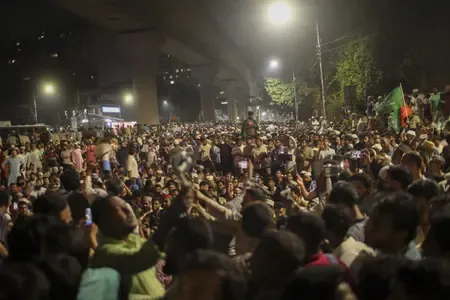
New Delhi, Dec 19 (NationPress) Moments after the demise of Sharif Osman Hadi, a prominent figure in the Bangladesh student movement, social media accounts associated with the ISI sprang into action, disseminating false narratives that incited violence across the nation. Indian intelligence agencies discovered a significant number of these ISI-backed accounts actively promoting misleading information that harbored a pronounced anti-India sentiment.
The main objective of the ISI was to plunge Bangladesh into turmoil, mirroring the unrest seen during the student protests that led to the ousting of Sheikh Hasina, according to officials.
The ISI had meticulously orchestrated this plan, instructing the Jamaat-e-Islami and its student faction, the Islamic Chhatra Shibir (ICS), to refrain from spearheading the protests.
According to the strategy, the ISI aimed to propagate fake narratives through social media platforms based in Pakistan, while the Jamaat and its affiliates were merely to incite violence based on this misinformation. The ISI preferred not to have the Jamaat publicly recognized as the leader of the unrest, especially with elections approaching in February.
Extensive preparations preceded this large-scale agitation, coinciding closely with the electoral period.
The ISI activated various radical factions it controls within Bangladesh, with these groups taking the lead while the Jamaat and its student wing orchestrated the violence from behind the scenes.
Although the entire turmoil was crafted by the ISI, it was primarily Pakistan's digital apparatus that executed the majority of the operations.
This digital framework also incorporated several media outlets financed by Pakistan, which published propaganda articles, many of which were anti-India. These pieces typically depicted India as the supporter of Sheikh Hasina.
The former leader, ousted last August, has sought refuge in India after fleeing her homeland.
This strategy has been part of a long-term objective by Pakistan, which aspires to transform Bangladesh into its own domain.
Amidst the ongoing violence and the spread of anti-India sentiment, the nation remains volatile, thereby exerting pressure on India's eastern border.
While the ISI devised this chaos, it has simultaneously fostered a rising wave of anti-India feelings.
Recognizing that not all Bangladeshis share the same ideology, the ISI is particularly targeting dissenters to cultivate an environment in Bangladesh akin to conditions in Pakistan.
Additionally, these operations serve Pakistan's purpose of conducting low-cost interventions, utilizing the Jamaat and its affiliates to instigate public unrest. Once the populace becomes incensed, widespread violence ensues.
Experts caution that this perilous game being played by certain factions in Bangladesh could have dire consequences. In the long term, a nation once hailed as a burgeoning economy may find itself in a predicament similar to Pakistan. Analysts further warn of a concerted effort to obstruct the electoral process. Should elections be postponed or canceled, the ISI’s next move could foster a separatist environment reminiscent of the turmoil observed in Jammu and Kashmir.
If successful, the situation in Bangladesh could deteriorate even further.
Meanwhile, radical Islamist elements would achieve their long-desired goal of establishing an Islamic state, an official remarked.
Point of View
I believe the unrest in Bangladesh, fueled by ISI's digital manipulation, poses a serious threat not only to the region's stability but also to India's national security. It is crucial for all stakeholders to engage in dialogue and find solutions that prevent the escalation of violence and promote peace.
NationPress
22 Sept 2026
Frequently Asked Questions
What triggered the recent violence in Bangladesh?
The violence was triggered by the death of Sharif Osman Hadi, a prominent leader in the student uprising, followed by ISI-backed propaganda spread through social media.
How is the ISI involved in the unrest?
The ISI is believed to have orchestrated the unrest by activating social media accounts that spread false narratives, inciting violence in Bangladesh.
What are the implications for India?
The unrest in Bangladesh and the anti-India sentiment being fueled could create significant challenges for India's eastern border security and regional stability.
What role do local groups play in this situation?
Local groups like Jamaat-e-Islami and Islamic Chhatra Shibir are reportedly being used by the ISI to incite violence while maintaining a lower profile.
What are the long-term risks of this unrest?
If the situation escalates, Bangladesh could face a scenario similar to Pakistan, with potential separatist movements and further destabilization.