CM Samrat Choudhary Backs BJP Candidates for RS, K'taka Council Polls
Synopsis
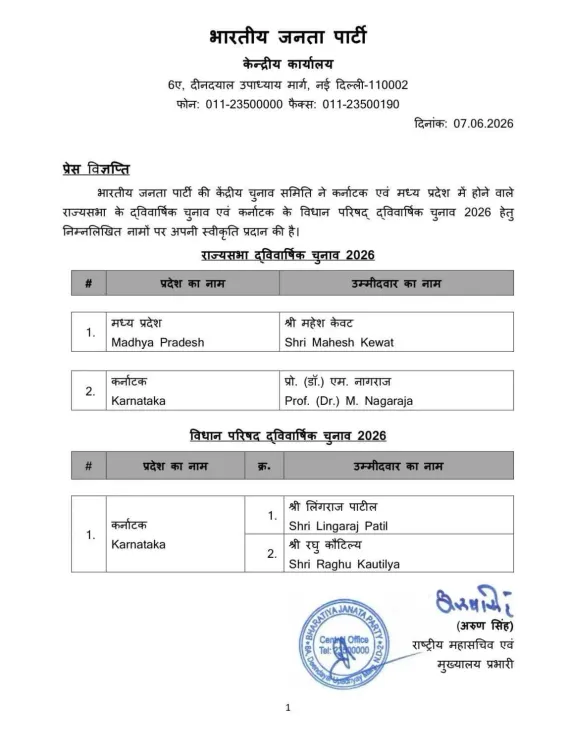
Bihar CM Samrat Choudhary announced on June 8 that the BJP Central Election Committee has approved its candidates for Rajya Sabha biennial elections in Karnataka and Madhya Pradesh, and the Karnataka Legislative Council biennial elections 2026, extending congratulations to all nominees.
Key Takeaways
The BJP Central Election Committee has approved candidates for Rajya Sabha biennial elections in Karnataka and Madhya Pradesh .
The committee also cleared nominees for the Karnataka Legislative Council biennial elections 2026 .
The announcement was shared by Bihar Chief Minister Samrat Choudhary on June 8, 2026 .
Rajya Sabha members are elected indirectly by state legislative assembly members, making party-level candidate approval a critical step.
Karnataka is a Congress-governed state, making the seat arithmetic more competitive for BJP compared to BJP-governed Madhya Pradesh .
Formal Election Commission notifications on polling dates and nomination schedules are awaited.
Bihar Chief Minister and senior BJP leader Samrat Choudhary on Monday, June 8, 2026, shared an announcement that the Bharatiya Janata Party's Central Election Committee has approved its list of candidates for the upcoming Rajya Sabha biennial elections in Karnataka and Madhya Pradesh, as well as the Karnataka Legislative Council biennial elections 2026. Choudhary extended congratulations and advance best wishes to all nominated candidates.
Context
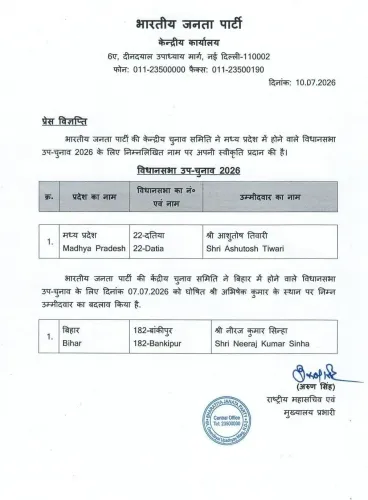
Posting in Hindi on June 8, Choudhary wrote: 'Bharatiya Janata Party ki Kendriya Chunav Samiti ne Karnataka evam Madhya Pradesh mein hone wale Rajya Sabha dwivaarshik chunav tatha Karnataka Vidhan Parishad dwivaarshik chunav-2026 ke liye nimnalikhit naamon ko apni sweekriti pradaan ki hai' — meaning, 'The BJP Central Election Committee has accorded its approval to the following names for the Rajya Sabha biennial elections to be held in Karnataka and Madhya Pradesh, and the Karnataka Legislative Council biennial elections-2026.' The post was accompanied by an image, presumably listing the approved nominees.
Rajya Sabha biennial elections are triggered every two years as one-third of the upper house's membership retires on a rolling basis under the constitutional framework. Members are elected indirectly by elected members of state legislative assemblies, making party coordination and candidate approval a critical organisational step.
Policy Backdrop
The BJP Central Election Committee is the apex internal body responsible for vetting and approving the party's candidates across all tiers of elections. Its approval is a standard prerequisite before candidates file nominations with the Election Commission of India. This process ensures centralised coordination across geographically dispersed state units.
Karnataka is one of the few states that maintains a bicameral legislature, with the Karnataka Legislative Council serving as its upper house. Biennial elections to the council follow a similar indirect-election model, with members of the state legislature and local bodies forming the electorate. Madhya Pradesh, in contrast, holds only Rajya Sabha vacancies in this cycle.
Stakeholders and Impact
The primary stakeholders are the BJP nominees themselves, whose political careers advance significantly with a berth in the Rajya Sabha or a state legislative council. Elected MLAs in Karnataka and Madhya Pradesh will cast ballots in these indirect elections, making floor management and inter-party negotiations critical in the days ahead.
For the BJP, securing upper-house seats in these states reinforces its legislative strength at the national level and in Karnataka's state legislature. The party currently governs Madhya Pradesh, giving it a numerical advantage there, while Karnataka is governed by the Congress, making the seat arithmetic more contested.
What's Next
The Election Commission is expected to issue formal notifications detailing nomination deadlines, scrutiny dates, and the precise polling schedule for these 2026 biennial elections. Once official timelines are published, the focus will shift to whether opposition parties in Karnataka attempt to contest the BJP's nominees or whether any seats are returned unopposed. The outcome will have direct implications for the party's numerical strength in the Rajya Sabha ahead of key legislative business in the coming parliamentary sessions.
Point of View
Where the Central Election Committee's imprimatur precedes all public filings. The simultaneous approval of nominees across two states and two legislative bodies signals the party is moving early to consolidate its upper-house presence ahead of key parliamentary sessions. In Karnataka, where the BJP is in opposition, winning Rajya Sabha seats will require precise vote-counting and possible cross-voting strategies — making this a test of the party's legislative floor management. The pattern reflects a broader BJP organisational discipline of pre-emptive candidate clearance rather than last-minute nominations.
NationPress
26 Oct 2026
Frequently Asked Questions
What is the BJP Central Election Committee?
The BJP Central Election Committee is the party's apex internal body responsible for approving candidates for all elections, including Rajya Sabha and state legislative council polls, before they file nominations with the Election Commission of India.
How are Rajya Sabha members elected in India?
Rajya Sabha members are elected indirectly by the elected members of state legislative assemblies through a system of proportional representation using the single transferable vote, not by the general public directly.
Why is Bihar CM Samrat Choudhary announcing Karnataka and Madhya Pradesh election candidates?
As a senior BJP leader, Samrat Choudhary shares official party organisational announcements on social media; such posts from state-level leaders are a common channel for amplifying central party decisions.
What is the Karnataka Legislative Council?
The Karnataka Legislative Council is the upper house of the Karnataka state legislature; Karnataka is one of a handful of Indian states that maintains a bicameral legislature, and its council members are elected indirectly by MLAs and local body representatives.
When will the Rajya Sabha biennial elections 2026 be held?
The exact polling dates are subject to formal notification by the Election Commission of India; the BJP's internal candidate approvals typically precede these official notifications by days or weeks.