Cauvery row: BJP leaders detained at KRS Dam, Vijayendra targets Shivakumar
Synopsis
Karnataka BJP turned the KRS Dam into a political flashpoint on 31 July, with senior leaders including Yediyurappa and Vijayendra detained after attempting to lay siege to the reservoir. The protest — triggered by a CWMA order to release water to Tamil Nadu — exposes the deepening fault lines over Cauvery politics as the Congress government faces accusations of prioritising Delhi power plays over farmers' interests.
Key Takeaways
BJP State President B.Y.
Vijayendra and several senior leaders were detained at KRS Dam, Srirangapatna on 31 July .
The protest targeted the Congress government's handling of a CWMA directive to release Cauvery water to Tamil Nadu .
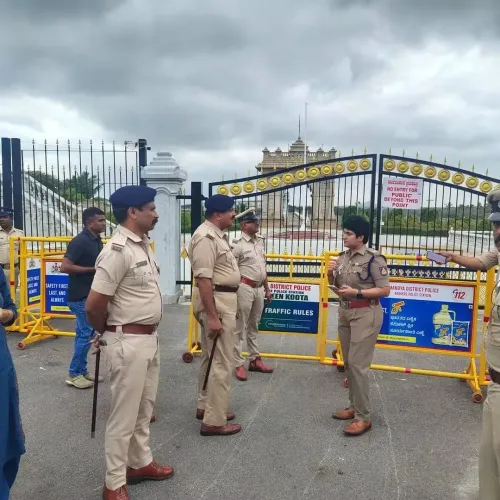
Over 1,500 police personnel were deployed around the KRS Dam to prevent the siege.
Yediyurappa demanded Chief Minister D.K.
Shivakumar refuse to release water or resign.
BJP demanded immediate implementation of the Mekedatu project and an earlier all-party meeting on the dispute.
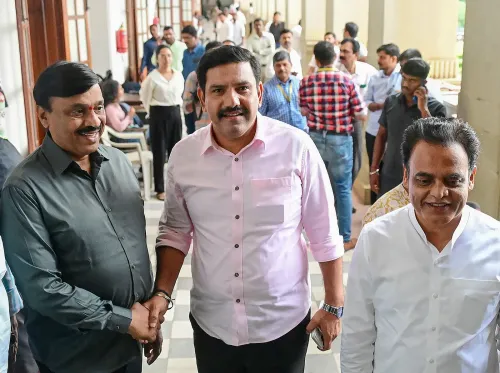
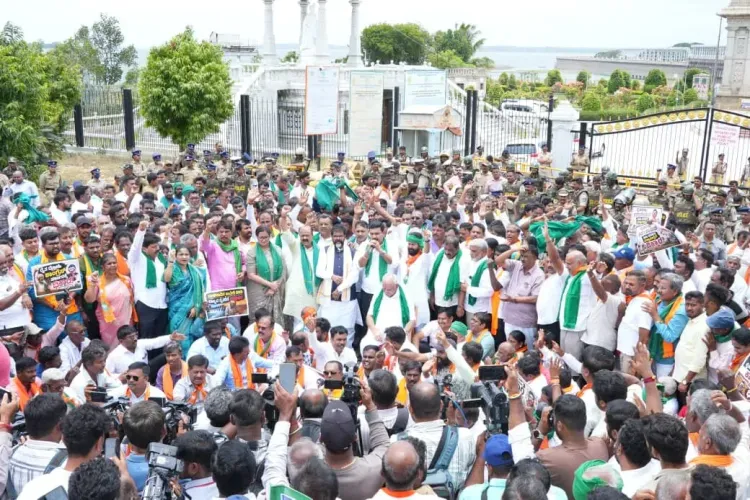
Karnataka Bharatiya Janata Party (BJP) leaders, including BJP State President B.Y. Vijayendra, were detained by police on 31 July after attempting to lay siege to the Krishna Raja Sagar (KRS) Dam in Srirangapatna, Mandya, as part of a large-scale protest against the Congress government's handling of the Cauvery water dispute. Vijayendra accused Chief Minister D.K. Shivakumar of 'shedding crocodile tears' over the issue, even as over 1,500 police personnel were deployed to contain the demonstration.
What Triggered the Protest
The BJP organised the agitation near the KRS Dam to condemn what it described as the state government's failure to protect Karnataka's interests following a direction by the Cauvery Water Management Authority (CWMA) to release water to Tamil Nadu. Police detained several BJP leaders and protesters after they attempted to march toward the dam. Security in the area was significantly tightened ahead of the demonstration.
Senior BJP Leaders at the Forefront
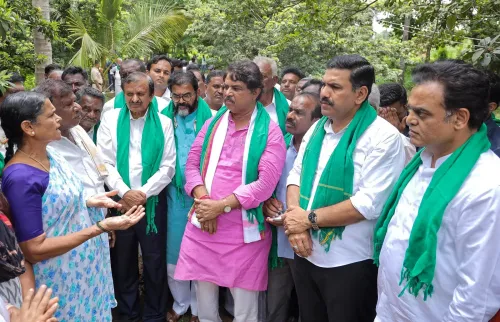
The protest drew a prominent cross-section of BJP leadership. Former Chief Minister B.S. Yediyurappa, Leader of Opposition in the Legislative Assembly R. Ashoka, Leader of Opposition in the Legislative Council Chalavadi Narayanaswamy, former MP Sumalatha Ambareesh, former minister N. Mahesh, MLC C.T. Ravi, MLA T.S. Srivatsa, BJP General Secretary Preetham J. Gowda, and BJP chief spokesperson Ashwath Narayan all participated. Party workers and elected representatives from Mandya, Mysuru, Hassan, and neighbouring districts also joined the demonstration.
What BJP Leaders Said
Addressing the gathering, Vijayendra alleged that Shivakumar had forgotten the plight of farmers after assuming office. He pointed to the Chief Minister's earlier padyatra for the Mekedatu project, contrasting it with what he called the Congress government 'playing with the lives of farmers instead of protecting their interests.'
Vijayendra criticised Shivakumar for making 10 visits to New Delhi in the preceding month without, he alleged, making serious efforts to defend Karnataka's farmers. 'Calling an all-party meeting now is like shutting the fort gates after the town has been looted,' he said. He also questioned why an all-party meeting had not been convened before the CWMA issued its order, noting that the state had already released substantial quantities of water to Tamil Nadu over the prior three months.
Former Chief Minister Yediyurappa accused Shivakumar of prioritising cabinet expansion discussions in New Delhi over the state's interests. He said that if the Chief Minister were sincere, he would refuse to release even a drop of water to Tamil Nadu and, if necessary, resign. Yediyurappa also urged Shivakumar to show Tamil Nadu Chief Minister M.K. Stalin the actual water levels at KRS, and pressed for immediate implementation of the Mekedatu project.
Leader of Opposition R. Ashoka alleged that Shivakumar was acting as 'Tamil Nadu's water agent' and claimed the Chief Minister should have consulted legal experts and presented Karnataka's case more effectively before the Cauvery authorities. Chalavadi Narayanaswamy said the government had failed to convince the CWMA about Karnataka's water shortage, while MLC C.T. Ravi warned that the people of Karnataka would not forgive any betrayal of the state's interests.
Broader Context
The Cauvery water dispute is a long-running inter-state conflict between Karnataka and Tamil Nadu, with periodic flare-ups tied to monsoon shortfalls and CWMA directives. The KRS Dam, a lifeline for irrigation in the Cauvery basin, sits at the centre of the dispute every dry season. This protest is among the most visible opposition-led actions on the issue since the Congress returned to power in Karnataka in 2023. The BJP's demand for the Mekedatu balancing reservoir — which would allow Karnataka to store surplus water — has been a recurring political flashpoint, with Tamil Nadu opposing the project.
The Congress government's response to the BJP's allegations and the CWMA's directive is expected to shape the political temperature in the Cauvery basin districts ahead of upcoming local body elections.
Point of View
Mysuru, and Hassan — the heartland of Cauvery basin politics — are constituencies the party cannot afford to cede to the Congress on a farmers' issue. Vijayendra's 'crocodile tears' framing and Yediyurappa's resignation demand are calibrated provocations, not policy alternatives. The more substantive question — why Karnataka did not mount a stronger legal challenge before the CWMA issued its order — goes largely unasked by both sides. The Mekedatu project, repeatedly invoked, remains stalled not just by Tamil Nadu's opposition but by Centre-level clearances that the BJP's own governments did not expedite. The Cauvery row is perennial; what changes each cycle is who is in power and who gets to play the aggrieved protector of the farmer.
NationPress
15 Sept 2026
Frequently Asked Questions
Why were BJP leaders detained at KRS Dam on 31 July?
BJP leaders were detained after attempting to lay siege to the Krishna Raja Sagar Dam in Srirangapatna as part of a protest against the Congress government's response to a CWMA directive ordering Karnataka to release Cauvery water to Tamil Nadu. Police deployed over 1,500 personnel to prevent the march.
What is the Cauvery Water Management Authority (CWMA) and what did it order?
The CWMA is the statutory body that oversees compliance with the Supreme Court's Cauvery water-sharing award between Karnataka, Tamil Nadu, Kerala, and Puducherry. It issued a direction to Karnataka to release water to Tamil Nadu, which triggered the BJP protest at KRS Dam on 31 July.
What did BJP State President B.Y. Vijayendra allege against CM Shivakumar?
Vijayendra alleged that Shivakumar had made 10 visits to New Delhi in the preceding month without seriously protecting Karnataka farmers' interests, and accused him of 'shedding crocodile tears' by calling an all-party meeting only after the CWMA order was issued.
What is the Mekedatu project and why is it politically significant?
The Mekedatu balancing reservoir, proposed across the Cauvery river near Bengaluru, would allow Karnataka to store surplus water before it flows into Tamil Nadu. Tamil Nadu opposes the project. The BJP has repeatedly demanded its implementation, making it a recurring flashpoint in Karnataka's Cauvery politics.
Who are the senior BJP leaders who participated in the KRS Dam protest?
The protest included former Chief Minister B.S. Yediyurappa, Leader of Opposition R. Ashoka, Legislative Council Leader of Opposition Chalavadi Narayanaswamy, former MP Sumalatha Ambareesh, MLC C.T. Ravi, MLA T.S. Srivatsa, and BJP General Secretary Preetham J. Gowda, among others.