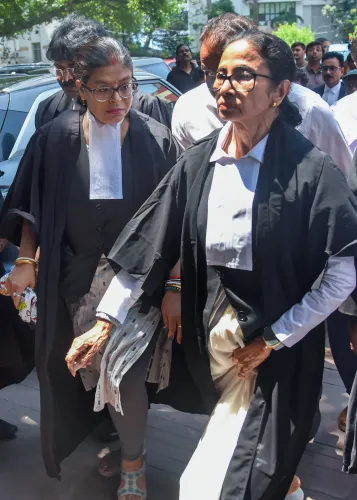
Calcutta HC dismisses PIL against Mamata over Bangladesh remarks

Synopsis
The Calcutta High Court shut down a PIL targeting Mamata Banerjee's cryptic Bangladesh remarks — remarks that hinted at a murderer's arrest but deliberately withheld a name. A state government report finding no cognisable offence sealed the petition's fate, but the episode highlights how politically charged speech at Indian rallies increasingly ends up in court.
Key Takeaways
The Calcutta High Court dismissed a PIL against Mamata Banerjee on 16 September over her Bangladesh -related comments.
A state government report submitted to the court found no cognisable offence in her remarks.
The PIL was filed by petitioner Avratanu Sarkar following Banerjee's speech at Esplanade, Kolkata on 2 June .
Banerjee had referred to a Bangladeshi national arrested by the STF during her tenure, without naming the individual.
The division bench was headed by new Chief Justice Ravindra Vithalrao Ghuge ; the previous bench had also questioned the PIL's admissibility on 1 September .
The Calcutta High Court on Wednesday, 16 September dismissed a public interest litigation (PIL) filed against All India Trinamool Congress (TMC) supremo and former West Bengal Chief Minister Mamata Banerjee over remarks she made about Bangladesh at a public meeting in Kolkata earlier this year. A state government report submitted to the court found that her comments contained no element of a cognisable offence, clearing the path for the bench to dispose of the petition.
The Court's Ruling
A division bench headed by newly appointed Chief Justice Ravindra Vithalrao Ghuge dismissed the PIL filed by petitioner Avratanu Sarkar. The dismissal came after the court, during its previous hearing on 1 September, had directed the state government to submit a report on the nature and content of Banerjee's remarks. The state's report, placed before the bench on Wednesday, concluded that the statements did not attract the ingredients of a cognisable offence under Indian law.
What Banerjee Said at Esplanade
The controversy stems from a public meeting held at Esplanade in central Kolkata on 2 June — shortly after the West Bengal Assembly elections. Without naming any individual directly, Banerjee referred to a murderer from Bangladesh who had allegedly entered West Bengal via Meghalaya and was subsequently arrested by the state police's Special Task Force (STF) during her tenure as Chief Minister.
Many observers at the meeting and in the media believed she was alluding to the killing of young Bangladeshi leader Osman Hadi, though Banerjee did not confirm this. Crowd members reportedly pressed her to name the individual, but she declined.
'After that, the Union Home Minister himself called me and gave credit. I did not say anything on this for so long. I did not open my mouth in the matter. Now that the oppression against us has reached its limit. But I am not mentioning names out of courtesy. The people of Bangladesh will become agitated. I don't want that. I love the country,' she had said at the meeting.
Earlier Judicial Scrutiny
When the PIL first came up for hearing on 1 September, the then acting Chief Justice Tapabrata Chakraborty had raised pointed questions about the court's role in adjudicating political speech at public gatherings. He questioned whether the judiciary should entertain a challenge to anything said by anyone at a public forum, and also raised doubts about the admissibility of the petition itself — signalling early scepticism about the PIL's legal standing.
Broader Context
The case reflects a wider pattern of PILs being filed against political leaders over statements made at rallies and public meetings, many of which courts have found lacking in legal merit. This is not the first time a PIL targeting Banerjee's public remarks has been dismissed by the Calcutta High Court. Notably, the episode underscores the delicate diplomatic sensitivities around public commentary on India-Bangladesh relations, particularly as bilateral ties have seen periodic strain. With the PIL now dismissed, no further judicial proceedings on this matter are expected unless a fresh petition with stronger legal grounds is filed.
Point of View
And how independent are they? The acting Chief Justice's own scepticism on 1 September about the PIL's admissibility suggests the petition was always on shaky legal ground, but the route through a state-authored exoneration report is a procedural choice worth noting. More broadly, the case is a reminder that PILs targeting political speech are increasingly being weaponised as instruments of political pressure rather than genuine public interest litigation — and courts are growing visibly impatient with the trend.
NationPress
16 Sept 2026
Frequently Asked Questions
Why did the Calcutta High Court dismiss the PIL against Mamata Banerjee?
The court dismissed the PIL after a state government report found that Banerjee's Bangladesh-related remarks at the Esplanade meeting on 2 June contained no element of a cognisable offence. The division bench headed by Chief Justice Ravindra Vithalrao Ghuge accepted the report and disposed of the petition filed by Avratanu Sarkar.
What did Mamata Banerjee say that triggered the PIL?
At a public meeting in Esplanade, Kolkata on 2 June, Banerjee referred to a murderer from Bangladesh who had entered West Bengal via Meghalaya and was arrested by the state STF during her tenure. She declined to name the individual, citing national interest and courtesy toward Bangladesh. Many believed she was alluding to the killing of Bangladeshi leader Osman Hadi.
Who filed the PIL and what did it seek?
The PIL was filed by an individual named Avratanu Sarkar, who sought judicial action against Banerjee over her remarks at the public meeting. The Calcutta High Court ultimately dismissed the petition after finding it legally untenable.
What was the Calcutta High Court's earlier stance on the PIL?
During the hearing on 1 September, then acting Chief Justice Tapabrata Chakraborty questioned whether courts should entertain challenges to statements made by anyone at public gatherings, and also raised doubts about the PIL's admissibility — signalling early scepticism about its legal standing.
What are the implications of this ruling for similar PILs?
The dismissal reinforces a growing judicial reluctance to entertain PILs that target political speech at rallies without a clear legal basis. It also highlights the role of state government reports in shaping court outcomes in such cases, which critics argue raises questions about procedural independence.