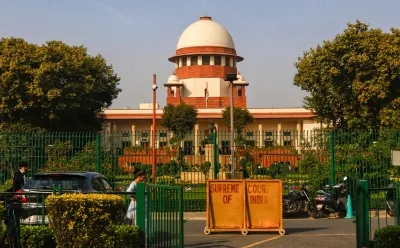
Calcutta HC rejects TMC plea against ECI central staff directive for 2026 Bengal polls

Synopsis
The Calcutta High Court has dismissed TMC's legal challenge against the ECI's order to deploy Central government and PSU employees as counting supervisors for the 2026 West Bengal polls — ruling the Commission's authority is unimpeachable and TMC's bias fears legally unsustainable.
Key Takeaways
Calcutta High Court on 30 April 2025 dismissed TMC 's writ petition against the ECI 's directive on central counting staff.
Justice Krishna Rao ruled that appointing Central government/PSU employees as counting supervisors is within the ECI 's authority.
The court cited Clause 15.7.9 of the Handbook for Returning Officers, which permits appointment from either Central or state government officials.
TMC 's contention that Central employees would favour the BJP -led Union government was held to be legally unsustainable.
The court noted that micro-observers , counting agents, and other officials would be present at every counting table as checks and balances.
TMC retains the right to challenge any irregularity via an election petition under Section 100 of the Representation of the People Act, 1951.
The Calcutta High Court on Thursday, 30 April 2025, dismissed a writ petition filed by the All India Trinamool Congress (TMC) challenging the Election Commission of India (ECI)'s directive to deploy Central government and Central Public Sector Undertaking (PSU) employees as counting supervisors and assistants for the 2026 West Bengal Assembly elections. A single-judge bench of Justice Krishna Rao rejected the petition in its entirety, ruling that the ECI's decision was well within its constitutional authority.
What the Court Ruled
Justice Krishna Rao, who had reserved the order earlier in the day after hearing arguments from both sides, pronounced the verdict in the evening. The bench held that it is the ECI's prerogative to appoint counting personnel from either the Central or state government, and found no legal infirmity in the impugned directive.
Point of View
Which has consistently sought to frame the ECI's deployment of Central personnel as partisan interference. The court's logic — that micro-observers, counting agents, and election petitions provide sufficient safeguards — is legally sound but politically contested in a state where the ruling party and the Centre are in open adversarial posture. What the judgment does not resolve is the broader trust deficit between West Bengal's state machinery and the Union government, a fault line that will shape the 2026 election narrative regardless of legal outcomes. The TMC's recourse now shifts entirely to the ballot and, if needed, the election tribunal.
NationPress
19 Sept 2026
Frequently Asked Questions
Why did the Calcutta High Court dismiss TMC's petition against the ECI directive?
The court ruled that the ECI has the constitutional prerogative to appoint counting supervisors and assistants from either Central or state government employees, and found no illegality in the directive. Justice Krishna Rao held that Clause 15.7.9 of the Handbook for Returning Officers explicitly permits such appointments from Central government or comparable undertakings.
What was TMC's main argument in the writ petition?
TMC, represented by Senior Advocate Kalyan Bandopadhyay, argued that the ECI directive lacked jurisdiction and deviated from the Commission's own handbook, which does not mandate Central government personnel for counting roles. The party also contended that Central employees, being under the BJP-led Union government, could favour the principal opposition in West Bengal.
How did the court address TMC's bias concerns?
The court held that TMC's apprehension of favouritism was not legally sustainable. It pointed out that micro-observers drawn from Central government/PSU employees, counting agents of candidates, and other officials would be present at every counting table, providing adequate checks and balances.
What legal remedy does TMC have if irregularities occur during counting?
The court stated that if TMC can prove that Central government or PSU employees manipulated votes during counting, it retains the liberty to raise such grounds in an election petition under Section 100 of the Representation of the People Act, 1951, after the declaration of results.
What is the ECI directive that TMC challenged?
The directive, issued by the Additional Chief Electoral Officer of West Bengal, required that at least one among the counting supervisor and counting assistant at each counting table for the 2026 West Bengal Assembly elections shall be a Central Government or Central PSU employee.