CM Bhajan Lal Greets Journalists on Hindi Journalism Day
Synopsis
Rajasthan Chief Minister Bhajan Lal Sharma marked Hindi Journalism Day on 30 May by saluting the courage, dedication, and democratic contribution of Hindi-language journalists, connecting the occasion to the 1826 founding of India's first Hindi newspaper, Udant Martand.
Key Takeaways
Bhajan Lal Sharma , Chief Minister of Rajasthan , posted greetings on Hindi Journalism Day on 30 May .
Hindi Journalism Day marks the 1826 launch of Udant Martand , India's first Hindi-language newspaper.
The CM credited Hindi journalism with giving expression to public sentiment and strengthening democratic values.
He specifically acknowledged journalists' 'dedication, courage, and continuous hard work.' Rajasthan has a BJP government since December 2023 , with Hindi media playing a central role in the state's public discourse.
Freedom of the press in India is anchored in Article 19(1)(a) of the Indian Constitution .
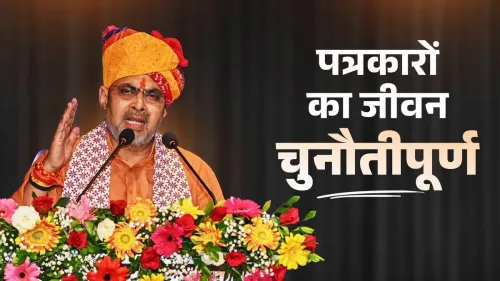
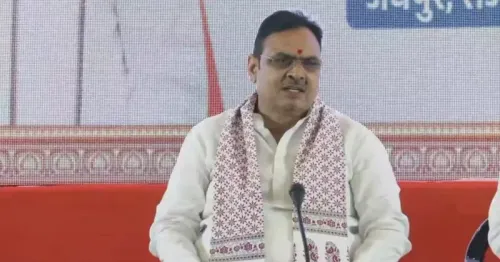
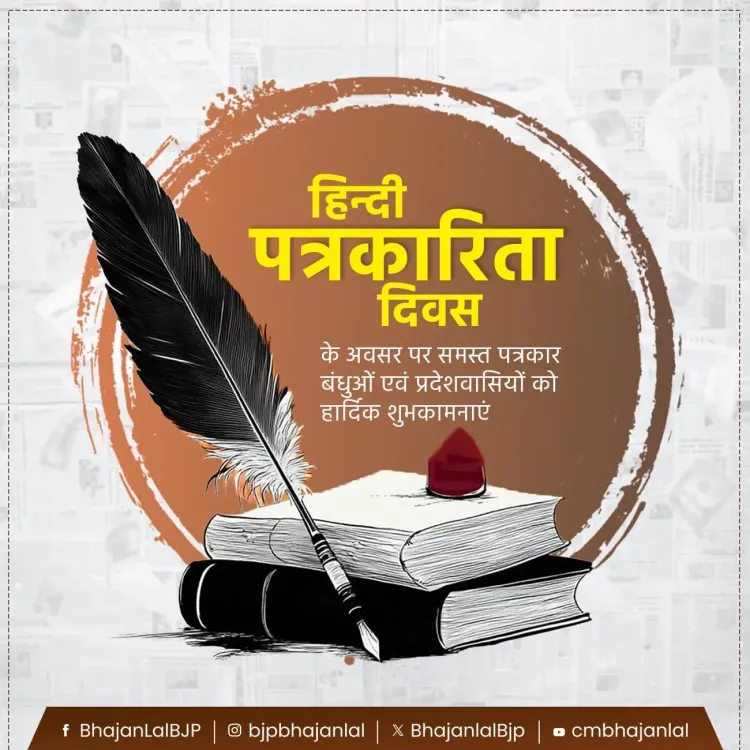
Rajasthan Chief Minister Bhajan Lal Sharma extended greetings to journalists and citizens of Rajasthan on the occasion of Hindi Journalism Day on 30 May, honouring the role of Hindi-language media in giving voice to public sentiment and strengthening democratic values.
In his post on X, the Chief Minister wrote: 'हिन्दी पत्रकारिता ने सदैव समाज की आवाज बनकर जनभावनाओं को अभिव्यक्ति दी है' ('Hindi journalism has always been the voice of society, giving expression to public sentiment'), and saluted the dedication, courage, and continuous hard work of all journalist colleagues.
Context
Hindi Journalism Day is observed annually on 30 May to commemorate the launch of Udant Martand in 1826 — India's first Hindi-language newspaper. The day serves as a marker for reflecting on the growth and contribution of Hindi-language media across the country, particularly in states where Hindi is the dominant language of public discourse.
Rajasthan is among the states where regional Hindi media carries significant weight in shaping public opinion and holding local governance to account. The state's press ecosystem spans print, digital, and broadcast formats, with Hindi outlets commanding wide readership across urban and rural areas alike.
Policy Backdrop
Article 19(1)(a) of the Indian Constitution guarantees freedom of speech and expression, forming the foundational legal framework for independent journalism in India, including the Hindi-language press. This constitutional guarantee has underpinned the expansion of Hindi media since independence, enabling it to serve large non-English-speaking populations across north and western India.
State-level leaders across parties routinely issue messages on media commemorative days, reflecting the political significance attached to maintaining constructive relations with regional press bodies. For the BJP government in Rajasthan, such occasions also align with broader efforts to promote Hindi in official and public communication.
Stakeholders and Impact
Working journalists, editors, and media organisations across Rajasthan are the direct audience for such messages. For many journalists — particularly those in smaller towns and districts — official acknowledgement of their professional contributions carries symbolic importance, especially amid ongoing national conversations around journalist welfare and press freedom.
Hindi media readers, who constitute the majority of the news-consuming public in the state, are also indirect stakeholders. The health and independence of Hindi-language journalism directly shapes how governance, policy, and social issues are communicated to ordinary citizens across the state.
What's Next
Attention will now turn to whether the Rajasthan government follows ceremonial greetings with concrete measures — such as journalist welfare schemes, accreditation reforms, or enhanced press facilities — in upcoming state assembly sessions. At the national level, ongoing reviews by the Press Council of India on media regulation and journalist protections will continue to set the broader framework within which state governments operate.
As Hindi journalism marks another year, the sector's ability to sustain independent regional reporting — particularly in an era of rapid digital transformation — will remain a key indicator of democratic health in states like Rajasthan.
Point of View
Visible appreciation of Hindi media — the primary channel through which governance reaches most voters — serves both symbolic and practical purposes. The message also fits a broader pattern of north Indian BJP leaders using Hindi-centric occasions to reinforce cultural and linguistic identity politics. What will matter more than the greeting itself is whether the Rajasthan government backs the sentiment with measurable journalist welfare or press freedom measures in the coming legislative cycle.
NationPress
26 Oct 2026
Frequently Asked Questions
Why is Hindi Journalism Day celebrated on 30 May?
Hindi Journalism Day is observed on 30 May each year to mark the publication of Udant Martand on 30 May 1826 — India's first Hindi-language newspaper, launched in Calcutta by Jugal Kishore Shukla.
Who is Bhajan Lal Sharma?
Bhajan Lal Sharma is the Chief Minister of Rajasthan , a BJP leader who assumed office in December 2023 following the party's victory in the state assembly elections.
What did CM Bhajan Lal Sharma say on Hindi Journalism Day?
CM Sharma said Hindi journalism has always been the voice of society, giving expression to public sentiment and playing an important role in strengthening democratic values, and he saluted the dedication, courage, and hard work of all journalist colleagues.
What is Udant Martand and why is it significant?
Udant Martand was India's first Hindi-language newspaper, published on 30 May 1826 . Its launch is commemorated annually as Hindi Journalism Day , recognising the historical roots of Hindi-language media in India.
What is the legal basis for press freedom in India?
Press freedom in India is protected under Article 19(1)(a) of the Indian Constitution , which guarantees freedom of speech and expression to all citizens, forming the legal foundation for independent journalism.