CM Bhajan Lal Meets Union Env Minister Bhupender Yadav
Synopsis
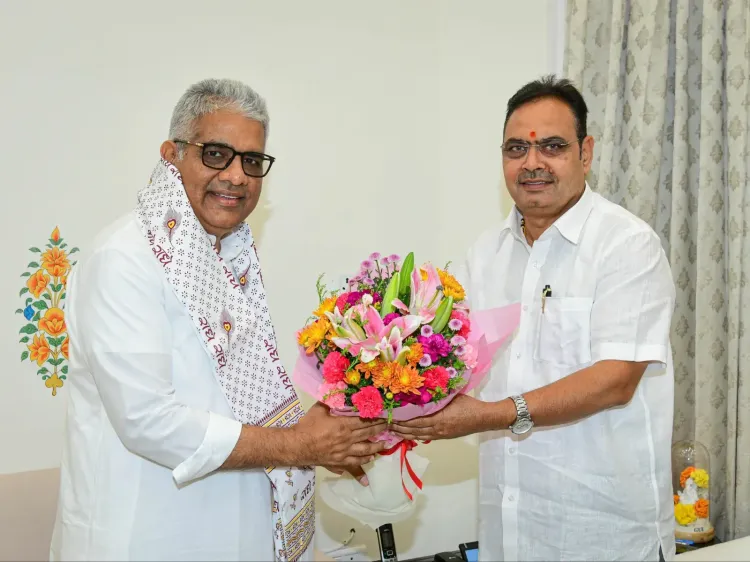
Rajasthan Chief Minister Bhajan Lal Sharma hosted Union Environment Minister Bhupender Yadav at the CM residence in Jaipur on 26 June 2026. The two BJP leaders discussed contemporary issues spanning environment, climate change and development, continuing the pattern of centre-state coordination on India's climate governance agenda.
Key Takeaways
Bhajan Lal Sharma received Union Environment Minister Bhupender Yadav at the Chief Minister's residence in Jaipur on 26 June 2026 .
Discussions covered environment, climate change and development-related issues, according to the CM's post on X.
Bhupender Yadav is a Rajasthan BJP MP and has held the Environment, Forest and Climate Change portfolio since 2021 .
Rajasthan has a State Action Plan on Climate Change aligned with the national framework established under the NAPCC of 2008 .
The state's arid ecology and industrial growth pressures make centre-state environment coordination particularly consequential for Rajasthan .
Analysts will watch for updated state climate action plans or new central guidelines on forest clearances and renewable-energy siting following the meeting.
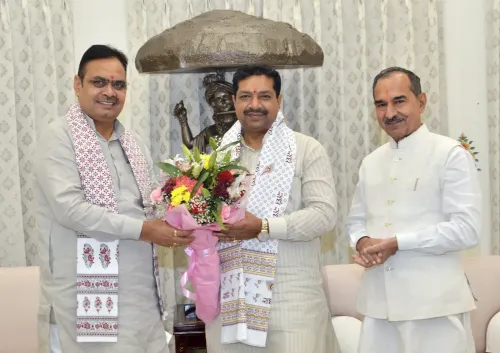
Rajasthan Chief Minister Bhajan Lal Sharma received Union Minister for Environment, Forest and Climate Change Bhupender Yadav at the Chief Minister's residence in Jaipur on Friday, 26 June 2026, for a courtesy call that covered a range of contemporary issues linked to environment, climate change and development.
Sharma posted on X that the two leaders held discussions on 'paryavaran, jalvayu parivartan aur vikas se jude vibhinn samsamayik vishyon' — 'various contemporary subjects related to environment, climate change and development' — during the meeting.
Context
Bhupender Yadav has served as Union Minister of Environment, Forest and Climate Change since 2021 and is himself a Rajasthan BJP MP, making his engagement with the state government a natural extension of both his ministerial mandate and his political constituency. The meeting at the Chief Minister's official residence signals a formal, protocol-level exchange rather than a routine working-level interaction. Such courtesy calls between central ministers and state chief ministers are a standard channel through which policy signals are exchanged before formal directives or guidelines are issued.
Policy Backdrop
India has maintained a structured climate governance architecture since the launch of the National Action Plan on Climate Change (NAPCC) in 2008, which established eight national missions integrating climate concerns into development planning. Rajasthan aligned with this framework through its own State Action Plan on Climate Change, formulated around 2014, covering water security, agriculture resilience and ecosystem conservation. These state-level plans are periodically updated to reflect India's evolving commitments under the Paris Agreement and its Nationally Determined Contributions (NDCs). Centre-state meetings of this nature are a key mechanism for synchronising state programmes with updated national targets on forest cover, pollution control and renewable energy.
Rajasthan's geography makes it particularly sensitive to the climate policy agenda. As a largely arid state, it faces persistent pressures from desertification, water stress and the competing demands of industrial and infrastructure growth. The state hosts several tiger reserves and ecologically significant landscapes that require active coordination between the state forest department and the central ministry on issues such as forest clearances and wildlife corridor management.
Stakeholders and Impact
The most directly affected stakeholders are arid-zone communities across Rajasthan who depend on state environmental policy for water access, land use rights and protection from the adverse effects of climate variability. Industrial and renewable-energy developers operating in the state also have a significant stake, as central guidelines on forest clearances and environmental impact assessments shape project timelines and costs. State forest and environment department officials will be watching for any revised central guidelines that may emerge from such high-level consultations.
The interaction also reinforces the broader pattern of centre-state coordination on environmental governance that has characterised BJP-governed states since 2014, where alignment between state administrations and the central government tends to accelerate policy implementation on shared priorities such as clean energy transition and green infrastructure.
What's Next
Observers will watch for any announcement of updated state climate action plans or fresh central guidelines on forest clearances and renewable-energy siting in Rajasthan following this engagement. The rollout of India's updated NDC commitments provides a near-term policy window in which such centre-state meetings often translate into concrete administrative action. Whether this courtesy call leads to a formal policy announcement or a joint initiative on Rajasthan's desert ecology remains to be seen.
Point of View
Where shared BJP governance at both levels smooths the path for coordinated policy action. With India's updated Nationally Determined Contributions requiring measurable state-level delivery, such courtesy calls increasingly serve as precursors to administrative directives on forest clearances, renewable-energy siting and pollution norms. For Rajasthan, a state balancing rapid industrial growth against a fragile desert ecology, these engagements carry outsized policy significance. The timing — mid-2026 — also coincides with the window when state governments are expected to revise their climate action plans ahead of the next global stocktake cycle.
NationPress
26 Jun 2026
Frequently Asked Questions
Why did Bhupender Yadav visit Rajasthan CM Bhajan Lal Sharma?
Union Environment Minister Bhupender Yadav paid a courtesy call on Rajasthan Chief Minister Bhajan Lal Sharma at the CM residence in Jaipur on 26 June 2026, during which they discussed issues related to environment, climate change and development.
What is Rajasthan's role in India's climate change policy?
Rajasthan has a State Action Plan on Climate Change aligned with the national framework, and its arid ecology makes it a key state for policies on water security, desertification control and renewable energy siting.
Who is Bhupender Yadav?
Bhupender Yadav is India's Union Minister for Environment, Forest and Climate Change since 2021 and is a BJP MP from Rajasthan.
What is the National Action Plan on Climate Change?
The National Action Plan on Climate Change, launched in 2008, is India's overarching framework with eight national missions integrating climate concerns into development planning, which state governments align their own plans with.
What could come out of the CM Bhajan Lal and Bhupender Yadav meeting?
Observers are watching for updated state climate action plans or revised central guidelines on forest clearances and renewable-energy projects in Rajasthan following the high-level consultation.