CM Bhajan Lal Pays Tribute to Rajasthan's First Rajpramukh
Synopsis
Rajasthan Chief Minister Bhajan Lal Sharma paid his respects to Maharaja Sawai Man Singh II on his death anniversary, calling the former Jaipur ruler's contribution to Rajasthan's integration 'invaluable.' The Maharaja served as the state's first Rajpramukh when Rajasthan was formally inaugurated on 30 March 1949.
Key Takeaways
CM Bhajan Lal Sharma posted a tribute on 24 June 2026 marking the death anniversary of Maharaja Sawai Man Singh II .
Maharaja Sawai Man Singh II was the last ruling Maharaja of Jaipur and served as Rajasthan's first Rajpramukh.
Rajasthan was formally inaugurated as a state on 30 March 1949 , integrating 22 princely states .
The integration process was completed with the States Reorganisation Act of 1956 , establishing the state's present boundaries.
The tribute is part of the BJP -led government's broader pattern of commemorating figures linked to Rajasthan's historical and cultural identity.
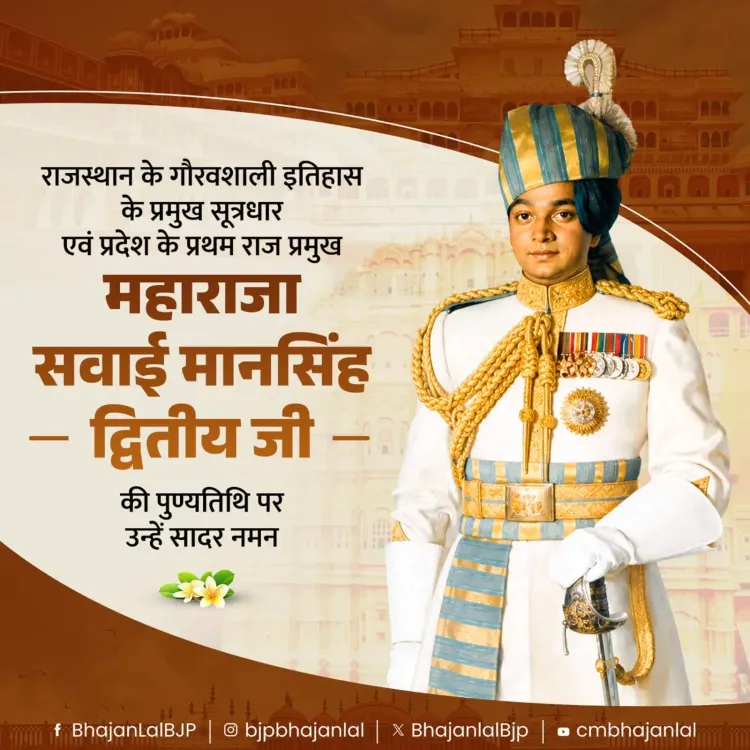
Rajasthan Chief Minister Bhajan Lal Sharma on Wednesday, 24 June 2026, paid tribute to Maharaja Sawai Man Singh II on his death anniversary, honouring the last ruling Maharaja of Jaipur who served as the state's first Rajpramukh after independence.
Context
Posting in Hindi on X, CM Sharma described Maharaja Sawai Man Singh II as a principal architect of Rajasthan ke gauravshali itihas [Rajasthan's glorious history] and its 'first Rajpramukh.' He wrote that the Maharaja's 'invaluable contribution to the integration and progress of Rajasthan will always be remembered,' offering his sadar naman [respectful salute] to the late ruler.
The tribute comes as part of a consistent practice by the BJP-led state government of publicly commemorating historical figures associated with Rajasthan's formation and cultural identity.
Policy Backdrop
Maharaja Sawai Man Singh II played a pivotal role in the integration of Rajasthan's 22 princely states into the Indian Union between 1948 and 1956. He was formally installed as the state's first Rajpramukh when Rajasthan was inaugurated on 30 March 1949.
The integration process concluded with the States Reorganisation Act of 1956, which established the present territorial boundaries of Rajasthan. The Maharaja's cooperation with the central government during this period is widely regarded as instrumental in the peaceful consolidation of one of India's largest states.
Stakeholders and Impact
The tribute resonates with the Rajasthani public and the descendants of the former royal families, for whom Maharaja Sawai Man Singh II remains a symbol of regal heritage and administrative statesmanship. His legacy is closely tied to Jaipur's identity as the state capital and cultural hub.
Across Indian politics, leaders routinely mark the death anniversaries of figures linked to the 1947–1956 princely-state integration to reinforce themes of national unity and administrative continuity. In Rajasthan, such observances carry added weight given the distinctive role that former princely rulers played in shaping the state's character, and they form a key part of the BJP's broader cultural outreach in the region.
What's Next
Annual observances around Rajasthan Diwas on 30 March are expected to continue serving as the primary occasion for honouring figures central to the state's formation. Any state-level proposals for heritage-site conservation or archival projects linked to former princely families would align with the commemorative spirit reflected in CM Sharma's tribute.
The government's sustained attention to such anniversaries signals that the legacy of Rajasthan's integration era will remain a reference point in the state's political and cultural discourse.
Point of View
The government signals continuity between royal-era statesmanship and the current administration's emphasis on heritage and unity. Such commemorations serve a dual function: reinforcing regional pride among Rajasthani voters while positioning the BJP as the custodian of the state's historical identity. This pattern is likely to intensify around landmark dates like Rajasthan Diwas as the party seeks to consolidate its cultural footprint in the state.
NationPress
22 Sept 2026
Frequently Asked Questions
Who was Maharaja Sawai Man Singh II?
Maharaja Sawai Man Singh II was the last ruling Maharaja of Jaipur and became the first Rajpramukh of Rajasthan when the state was formally inaugurated on 30 March 1949, playing a key role in integrating the region's 22 princely states into the Indian Union.
What is a Rajpramukh?
A Rajpramukh was the constitutional head of a Part B State in India during the early post-independence period, a role equivalent to a governor, typically held by the senior-most former ruling prince of the region.
When was Rajasthan formed as a state?
Rajasthan was formally inaugurated on 30 March 1949, though the integration of all 22 princely states was completed with the States Reorganisation Act of 1956, which established the state's present boundaries.
Why did CM Bhajan Lal Sharma pay tribute to Maharaja Sawai Man Singh II?
CM Bhajan Lal Sharma paid tribute on the Maharaja's death anniversary, honouring his invaluable contribution to Rajasthan's integration and progress, in line with the BJP government's practice of commemorating historical figures tied to the state's identity.
What is Rajasthan Diwas?
Rajasthan Diwas, observed on 30 March each year, marks the formal inauguration of Rajasthan as a state in 1949 and is the primary occasion for honouring figures central to the state's formation and history.