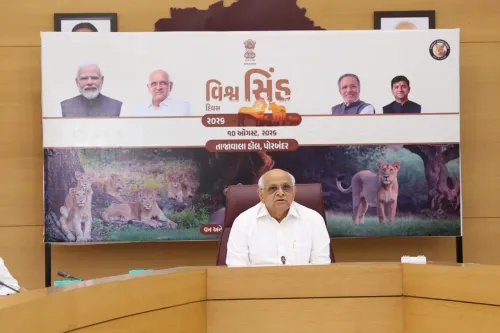
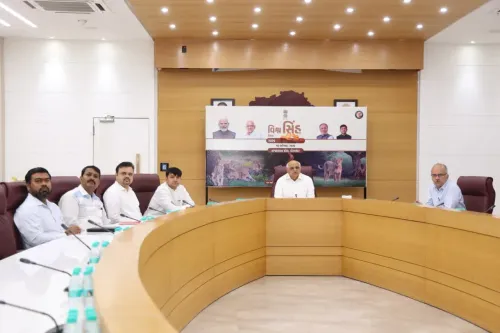
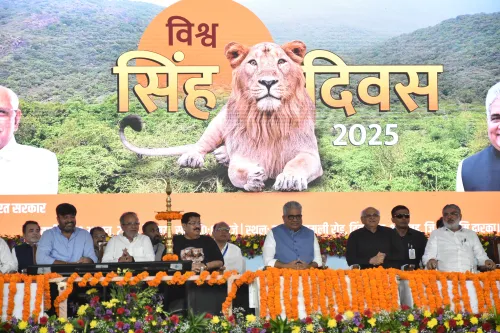
CM Bhupendra Patel Hails Asiatic Lion Comeback on World Lion Day
Synopsis
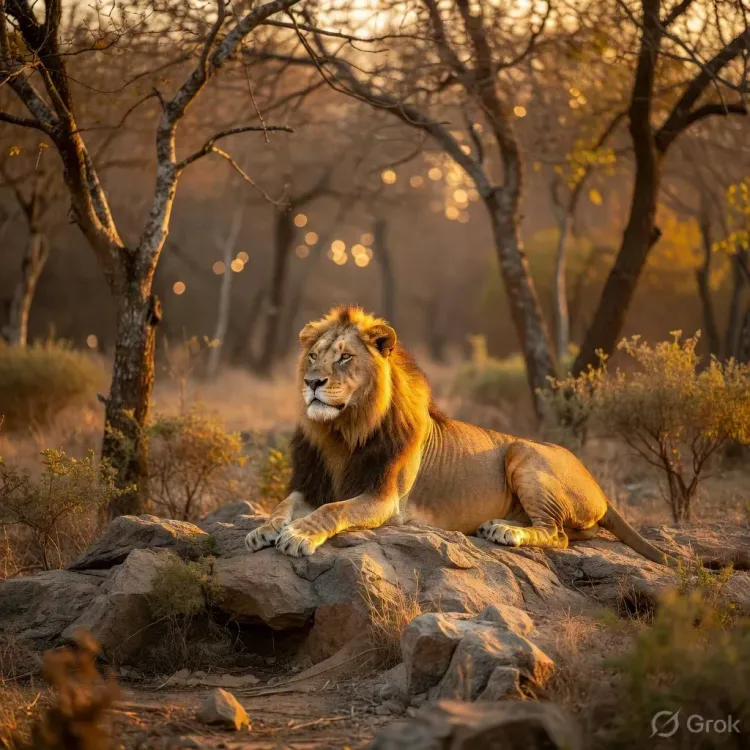
On World Lion Day 2026, Gujarat CM Bhupendra Patel celebrated the Asiatic lion's range expansion across Saurashtra, including a return to Barda sanctuary. He credited PM Modi's leadership and pointed to Union Minister Bhupender Yadav's article on India's conservation journey, rooted in community coexistence and Project Lion's habitat-connectivity push.
Key Takeaways
World Lion Day, 10 August 2026: Gujarat CM Bhupendra Patel highlighted Asiatic lion population growth and territorial expansion across Saurashtra .
Barda Wildlife Sanctuary in Gujarat has been identified as a second habitat centre for Asiatic lions, reducing single-site extinction risk.
The Asiatic lion population stood at 523 in 2015 , up from fewer than 50 at the time of Gir's notification in 1965 .
Project Lion , launched by the Government of India in 2020 , focuses on habitat connectivity, veterinary preparedness, and community participation.
Maldhari pastoralist communities in Gir are central to Gujarat's globally noted human-wildlife coexistence model.
CM Patel directed followers to an article by Union Environment Minister Bhupender Yadav on India's lion conservation journey.
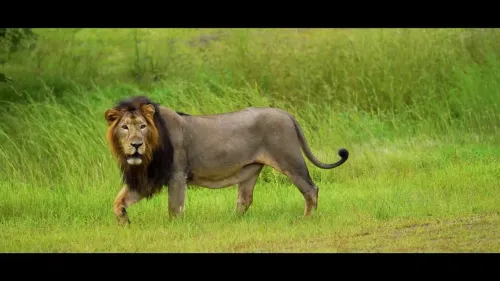
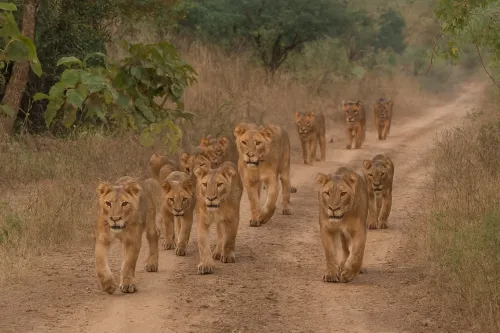
On World Lion Day, 10 August 2026, Gujarat Chief Minister Bhupendra Patel highlighted one of India's most quietly remarkable conservation stories — the Asiatic lion's steady reclamation of its ancestral range across Saurashtra, including a historic return to the Barda Wildlife Sanctuary.
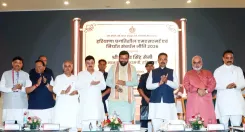
Pointing to the expansion of lion territory under the leadership of Prime Minister Narendra Modi, CM Patel also directed attention to an article by Union Minister for Environment, Forest and Climate Change Bhupender Yadav, framing India's lion conservation journey as a model worth studying globally.
From the Brink at Gir to the Hills of Barda
The Asiatic lion's survival is one of conservation's most cited turnarounds. When Gir National Park was formally notified as a protected area in 1965, the species had plummeted to fewer than 50 individuals. Decades of protection, habitat management, and — critically — community participation reversed that trajectory. By 2015, the population had climbed to 523, and successive censuses have recorded further growth. Barda, a sanctuary in the Kathiawar peninsula of Gujarat, represents the next chapter. Identified as an additional habitat centre to reduce the risk of a single catastrophic event wiping out the entire wild population, it has been the focus of translocation planning since the 2010s. CM Patel's reference to the lions' 'historical return' to Barda signals continued momentum on that front — though the precise timing and scale of recent movements remain subject to official confirmation.The Maldhari Model: Coexistence as Conservation Strategy
What makes Gujarat's lion story stand out globally is not just the numbers — it is the method. The Maldhari pastoralist communities who share the Gir landscape with lions have, over generations, developed a coexistence that most wildlife managers consider extraordinary. Livestock losses are absorbed, lion movements are tracked informally, and conflict is managed without the hostility that has undermined big-cat conservation elsewhere in the world. This community-centred approach became the philosophical backbone of Project Lion, launched by the Government of India in 2020, which focuses on habitat connectivity, veterinary preparedness, and deepening local participation rather than simply fencing lions in.Why a Second Population Centre Matters
The push to establish Barda as a second home for Asiatic lions is driven by cold ecological logic. A single disease outbreak — canine distemper, for instance, devastated African lion populations in the Serengeti — or a severe drought concentrated in Gir could be catastrophic if the entire global wild population of a species occupies one patch of forest. Distributing the population across multiple sites is standard conservation risk management, and Barda's proximity within Saurashtra makes it the most ecologically coherent option. Earlier plans to translocate lions to Kuno National Park in Madhya Pradesh were repeatedly delayed after prolonged legal and administrative disputes. Gujarat's focus has since shifted firmly toward in-state expansion — a strategy that CM Patel's post, and the Union Minister's article it promotes, reinforces as the current official direction. The next Asiatic lion census will be the clearest test of whether that strategy is delivering — and whether Barda is becoming a genuine second stronghold or remains a work in progress.Point of View
Sidestepping the long-stalled Kuno translocation debate without explicitly revisiting it. Amplifying Union Minister Yadav's article also signals coordinated central-state communication on flagship wildlife diplomacy. With the next lion census on the horizon, this is as much a preview of an anticipated headline as it is a commemorative post.
NationPress
10 Aug 2026
Frequently Asked Questions
What is the current population of Asiatic lions in India?
The last confirmed census figure stood at 523 Asiatic lions in 2015 . Subsequent counts have indicated further growth, but the precise latest figure is subject to official census release. All wild Asiatic lions live in Gujarat's Saurashtra region .
Where is Barda Wildlife Sanctuary and why is it important for lions?
Barda Wildlife Sanctuary is located in the Kathiawar peninsula of Gujarat , west of Gir. It has been selected as a second habitat site for Asiatic lions to reduce the risk of the entire wild population being wiped out by a single disaster such as disease or drought.
What is Project Lion India?
Project Lion was launched by the Government of India in 2020 to strengthen Asiatic lion conservation through habitat connectivity, veterinary preparedness, and deeper community participation, modelled on the coexistence practices of Saurashtra's local communities.
Who are the Maldhari communities and what is their role in lion conservation?
The Maldhari are traditional pastoralists who live within and around Gir National Park . Their long-standing coexistence with lions — absorbing livestock losses and informally monitoring lion movements — is widely regarded as a global benchmark in human-wildlife conflict management.
Why were Asiatic lions not moved to Kuno National Park in Madhya Pradesh?
Plans to translocate Asiatic lions to Kuno National Park in Madhya Pradesh faced prolonged legal and administrative delays over several years. Gujarat's conservation focus has since centred on expanding the lions' range within the state, particularly toward Barda sanctuary .