CM Bhupendra Patel Thanks Governor Devvrat for Guidance on Gujarat Growth
Synopsis
Gujarat Chief Minister Bhupendra Patel publicly thanked Governor Acharya Devvrat on 15 July 2026 for his continuous guidance on Antyodaya welfare and natural farming, reaffirming Team Gujarat's commitment to the state's all-round development.
Key Takeaways
CM Bhupendra Patel publicly acknowledged Governor Acharya Devvrat's guidance on 15 July 2026 via a post on X.
The Chief Minister specifically cited Antyodaya welfare and natural farming as key areas where the Governor's guidance has been valuable.
Antyodaya Anna Yojana , launched nationally in 2000 , forms the backbone of Gujarat's welfare targeting for the poorest households.
Gujarat has promoted natural farming clusters and low-input agriculture since 2015 , aligning with central schemes like Paramparagat Krishi Vikas Yojana .
Governor Acharya Devvrat is a well-known advocate of cow-based natural farming and has consistently supported the state's agricultural sustainability agenda.
Team Gujarat reaffirmed its commitment to the holistic development of the state across all sectors.
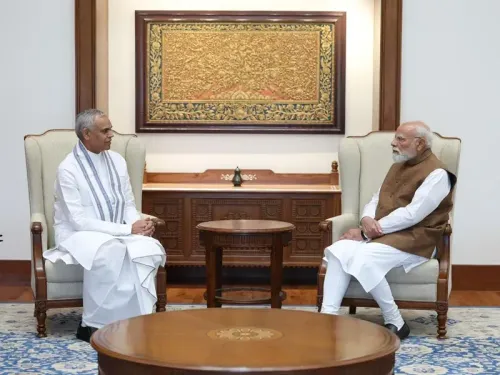
Gujarat Chief Minister Bhupendra Patel on Wednesday, 15 July 2026, publicly acknowledged the guidance of Governor Acharya Devvrat, expressing gratitude for the Governor's continued support toward the state's all-round development, with particular emphasis on Antyodaya welfare and natural farming.
Context
Responding to a message from Governor Acharya Devvrat on the social media platform X, Chief Minister Patel wrote in Hindi: 'Antyodaya ke kalyan aur prakritik krishi sahit har kshetra mein Gujarat ki pragati ke liye aapka nirantar margdarshan hamare liye amulya urja ka srot hai' — meaning, 'Your continuous guidance for Gujarat's progress in every field, including Antyodaya welfare and natural farming, is an invaluable source of energy for us.' He added that Team Gujarat remains fully committed to the holistic development of the state.
The exchange reflects the working relationship between the Raj Bhavan and the state executive, with both offices publicly aligned on the twin priorities of welfare targeting for the poorest households and promotion of sustainable agricultural practices.
Policy Backdrop
The Antyodaya philosophy — focused on uplifting the last person in the queue — has been a cornerstone of BJP governance since its origins in Jan Sangh ideology. At the national level, the Antyodaya Anna Yojana, launched in 2000, extended subsidised foodgrains to the most marginalised families, and Gujarat has consistently implemented Antyodaya-linked schemes targeting rural and tribal households.
Natural farming has been another sustained policy focus for Gujarat. From 2015 onwards, the state promoted natural farming clusters and participated in central programmes such as the Paramparagat Krishi Vikas Yojana, aimed at reducing dependence on chemical fertilisers and lowering input costs for small and marginal farmers. Governor Acharya Devvrat, a former Arya Samaj leader and long-standing advocate of cow-based natural farming methods, has been a prominent voice championing this approach within the state.
Stakeholders and Impact
The beneficiaries of the two policy streams cited in the post — Antyodaya welfare and natural farming — are primarily marginal farmers and rural households across Gujarat's districts. Natural farming initiatives directly reduce input costs for smallholders, while Antyodaya-linked food and welfare schemes provide a social safety net for the state's poorest families.
Gujarat, governed by the BJP since 1995, has built a governance model that pairs industrial and infrastructure growth with targeted rural welfare. The public affirmation of the Governor–Chief Minister alignment signals continued institutional momentum behind these programmes.
What's Next
Observers will watch the state's forthcoming budget sessions and legislative agenda for concrete allocations toward expanding natural farming clusters and strengthening Antyodaya-linked rural schemes. Any fresh gubernatorial guidelines or joint Raj Bhavan–state government initiatives on sustainable agriculture could follow from the coordination signalled in this exchange. The broader pattern suggests Gujarat will continue using both welfare targeting and low-input agriculture as twin pillars of its rural development narrative in the near term.
Point of View
Publicly invoking Antyodaya keeps the party's foundational ideological commitment visible even as Gujarat's identity increasingly centres on industrial and infrastructure growth. Governor Devvrat's advocacy for natural farming has given the state an unusual degree of gubernatorial soft power on agricultural policy, reinforcing central government messaging on sustainable agriculture at the state level. Together, these dynamics suggest Gujarat will continue to project a dual identity — as both an economic powerhouse and a welfare-focused, agri-reform state — heading into future electoral cycles.
NationPress
15 Jul 2026
Frequently Asked Questions
Who is Gujarat Governor Acharya Devvrat?
Acharya Devvrat is the Governor of Gujarat and a former Arya Samaj leader widely known for his advocacy of cow-based natural farming methods, which he has promoted actively during his tenure at the Raj Bhavan.
What is Antyodaya and how does it apply to Gujarat?
Antyodaya is a welfare philosophy focused on uplifting the poorest households, operationalised nationally through the Antyodaya Anna Yojana in 2000 to provide subsidised foodgrains. Gujarat implements Antyodaya-linked schemes targeting rural and tribal families across the state.
What is natural farming and why is Gujarat promoting it?
Natural farming is a low-input agricultural practice that avoids synthetic fertilisers and pesticides, often using cow-based inputs. Gujarat has promoted natural farming clusters since 2015 to reduce costs for small farmers and align with central sustainability programmes.
What did CM Bhupendra Patel say about Governor Devvrat?
CM Patel said the Governor's continuous guidance for Gujarat's progress in every field — including Antyodaya welfare and natural farming — is an invaluable source of energy, and reaffirmed that Team Gujarat is fully committed to the state's holistic development.
What is Team Gujarat?
'Team Gujarat' is the collective term used by Chief Minister Bhupendra Patel and the state government to refer to the administration and its partners working toward Gujarat's overall development across sectors.