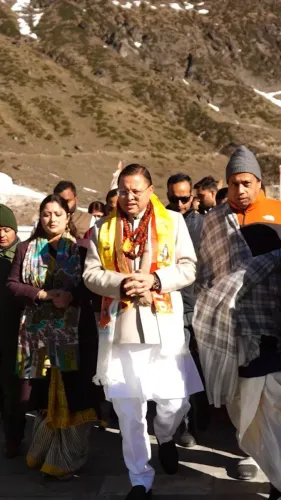
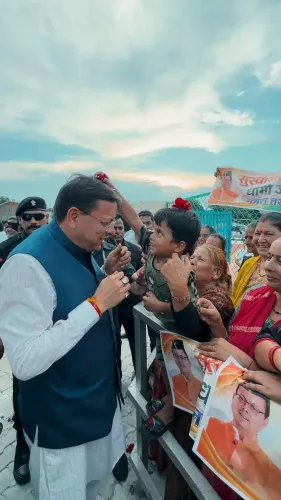
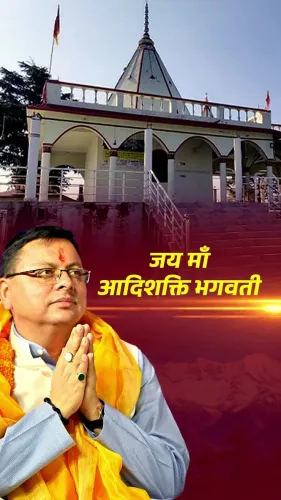
CM Dhami extends greetings on Navratri's third day
Synopsis
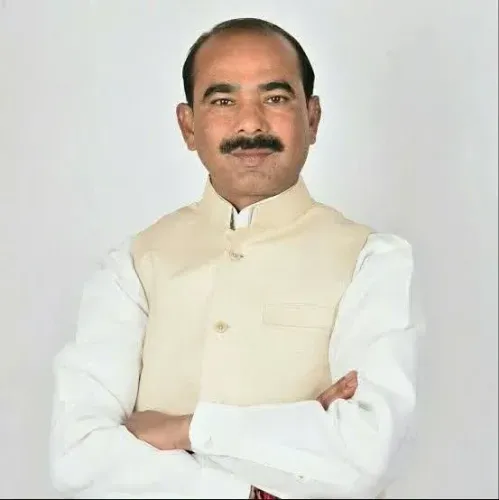
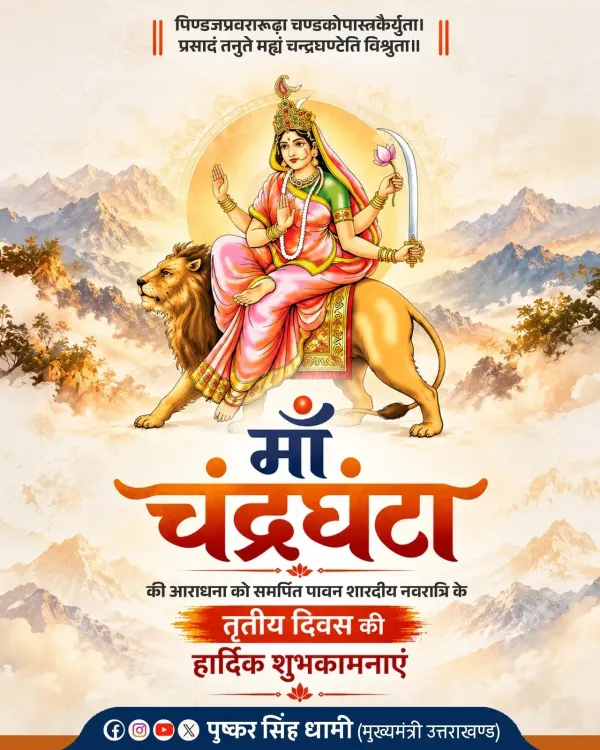
Uttarakhand CM Pushkar Singh Dhami greeted devotees on the third day of Sharadiya Navratri, praying that Maa Chandraghanta's blessings bring courage, self-confidence, and fearlessness to all.
Key Takeaways
CM Pushkar Singh Dhami posted Navratri greetings on X on 13 October 2026 , the third day of Sharadiya Navratri.
Maa Chandraghanta , worshipped on the third day, is the form of Goddess Durga associated with strength, valour, and removal of fear.
Dhami invoked blessings of courage, self-confidence, and fearlessness for all devotees.
Uttarakhand , known as 'Devbhoomi', hosts some of India's most revered Shakti temples, giving Navratri particular cultural weight in the state.
The festival builds toward Vijayadashami , with temple celebrations expected to grow across the state.
On the third day of Sharadiya Navratri, Uttarakhand Chief Minister Pushkar Singh Dhami offered warm wishes to devotees across the state and beyond, invoking the blessings of Maa Chandraghanta — the form of Goddess Durga worshipped on this day as the embodiment of courage, peace, and the vanquishing of obstacles.
In his post on X, CM Dhami wrote: 'शक्ति, साहस, वीरता और धर्म की रक्षा की अधिष्ठात्री देवी माँ चंद्रघंटा' — hailing the goddess as the presiding deity of strength, valour, and the protection of dharma. He expressed the wish that her divine blessings bring courage, self-confidence, and fearlessness into the lives of all.
Who is Maa Chandraghanta, and why the third day matters
Maa Chandraghanta is the third of the nine principal manifestations of Goddess Durga venerated during Navratri. She is depicted with a crescent moon on her forehead shaped like a bell — ghanta — and is believed to embody fierce grace: the warrior who protects her devotees while radiating calm. Devotees worship her specifically seeking inner strength, confidence, and relief from fear.
Sharadiya Navratri, the autumn edition of the nine-night festival, is observed across India with particular fervour in the hill temples of Uttarakhand, a state whose geography and cultural identity are deeply interwoven with Shakti worship. From the Nanda Devi shrines to the ghats of Haridwar, the festival draws lakhs of pilgrims every year.
A cultural tradition among India's elected leaders
Festival greetings from state chief ministers on social media have become a fixture of Indian political life. For CM Dhami, such posts serve a dual purpose: connecting with Uttarakhand's deeply religious electorate and affirming the state government's acknowledgement of living cultural traditions. Uttarakhand, often called the 'Devbhoomi' or land of gods, holds some of India's most revered Shakti temples, giving these seasonal observances particular resonance in the state's public life.
With Navratri building toward its culmination at Vijayadashami, celebrations at temples and public pandals across Uttarakhand are expected to grow in scale over the coming days.
Point of View
And CM Dhami's consistent Navratri posts reinforce his positioning as a culturally attuned leader in a state where religious identity and governance are closely linked. Uttarakhand's 'Devbhoomi' branding — anchored in its dense network of Hindu temples and pilgrimage circuits — makes Shakti-festival messaging especially resonant with the state's electorate. Such posts carry no direct policy content but form part of a broader soft-power vocabulary through which BJP leaders in particular signal continuity with Hindu cultural tradition. The cumulative effect, visible across each of the nine days of Navratri, is a sustained, low-cost public-presence strategy timed to one of the year's highest-attention religious moments.
NationPress
13 Oct 2026
Frequently Asked Questions
Which goddess is worshipped on the third day of Navratri?
Maa Chandraghanta is worshipped on the third day of Navratri. She is a form of Goddess Durga depicted with a crescent moon on her forehead and is associated with courage, peace, and the destruction of evil.
What did CM Dhami post for Navratri 2026?
Uttarakhand CM Pushkar Singh Dhami posted greetings for the third day of Sharadiya Navratri on 13 October 2026 , praying that Maa Chandraghanta's blessings bring courage, self-confidence, and fearlessness to all devotees.
Why is Uttarakhand called Devbhoomi?
Uttarakhand is called 'Devbhoomi' — meaning 'land of gods' — because it is home to some of Hinduism's most sacred temples and pilgrimage sites, including the Char Dham shrines and numerous Shakti temples, making it a major centre of religious life in India.
When does Sharadiya Navratri end in 2026?
Sharadiya Navratri concludes with Vijayadashami (Dussehra) on the tenth day. The exact date for 2026 follows the Hindu lunar calendar, and celebrations across Uttarakhand temples and public venues are expected to peak in the final days of the festival.
Why do Indian chief ministers post festival greetings on social media?
Festival greetings on platforms like X have become a standard part of public engagement for Indian elected leaders, allowing them to connect with large religious communities, affirm cultural identity, and maintain visibility during high-attention national observances like Navratri.