CM Dhami Credits Voters as Uttarakhand Elderly Couples Get Monthly Pension
Synopsis
Uttarakhand Chief Minister Pushkar Singh Dhami on June 25, 2026, credited the public's electoral mandate for enabling monthly pension benefits to elderly couples in the state, framing welfare delivery as a direct outcome of voters' trust in the ruling government.
Key Takeaways
CM Pushkar Singh Dhami announced on June 25, 2026 that elderly couples in Uttarakhand are receiving monthly pension benefits.
Dhami attributed the welfare measure directly to the 'power of voters' mandate,' linking electoral outcomes to social security delivery.
The National Social Assistance Programme (NSAP) , launched in 1995 , forms the central framework for old-age pensions in India, with states including Uttarakhand supplementing benefits.
Outmigration of working-age adults from Uttarakhand's hill districts makes pension support especially critical for elderly residents left behind.
Exact pension amounts and eligibility criteria for elderly couples under the referenced scheme have not been officially confirmed in public records.
Future state budget allocations and assembly discussions will determine the sustainability and scale of pension coverage expansion.
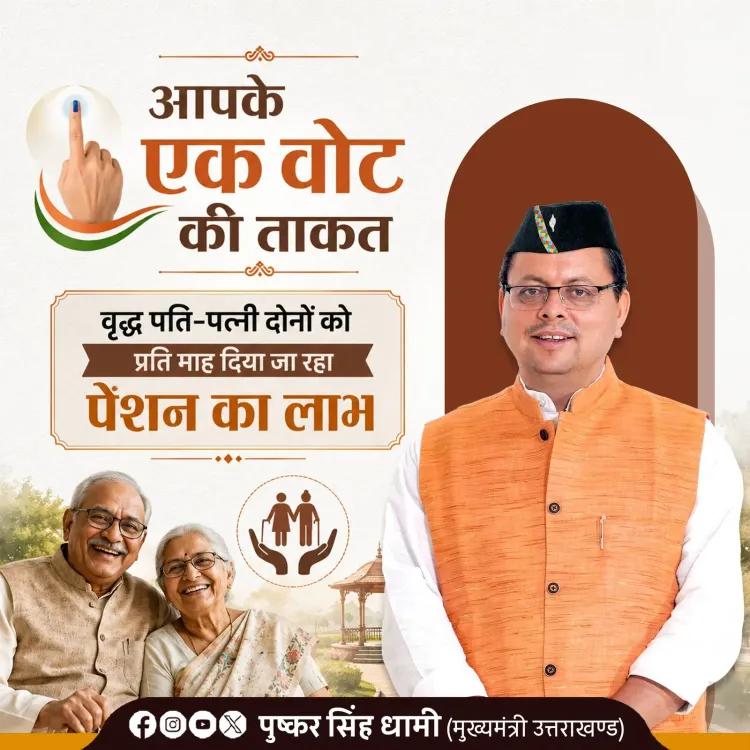
Uttarakhand Chief Minister Pushkar Singh Dhami on Thursday, June 25, 2026, credited the electoral mandate of the state's voters for enabling monthly pension benefits to elderly couples across Uttarakhand, saying the power of a single vote had brought dignity, security, and renewed confidence to the lives of senior citizens.
In a post on X, CM Dhami wrote in Hindi: 'आपके एक वोट की शक्ति ने हमारे वरिष्ठ नागरिकों के जीवन में सम्मान, सुरक्षा और आत्मविश्वास का नया संबल प्रदान किया है' ('The power of your one vote has provided a new foundation of respect, security, and confidence in the lives of our senior citizens'). He added that elderly couples in the state are today receiving the benefit of a monthly pension.
Context
Uttarakhand has a significant elderly population, and social security for senior citizens has long been a priority concern in the hill state, where outmigration of working-age adults leaves many older residents dependent on government support. The Chief Minister's message frames pension delivery as a direct outcome of the voters' trust placed in the ruling government.
This kind of post-election communication — linking welfare delivery explicitly to the electoral mandate — is a recurring feature of BJP-led state governments' outreach, particularly around social security schemes targeting vulnerable demographics.
Policy Backdrop
The foundational architecture for old-age pensions in India is the National Social Assistance Programme (NSAP), a central government scheme launched in 1995 that provides monthly pensions to elderly persons below the poverty line. State governments, including Uttarakhand, are permitted and encouraged to supplement NSAP payouts with their own contributions, effectively increasing the total benefit reaching beneficiaries.
Across BJP-ruled states, there has been a broader pattern of prioritising direct cash transfers to senior citizens alongside national programmes, with state budgets frequently topping up central allocations. The specific monthly pension amount and eligibility criteria for elderly couples referenced in CM Dhami's post have not been independently confirmed from established public records.
Stakeholders and Impact
The primary beneficiaries are elderly couples in Uttarakhand who qualify for the state's pension scheme. For many households in the state's remote hill districts — where younger family members have migrated to urban centres for employment — a monthly pension represents a critical and often sole source of regular income.
The broader political signal is aimed at the general voter base, reinforcing the government's message that electoral participation translates into tangible welfare outcomes. Senior citizens as a demographic also represent a significant and consistent voting bloc in state elections.
What's Next
Attention will now turn to Uttarakhand's state budget deliberations and any forthcoming assembly discussions on expanding pension coverage, revising monthly amounts, or broadening eligibility criteria for elderly couples. Advocacy groups focused on senior citizen welfare are likely to use this public commitment as a benchmark for holding the administration accountable on delivery timelines and coverage numbers.
The government's ability to sustain and scale pension outlays will ultimately depend on fiscal headroom in successive state budgets — a key indicator for whether this electoral promise translates into a durable entitlement.
Point of View
CM Dhami is employing a well-established BJP communication strategy: converting welfare implementation into a gratitude loop between government and voter. This approach reinforces political loyalty while also setting a public benchmark the administration will be expected to meet. The post fits a broader pattern across BJP-ruled states of using direct benefit transfers to senior citizens as both a social security tool and an electoral consolidation mechanism. The critical question going forward is whether the state's fiscal capacity can sustain — and expand — these commitments beyond the political messaging cycle.
NationPress
24 Sept 2026
Frequently Asked Questions
What did Uttarakhand CM Pushkar Singh Dhami announce about pensions for the elderly?
CM Pushkar Singh Dhami announced on June 25, 2026, that elderly couples in Uttarakhand are receiving monthly pension benefits, crediting the voters' electoral mandate for making this welfare delivery possible.
What is the National Social Assistance Programme and how does it relate to Uttarakhand pensions?
The National Social Assistance Programme (NSAP) is a central government scheme launched in 1995 that provides monthly pensions to elderly persons below the poverty line. Uttarakhand, like other states, can supplement NSAP payouts with its own contributions to increase the total benefit.
How much monthly pension do elderly couples in Uttarakhand receive?
The exact monthly pension amount for elderly couples in Uttarakhand referenced in CM Dhami's announcement has not been confirmed from established public records at this time.
Why is old-age pension especially important in Uttarakhand?
Uttarakhand experiences significant outmigration of working-age adults to urban centres, leaving many elderly residents in hill districts with limited income support. A monthly pension often serves as their primary source of regular financial security.
What happens next with Uttarakhand's senior citizen pension scheme?
Observers will watch Uttarakhand's upcoming state budget allocations and assembly discussions for decisions on expanding pension coverage, revising monthly amounts, or broadening eligibility criteria for elderly couples.