CM Fadnavis Pays Tribute to Sudhir Phadke on Birth Anniversary
Synopsis
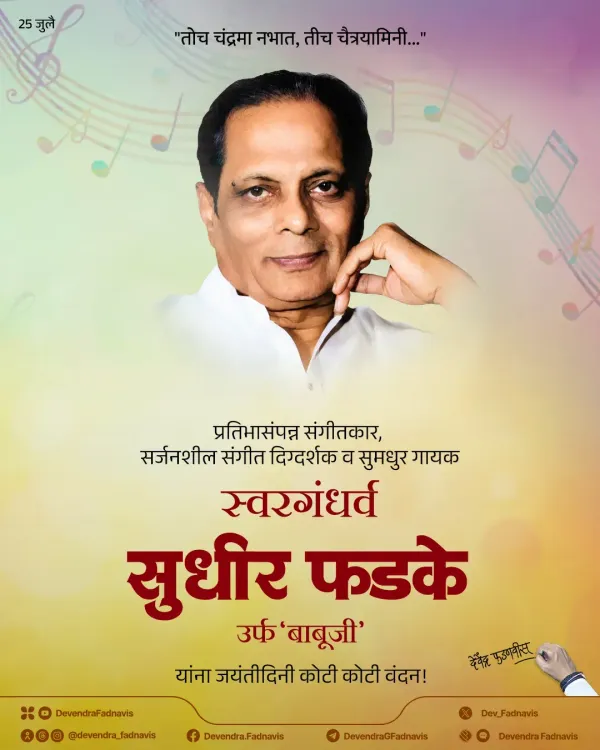
Maharashtra Chief Minister Devendra Fadnavis on 25 July 2026 paid tribute to celebrated Marathi musician Sudhir Phadke, known as Swaragandharva or 'Babuji', on his birth anniversary, calling him an immortal treasure of Marathi music and an enchanter of audiences across generations.
Key Takeaways
Devendra Fadnavis , Chief Minister of Maharashtra, posted a tribute to Sudhir Phadke on his birth anniversary on 25 July 2026 .
Phadke, known as Swaragandharva or 'Babuji', was a celebrated Marathi and Hindi composer, music director, and singer who lived from 1919 to 2002 .
Fadnavis described Phadke as a 'gifted composer, creative music director, and melodious singer' who preserved the 'immortal treasure of Marathi music.' The tribute was posted bilingually in English and Marathi, consistent with Fadnavis's practice of addressing both regional and national audiences.
Maharashtra governments across parties have historically used cultural anniversaries to affirm support for Marathi linguistic and artistic identity.
No confirmed government scheme directly tied to Phadke has been announced alongside this tribute.
Maharashtra Chief Minister Devendra Fadnavis on Saturday, 25 July 2026, paid tribute to legendary Marathi musician Sudhir Phadke, popularly known as Swaragandharva or 'Babuji', on his birth anniversary, hailing his enduring contribution to Maharashtra's musical heritage.
Context
Fadnavis took to X to offer what he called 'koti koti vandan' (countless salutations) to Phadke, describing him as a 'gifted composer, creative music director, and melodious singer' whose voice had 'enchanted music lovers' and preserved 'the immortal treasure of Marathi music.' The post was shared in both English and Marathi, reflecting the bilingual public identity Fadnavis maintains on social media.
The tribute described Phadke as someone who 'rasikancha mantramugdha karnare' — one who mesmerised audiences with his mellifluous singing — and credited him with safeguarding the timeless legacy of Marathi music.
Who Was Sudhir Phadke?
Sudhir Phadke (1919–2002), revered across Maharashtra as Swaragandharva (the celestial musician of melody), was one of the most celebrated voices in Marathi and Hindi music through the mid-to-late twentieth century. He composed and sang devotional, patriotic, and film songs that became pillars of Marathi cultural identity.
His work spanned decades and bridged folk traditions with formal classical sensibilities, earning him a devoted following among rasikas — connoisseurs of classical and semi-classical music — across the Marathi-speaking world and beyond. He was also known for his contributions to Hindi film music, making him a figure of national cultural significance.
Policy Backdrop
Maharashtra governments across party lines have long used birth and death anniversaries of cultural icons to signal official commitment to regional linguistic and artistic identity. The BJP-led administration under Fadnavis has continued this tradition, periodically issuing formal tributes to Marathi composers, poets, and performers on significant dates in the cultural calendar.
Such commemorations are often accompanied by announcements from the state's cultural department around music festivals, archival projects, or state awards — though no specific government scheme directly tied to Phadke has been confirmed in official records at the time of this tribute.
Stakeholders and Impact
The tribute resonates most immediately with Maharashtra's large community of Marathi musicians, cultural organisations, and rasikas who regard Phadke as a foundational figure. For the BJP government, such gestures reinforce its positioning as a custodian of Marathi cultural pride — a politically significant identity marker in the state.
Cultural bodies and music academies across Maharashtra are expected to hold commemorative programmes on Phadke's birth anniversary, with the Chief Minister's public tribute lending official weight to those observances.
What's Next
Observers of Maharashtra's cultural policy will watch whether the state cultural department follows the Chief Minister's tribute with concrete announcements — such as retrospective concerts, archival digitisation of Phadke's recordings, or posthumous state honours — as part of the ongoing centenary cycle of commemorations for the musician. Such steps would signal that the tribute extends beyond ceremonial acknowledgement into substantive cultural policy.
Point of View
A space it contests with regional parties. By invoking Phadke's status as an 'immortal treasure,' the Chief Minister signals continuity with a broader state tradition of honouring Marathi artistic heritage through official platforms. The bilingual framing of the post — Marathi for regional authenticity, English for wider reach — reflects a calibrated communication strategy. Whether ceremonial tributes translate into substantive cultural policy, such as archival or festival commitments, remains the more consequential test.
NationPress
25 Jul 2026
Frequently Asked Questions
Who is Sudhir Phadke and why is he famous?
Sudhir Phadke (1919–2002), known as Swaragandharva or 'Babuji', was a celebrated Marathi and Hindi composer, music director, and singer whose devotional, patriotic, and film songs became pillars of Maharashtra's musical heritage.
Why did CM Devendra Fadnavis pay tribute to Sudhir Phadke?
Fadnavis paid tribute to mark Sudhir Phadke's birth anniversary on 25 July 2026, honouring his extraordinary contribution as a composer, music director, and singer to Maharashtra's rich musical tradition.
What does 'Swaragandharva' mean?
'Swaragandharva' is an honorific title in Marathi meaning 'the celestial musician of melody' — it was used to describe Sudhir Phadke in recognition of his exceptional mastery of musical composition and singing.
When was Sudhir Phadke born?
Sudhir Phadke was born in 1919 and passed away in 2002, leaving behind a legacy spanning decades of Marathi and Hindi music.
Does the Maharashtra government hold events for Sudhir Phadke's anniversary?
Maharashtra cultural bodies and music organisations typically hold commemorative programmes on Phadke's birth anniversary; official state government schemes or events directly tied to Phadke have not been confirmed at the time of this tribute.