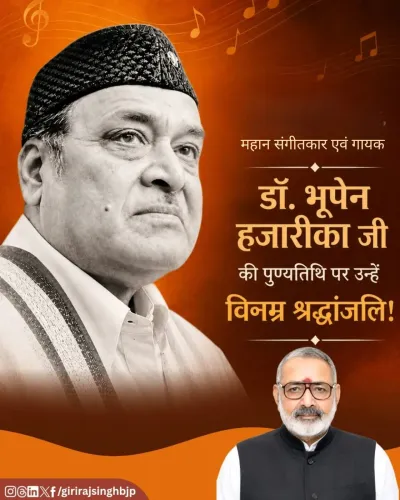
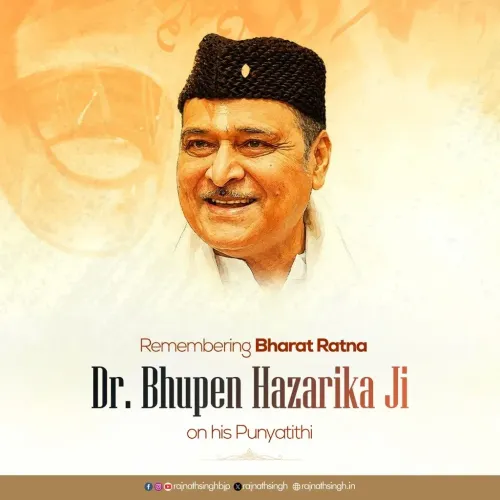
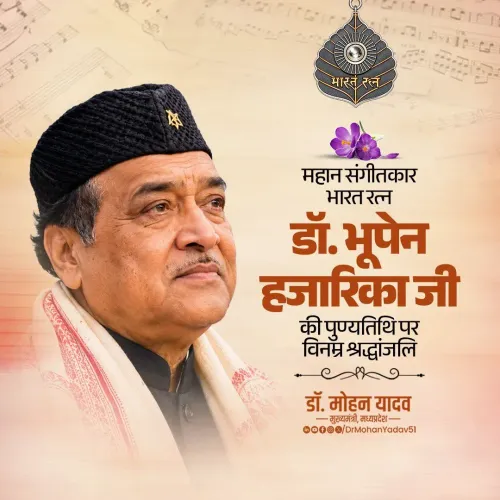
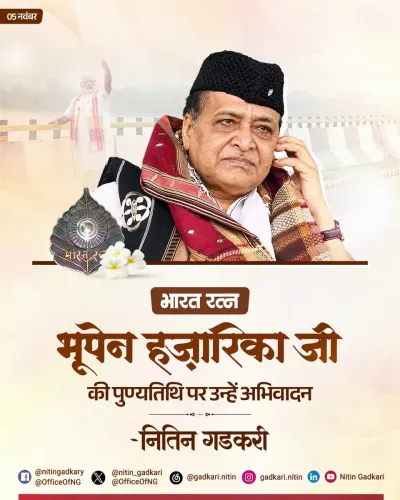
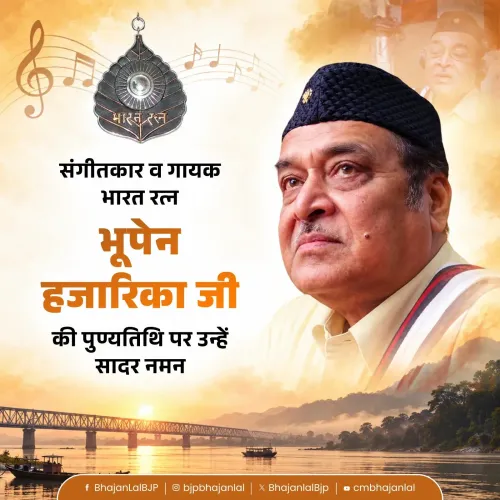
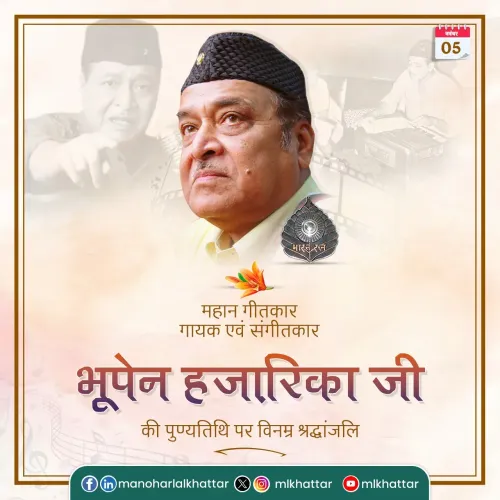
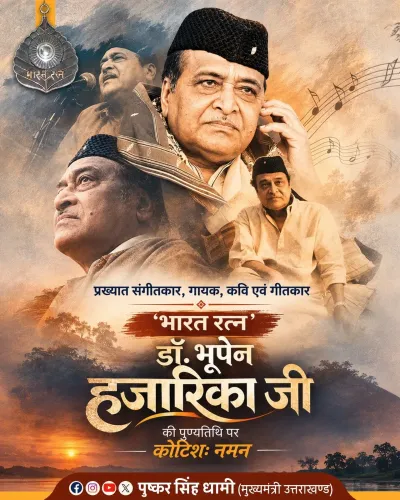
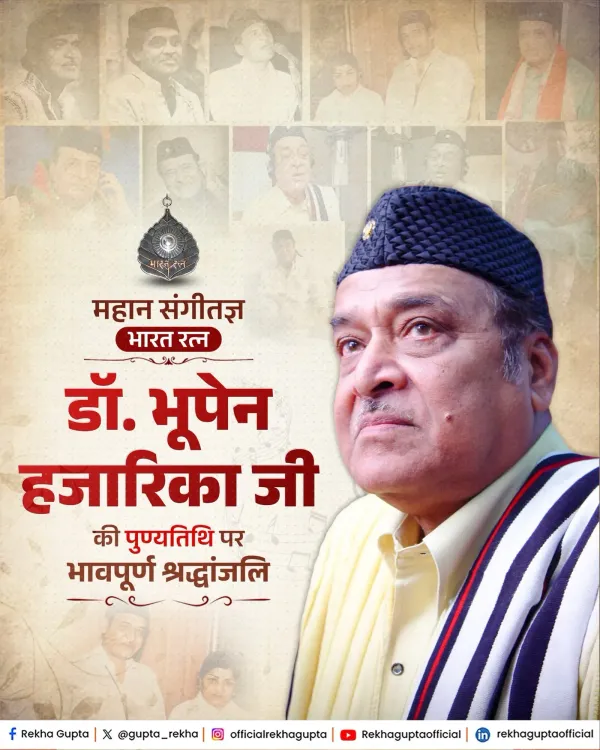
CM Rekha Gupta pays tribute to Bharat Ratna Bhupen Hazarika
Synopsis
On Bhupen Hazarika's death anniversary, Delhi Chief Minister Rekha Gupta paid tribute to the Bharat Ratna-awarded Assamese singer-composer, praising his music for uniting Northeast India's folk culture with the national cultural consciousness and voicing the struggles of the marginalised.
Key Takeaways
Delhi CM Rekha Gupta posted a tribute to Dr.
Bhupen Hazarika on his death anniversary, 5 November 2026 .
Hazarika was posthumously awarded the Bharat Ratna in 2019 , India's highest civilian honour, for his cultural contributions.
Gupta praised Hazarika for expressing the suffering of society's most marginalised and spreading messages of humanity, equality, and social harmony.
Hazarika is credited with linking the rich folk traditions of Northeast India — especially Assam — to the broader national cultural consciousness.
His music transcended language and geographical boundaries, making him a symbol of national unity.
A voice that carried the Brahmaputra's breadth and the ache of India's forgotten margins — Bharat Ratna Dr. Bhupen Hazarika is remembered on his death anniversary, 5 November 2026, with Delhi Chief Minister Rekha Gupta leading tributes from the capital.
In a heartfelt post in Hindi, CM Gupta described Hazarika — affectionately known as Bhupen Da — as a 'mahan sangeet sadhak aur janchetna ke swar' (a great musical ascetic and the voice of public consciousness). She wrote that his music held within it 'the vastness of the Brahmaputra, the fragrance of Assam's soil, and the pulse of India's soul', and that through his voice he gave expression to the suffering of the last person in society, carrying a message of humanity, equality, and social harmony to every corner of the nation.
Northeast's folk soul, carried to every Indian stage
What set Hazarika apart, Gupta emphasised, was his singular ability to weave the rich folk culture of Northeast India into the broader cultural consciousness of the entire country — transcending language barriers and geographical boundaries to become a powerful medium of national unity. That is no small claim, and history backs it up. Born in Assam in 1926, Hazarika spent decades drawing on the riverine traditions of the Brahmaputra valley to craft songs that spoke simultaneously to local pride and universal humanity.
His compositions were sung in Assamese, Bengali, and Hindi, reaching audiences who shared neither a language nor a geography with him — yet felt, unmistakably, that he was singing about them. That cultural bridging work was formally recognised when the government of India conferred the Bharat Ratna — the country's highest civilian honour — on him posthumously in 2019.
A pattern of official tribute to the Northeast's loudest voice
Annual commemorations of Hazarika on 5 November have become a fixture in India's political calendar, with leaders across the spectrum invoking his legacy to underscore themes of regional inclusion and social cohesion. For BJP leaders in Delhi, tributes to Hazarika carry an added resonance — they signal continued cultural outreach toward the Northeast, a region the party has worked to consolidate politically and symbolically over the past decade.
Gupta's tribute, warm and deeply textured in its language, fits that pattern while also standing as a genuine moment of cultural remembrance. The Northeast's communities, cultural organisations, and the millions who grew up hearing Hazarika's voice on All India Radio will recognise the sincerity in the specific imagery she chose — not a bureaucratic salutation, but a poet's salute.
Bhupen Hazarika sang so the last person in the room could be heard. The least India can do is keep saying his name.
Point of View
A region central to the party's political consolidation strategy. Hazarika's legacy, rooted in social equity and regional pride, is a rare symbol that cuts across political lines, making him a unifying reference point. Rekha Gupta's choice of evocative, literary language rather than a standard salutation signals an effort to deepen that symbolic connection. The broader arc here is about which artists a ruling party chooses to elevate as icons of national integration — and what that choice says about its vision of India.
NationPress
5 Nov 2026
Frequently Asked Questions
When did Bhupen Hazarika pass away?
Bhupen Hazarika passed away on 5 November 2011 , and his death anniversary is observed each year on that date with tributes from cultural and political figures across India.
Why was Bhupen Hazarika awarded the Bharat Ratna?
Bhupen Hazarika was awarded the Bharat Ratna posthumously in 2019 in recognition of his extraordinary contributions to Indian music and culture, particularly for linking Northeast India's folk traditions with the national cultural consciousness.
What is Bhupen Hazarika known for?
Bhupen Hazarika was a legendary Assamese singer, composer, and lyricist known for music rooted in the Brahmaputra valley's folk traditions. His songs addressed themes of social justice, equality, and humanity, and were performed in Assamese, Bengali, and Hindi.
How did Bhupen Hazarika contribute to national unity?
Hazarika's music transcended regional language and geographical barriers by bringing the rich folk culture of Northeast India — especially Assam — to national audiences, making him a powerful symbol of cultural integration and social harmony.