CM Himanta Backs ITLA as Key Step for Assam and Viksit Bharat

Synopsis
Assam Chief Minister Himanta Biswa Sarma has welcomed the government's approval of the Integrated Transport and Logistics Authority (ITLA), saying the body's mandate to coordinate large infrastructure projects and remove bottlenecks is especially significant for fast-growing northeastern states like Assam.
Key Takeaways
The Integrated Transport and Logistics Authority (ITLA) has received government approval as a new institutional body for long-term transport and logistics planning in India.
Assam CM Himanta Biswa Sarma publicly endorsed the move on October 6, 2026 , framing it as critical for northeast India's economic integration.
ITLA is intended to address inter-agency coordination failures and bottlenecks that slow large-scale infrastructure project execution.
Sarma linked the approval directly to the Modi government's Viksit Bharat vision, positioning Assam as a beneficiary of the national infrastructure push.
Better logistics connectivity in the northeast could improve investment, trade, and cross-border commerce with Bangladesh, Bhutan, and Myanmar.
As NEDA convenor , Sarma's backing may influence how other northeastern states align with ITLA's planning framework.
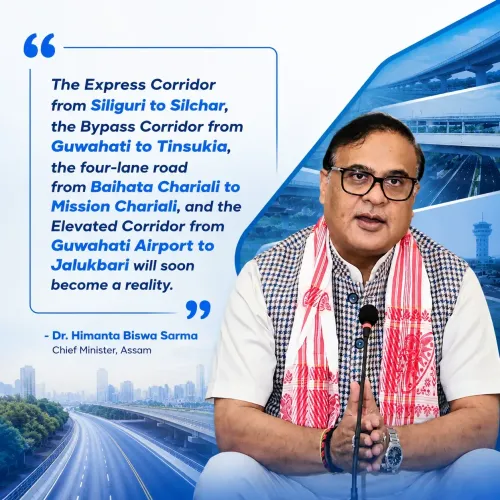
A new institutional framework for long-term transport planning just cleared a major hurdle — and Assam Chief Minister Himanta Biswa Sarma says it could not have come at a better time for a state racing to unlock its economic potential. Sarma welcomed the approval of the Integrated Transport and Logistics Authority (ITLA) on Tuesday, October 6, 2026, calling it an important step toward a stronger, better-connected India under Prime Minister Narendra Modi.
What ITLA is built to do
The Integrated Transport and Logistics Authority is designed to bring a long-term, coordinated lens to infrastructure planning — addressing a chronic pain point in large-scale project execution: poor inter-agency coordination and bottlenecks that slow delivery. By consolidating planning oversight across transport and logistics, the authority is intended to cut through fragmentation and accelerate implementation timelines.
Sarma framed ITLA's mandate precisely: 'By taking a long-term view of infrastructure planning and improving coordination around large projects, ITLA can help remove bottlenecks and accelerate execution.' The emphasis on coordination signals that this is less about funding and more about governance architecture — the connective tissue that holds big projects together.
Why Assam has a particular stake in faster connectivity
For Assam — a landlocked northeastern state that functions as the gateway to the rest of India's northeast — transport and logistics connectivity are not abstractions. They are the difference between regional isolation and economic integration. Sarma highlighted that better connectivity 'can open new opportunities for investment, trade and regional growth' for a fast-growing state like Assam.
The northeast has historically faced higher logistics costs and longer lead times than mainland India, factors that have deterred investment and complicated trade with neighbouring countries like Bangladesh, Bhutan, and Myanmar. An authority that irons out project bottlenecks at the planning stage — rather than firefighting mid-execution — could have an outsized effect on states where infrastructure gaps remain largest.
Sarma's signal on the Viksit Bharat arc
The Chief Minister explicitly linked the ITLA approval to the Modi government's flagship Viksit Bharat (Developed India) vision, framing the institutional reform as one building block in a larger national ambition. It is a deliberate positioning: by tying a technocratic governance reform to a national aspirational narrative, Sarma is signalling to investors and regional partners that Assam intends to move in step with — and benefit from — the broader national infrastructure push.
For a leader who also convenes the North-East Democratic Alliance (NEDA), this kind of endorsement carries weight beyond Assam's borders, potentially nudging other northeastern states to align their planning expectations with ITLA's emerging framework.
The real test for ITLA will come not at approval but at implementation — when coordination mandates meet the ground reality of overlapping jurisdictions, state-centre funding flows, and the sheer complexity of building in difficult terrain. That is the clock that has now started.
Point of View
Endorsing it serves a dual purpose: demonstrating Assam's alignment with New Delhi's development agenda while making a credible case to investors that the northeast's logistics disadvantage is being systematically addressed. As NEDA convenor, his framing also subtly invites other northeastern states into the ITLA orbit, potentially amplifying the authority's regional footprint. The harder question — whether a new coordinating body can overcome the entrenched centre-state funding and jurisdiction tangles that have historically delayed projects — remains open.
NationPress
6 Oct 2026
Frequently Asked Questions
What is the Integrated Transport and Logistics Authority (ITLA)?
ITLA is a newly approved Indian government body designed to bring long-term, coordinated planning to transport and logistics infrastructure, aiming to remove bottlenecks and improve execution of large projects across the country.
Why did Assam CM Himanta Biswa Sarma welcome the ITLA approval?
Sarma welcomed the approval because better transport and logistics connectivity is critical for Assam and the northeast, which face higher logistics costs and infrastructure gaps that limit investment and trade.
How does ITLA relate to the Viksit Bharat vision?
Sarma explicitly linked ITLA to PM Modi's Viksit Bharat (Developed India) programme, framing institutional infrastructure reform as a building block in achieving a more connected and efficient India.
What impact could ITLA have on northeast India?
By improving coordination and cutting bottlenecks in infrastructure projects, ITLA could lower logistics costs in the northeast, attract investment, and facilitate trade with neighbouring countries like Bangladesh, Bhutan, and Myanmar.
What is NEDA and how does it connect to this announcement?
NEDA, the North-East Democratic Alliance, is a regional political alliance convened by Himanta Biswa Sarma. His endorsement of ITLA as NEDA convenor gives the approval significance beyond Assam, potentially shaping how other northeastern states engage with the new authority.