CM Himanta Flags Assam's Rise as Regional Logistics Hub
Synopsis
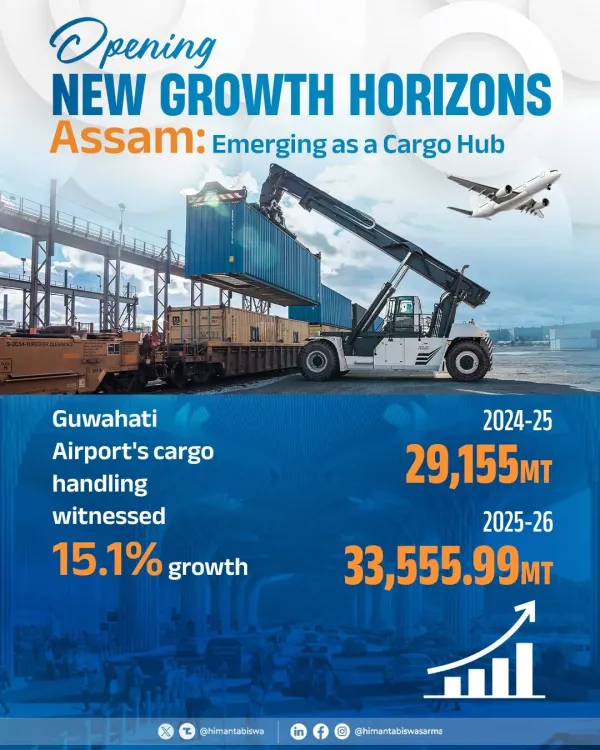
Assam Chief Minister Himanta Biswa Sarma has cited a 15.1 per cent year-on-year surge in cargo at Guwahati Airport — totalling 33,555.99 MT — as proof that the state is emerging as a regional logistics hub, pledging to accelerate industrialisation and freight sector growth.
Key Takeaways
Guwahati Airport recorded a 15.1% year-on-year increase in cargo handled, reaching 33,555.99 metric tonnes .
CM Himanta Biswa Sarma described Assam as 'rapidly emerging as a logistics hub in the region.' The state's logistics push is backed by central frameworks including UDAN and PM Gati Shakti .
Assam's geographic position makes it a natural corridor under India's Act East Policy linking the mainland to Southeast Asia .
Stakeholders including logistics firms, industrial investors, and local traders stand to benefit from improved air-cargo infrastructure.
State-level announcements on logistics parks or industrial corridors are expected as the government moves to formalise its strategy.
Assam Chief Minister Himanta Biswa Sarma on Friday, June 12, 2026, highlighted the state's growing stature as a logistics hub in the region, citing a 15.1 per cent year-on-year jump in cargo handled at Guwahati Airport — reaching 33,555.99 metric tonnes in the last financial year. The Chief Minister said the state intends to build on this momentum to boost the cargo logistics sector as part of its broader industrialisation drive.
Context
Lokpriya Gopinath Bordoloi International Airport in Guwahati serves as the primary aviation gateway for Northeast India, handling both passenger and freight traffic. The cargo growth figure cited by CM Sarma reflects a sustained uptick in air freight activity at the airport, which has been expanding its infrastructure capacity over recent years. The Chief Minister framed the data as evidence that Assam is transitioning from a peripheral economy to an active node in regional supply chains.
Policy Backdrop
Assam's logistics ambitions are anchored in two overlapping national policy frameworks. The UDAN regional connectivity scheme, launched in 2016, expanded air services and cargo operations at airports across the Northeast, giving airports like Guwahati a fillip in freight volumes. Simultaneously, the PM Gati Shakti framework has channelled central investment into multimodal infrastructure — highways, inland waterways, and airports — across the region, creating the physical backbone that logistics growth requires.
The push also aligns closely with India's Act East Policy, which seeks to deepen physical and trade connectivity between the Northeast and Southeast Asia. Assam, sitting at the geographic crossroads of this corridor, is positioning itself as a natural transshipment and warehousing point for goods moving between the Indian mainland and markets to the east. CM Sarma, who also serves as convenor of the North-East Democratic Alliance (NEDA), has consistently projected the Northeast as an economic frontier rather than a remote periphery.
Stakeholders and Impact
The beneficiaries of a stronger cargo logistics ecosystem in Assam span several sectors. Logistics companies and freight forwarders stand to gain from higher throughput and potential new infrastructure such as dedicated logistics parks or air-cargo terminals. Industrial investors eyeing the Northeast as a manufacturing base will weigh cargo connectivity as a critical factor, and local traders — particularly those dealing in perishables, textiles, and electronics — would benefit from faster, more reliable air freight links.
For Northeast India more broadly, a well-functioning logistics hub in Guwahati could reduce the cost and transit time of goods reaching the region's seven states, addressing a long-standing structural disadvantage that has historically dampened private investment.
What's Next
The state government's stated intent to 'build upon this momentum' signals that policy announcements — potentially covering logistics parks, industrial corridors, or incentives for freight operators — could follow in the near term. Observers will watch subsequent annual cargo statistics from Guwahati Airport and any formal state-level logistics policy that translates the Chief Minister's remarks into concrete targets. How quickly private capital responds to the state's positioning will be a key indicator of whether the 15.1 per cent growth rate can be sustained or accelerated.
Point of View
Allowing the state government to present local growth as part of a larger national vision. For Sarma, who has staked much of his political identity on economic transformation in the Northeast, logistics is an area where tangible metrics — tonnage, growth rates — can be cited to demonstrate delivery. The next test will be whether the rhetoric translates into announced infrastructure projects or investor commitments in the months ahead.
NationPress
29 Jul 2026
Frequently Asked Questions
Why is Assam being called a logistics hub?
Assam is being positioned as a logistics hub because of its strategic location at the gateway to Northeast India and Southeast Asia, combined with rising cargo volumes at Guwahati Airport and central government investment in multimodal infrastructure under frameworks like PM Gati Shakti and the Act East Policy.
How much cargo did Guwahati Airport handle last year?
According to CM Himanta Biswa Sarma's post, Guwahati Airport handled 33,555.99 metric tonnes of cargo, representing a 15.1 per cent year-on-year increase.
What is the UDAN scheme and how does it help Assam?
UDAN (Ude Desh ka Aam Naagrik) is a regional connectivity scheme launched in 2016 that expanded air services and cargo operations at airports across India, including in the Northeast. It helped boost freight activity at airports like Guwahati by improving route connectivity and airport infrastructure.
What is India's Act East Policy and its link to Assam?
India's Act East Policy aims to strengthen physical and trade connectivity between Northeast India and Southeast Asia. Assam, sitting at the geographic crossroads of this corridor, is central to the policy's goals, making its logistics infrastructure development a strategic national priority.
What could Assam announce next for its logistics sector?
Observers expect the Assam government to announce dedicated logistics parks, industrial corridors, or investor incentives in the near term, following CM Sarma's stated intent to build on the current cargo growth momentum.