CM Himanta Wishes Assam on Bhai Dooj and Bhai Phota
Synopsis
Assam Chief Minister Himanta Biswa Sarma marked Bhai Dooj and Bhai Phota on 11 November 2026, extending greetings for the sibling-bond festival and reflecting Assam's multi-ethnic Hindu traditions in a single message.
Key Takeaways
Assam CM Himanta Biswa Sarma posted Bhai Dooj and Bhai Phota greetings on 11 November 2026 .
Bhai Dooj falls on the second lunar day after Diwali; it is called Bhai Phota in Bengal and parts of Assam.
Sarma described the occasion as 'a timeless tradition' honouring 'affection, trust and lifelong companionship.' The dual naming acknowledged Assam's Bengali-origin population alongside the broader Assamese community.
Sarma also serves as convenor of the North-East Democratic Alliance (NEDA) , making inclusive cultural messaging a consistent feature of his public outreach.
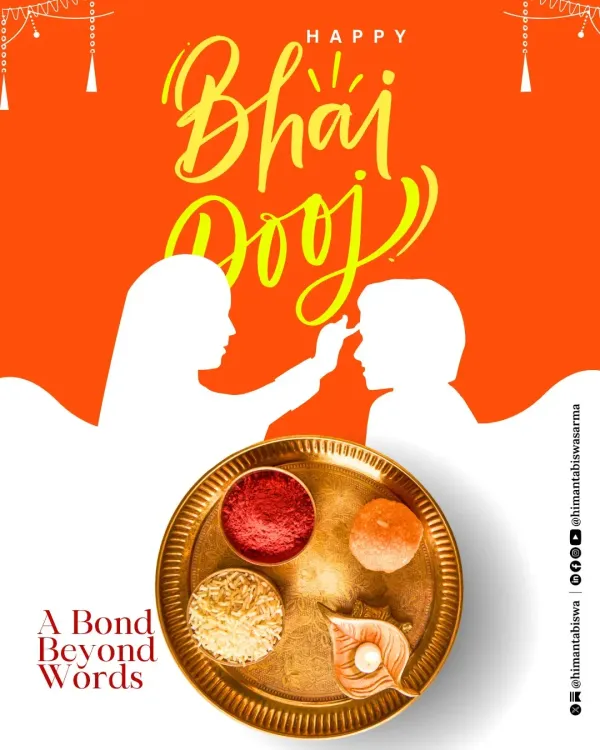
The bond between siblings took centre stage on Wednesday, 11 November 2026, as Assam Chief Minister Himanta Biswa Sarma extended heartfelt greetings to mark Bhai Dooj — celebrated across much of India — and its Bengali counterpart, Bhai Phota, observed widely in Assam and West Bengal.
In his post, the Chief Minister described the occasion as 'a timeless tradition that honours the affection, trust and lifelong companionship shared by brothers and sisters,' invoking blessings of peace, prosperity and good health for all. The dual naming — Bhai Dooj alongside Bhai Phota — was a deliberate nod to Assam's layered cultural identity, where Assamese, Bengali and other communities celebrate the festival under different names but with a shared spirit.
Bhai Dooj and Bhai Phota: the same devotion, two names
Bhai Dooj falls on the second lunar day after Diwali, making it the final note in the five-day festival arc. Sisters apply a tilak on their brothers' foreheads, offer sweets and pray for their long life; brothers in turn pledge their protection. In Bengal and parts of Assam, the ritual is called Bhai Phota — 'phota' meaning the sacred mark — and carries the same emotional weight with a few local variations in custom and prayer.
Why Sarma's greeting carries a regional signal
As convenor of the North-East Democratic Alliance (NEDA) — the BJP-led coalition of North-Eastern parties — Sarma's public messaging consistently mirrors the multi-ethnic texture of the region. Acknowledging both Bhai Dooj and Bhai Phota in a single breath reflects the demographic reality of Assam, where a significant Bengali-origin population observes Bhai Phota alongside the broader Hindu calendar. For elected leaders across India, festival greetings on social media are a routine but meaningful form of cultural outreach, affirming community ties without a direct policy ask. Sarma has made this a consistent practice across the festival calendar.
Point of View
Festival greetings are rarely just courtesy — they are quiet coalition maintenance. Sarma's deliberate pairing of 'Bhai Dooj' and 'Bhai Phota' signals awareness of Assam's Bengali-Hindu voter base, a constituency that matters electorally and culturally. The pattern — consistent acknowledgment of overlapping regional customs — is a soft-power habit that reinforces inclusive identity without policy commitments. It is routine, but in a diverse state, routine inclusivity is itself a political act.
NationPress
11 Nov 2026
Frequently Asked Questions
What is Bhai Dooj and when is it celebrated?
Bhai Dooj is a Hindu festival celebrating the bond between brothers and sisters, observed on the second lunar day after Diwali. Sisters apply a tilak on their brothers' foreheads and pray for their well-being.
What is the difference between Bhai Dooj and Bhai Phota?
They are the same festival — Bhai Phota is the Bengali name for Bhai Dooj. 'Phota' refers to the sacred mark placed on the brother's forehead; the ritual is similar but has some local variations in Bengal and parts of Assam.
Why did Himanta Biswa Sarma mention both Bhai Dooj and Bhai Phota?
Assam has a significant Bengali-origin population that observes Bhai Phota, alongside communities that celebrate it as Bhai Dooj. Using both names reflects the state's multi-ethnic character.
Is Himanta Biswa Sarma the Chief Minister of Assam?
Yes. Himanta Biswa Sarma has served as Chief Minister of Assam since 2021 . He is a senior BJP leader and also the convenor of the North-East Democratic Alliance (NEDA).
What is NEDA and what is Sarma's role in it?
NEDA — the North-East Democratic Alliance — is a BJP-led coalition of parties from India's North-Eastern states. Himanta Biswa Sarma serves as its convenor, making him a key figure in the BJP's regional political strategy.