CM Himanta Launches Drive to Fill 2 Lakh Assam Govt Jobs
Synopsis
Assam Chief Minister Himanta Biswa Sarma has announced that his administration is actively mapping vacancies, departments, and timelines to deliver on the electoral commitment of 2 lakh government jobs, signalling the formal start of the post-election implementation phase.
Key Takeaways
CM Himanta Biswa Sarma announced on 28 May 2026 that his team has begun work on delivering 2 lakh government jobs in Assam .
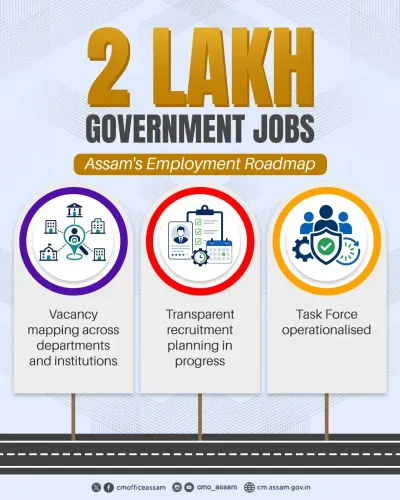
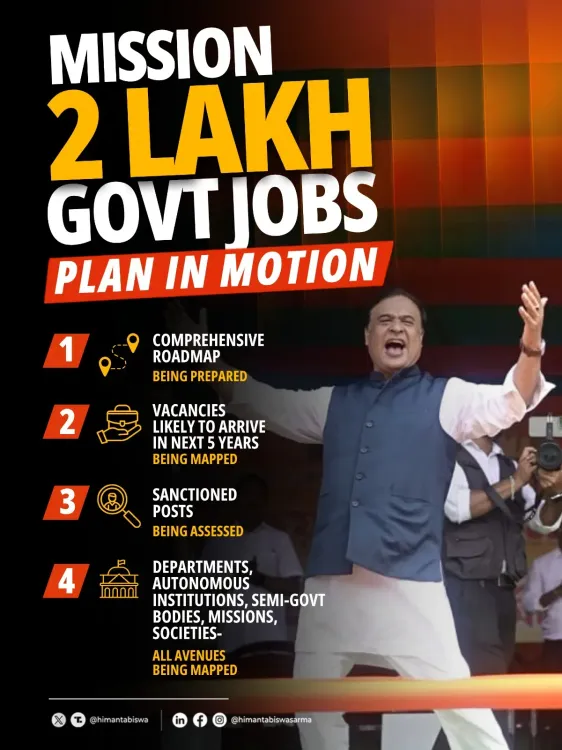
The exercise involves identifying vacancies, mapping departments and bodies, and chalking out a time frame for recruitment.
The commitment of 2 lakh govt posts was a central electoral pledge of the BJP-led alliance in Assam .
The Assam Public Service Commission and other state recruiting bodies are expected to issue formal notifications once the roadmap is finalised.
The approach mirrors post-election public-sector recruitment drives undertaken in other NDA -ruled states such as Uttar Pradesh and Madhya Pradesh .
Unemployed youth and government job aspirants across Assam are the primary stakeholders of the exercise.
Assam Chief Minister Himanta Biswa Sarma on Thursday, 28 May 2026 announced that his administration has begun the groundwork to deliver on an electoral commitment of 2 lakh government jobs, saying his team is already mapping vacancies, departments, and timelines to fulfil the pledge.
Context
In a post on X, CM Sarma wrote: 'There's no time to rest in our quest to deliver on our promises. My team is already at work to identify vacancies, create the roadmap, map out departments and bodies and chalk out the time frame to deliver on the commitment of 2 lakh Govt jobs.' The statement signals that the post-election implementation phase has formally begun, with internal administrative machinery now engaged in the exercise.
The commitment of 2 lakh government posts has been a central plank of the BJP-led alliance's electoral messaging in Assam. The Chief Minister's public declaration of an active roadmap-building process is intended to signal urgency and accountability to job-seeking youth across the state.
Policy Backdrop
The BJP alliance's 2021 Assam assembly election manifesto included a commitment to filling government vacancies and generating large-scale public employment to address persistent youth unemployment in the state. This latest announcement suggests the current government is treating the pledge as a time-bound deliverable rather than a long-term aspiration.
Across India, NDA-ruled states have followed a broadly similar sequence after electoral victories: a post-poll audit of existing vacancies, the publication of a department-wise recruitment roadmap, and the issuance of notifications through state public service commissions and other recruiting bodies. Uttar Pradesh and Madhya Pradesh have both undertaken comparable exercises, with mixed records on delivery timelines.
The Assam Public Service Commission and other state recruiting bodies are expected to be the primary institutional channels through which any vacancy notifications will eventually be issued, once the internal mapping exercise is complete.
Stakeholders and Impact
The most directly affected group is Assam's large pool of unemployed and underemployed youth, many of whom have been waiting for government recruitment cycles to resume or expand. Government employment remains a highly sought-after destination in the state due to its relative job security and structured pay scales.
Departments and statutory bodies across the state government will be required to submit vacancy data as part of the mapping exercise described by CM Sarma. The exercise is also likely to involve coordination with the finance department to assess the fiscal headroom available for absorbing new recruits across pay grades.
What's Next
The immediate next step, as outlined by CM Sarma, is the completion of the internal mapping exercise — identifying vacancies department by department and establishing a time-bound calendar for filling them. Once that roadmap is finalised, formal recruitment notifications are expected to follow through the appropriate state-level bodies.
The credibility of the commitment will ultimately be judged by the pace at which recruitment advertisements are published and selections are completed. Observers will watch closely for the release of a department-wise vacancy list and any formal announcement of recruitment calendars, which would convert the administrative intent expressed on 28 May 2026 into a verifiable public record.
Point of View
CM Sarma is converting an electoral pledge into an administrative accountability marker — a move that creates a visible benchmark against which his government will be measured. The announcement fits a well-established pattern in NDA-ruled states of using post-election recruitment drives to consolidate support among aspirational youth. The absence of a specific timeline or department-wise breakdown, however, means the announcement is still in the intent phase, and the real test will come when formal notifications are issued. For NEDA's broader political project in the North-East, a credible jobs delivery record in Assam would serve as a template — and a campaign argument — for alliance partners in neighbouring states.
NationPress
24 Sept 2026
Frequently Asked Questions
What is Assam CM Himanta Biswa Sarma's 2 lakh jobs promise?
It refers to the BJP-led alliance's electoral commitment to fill 2 lakh government vacancies in Assam. CM Sarma announced on 28 May 2026 that his team has begun mapping vacancies and preparing a time-bound roadmap to deliver on this pledge.
How will Assam fill 2 lakh government jobs?
The Assam government plans to identify existing vacancies across departments and statutory bodies, create a department-wise roadmap, and issue recruitment notifications through the Assam Public Service Commission and other state recruiting bodies.
When will Assam government job recruitment start in 2026?
CM Sarma has indicated the roadmap and time frame are being prepared, but no specific recruitment start date has been announced yet. Formal notifications are expected once the internal vacancy mapping exercise is complete.
Which departments in Assam are included in the 2 lakh jobs drive?
CM Sarma has said his team is mapping out all relevant departments and bodies, but a finalised department-wise list has not yet been made public as of 28 May 2026.
Has Assam delivered on government job promises before?
The BJP alliance's 2021 Assam manifesto included large-scale employment commitments. The current exercise is the stated implementation of that pledge, following a pattern seen in other NDA-ruled states, though delivery timelines have varied across states.