CM Himanta to Bring Assamese Cuisine to All State Capitals
Synopsis
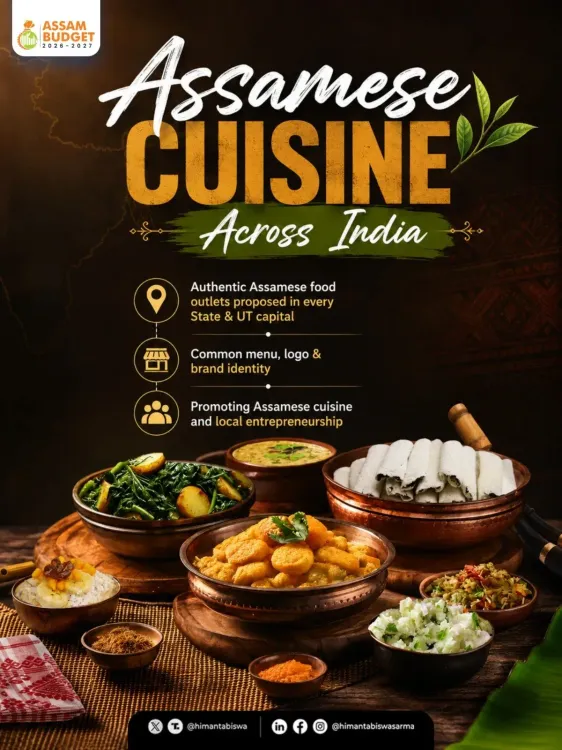
Assam CM Himanta Biswa Sarma announced under Assam Budget 2026 that authentic Assamese cuisine will be rolled out across all state and UT capitals through a common brand identity, responding to public demand and building on the state's long-standing cuisine-promotion policy.
Key Takeaways
Assam CM Himanta Biswa Sarma announced on 10 July 2026 that Assamese cuisine will be available in all state and UT capitals.
The initiative will operate under a common brand identity , ensuring a standardised, authentic experience nationwide.
The announcement is part of Assam Budget 2026 , indicating formal budgetary backing.
The move aligns with Assam's tourism policy goals dating to 2017 and central schemes like Swadesh Darshan and Ek Bharat Shreshtha Bharat .
Food entrepreneurs and small producers across Assam are the primary economic beneficiaries.
The exact brand name, outlet selection process and roll-out timeline are yet to be formally announced.
Assam Chief Minister Himanta Biswa Sarma announced on Friday, 10 July 2026 that authentic Assamese cuisine will soon be made available across all state and Union Territory capitals under a unified common brand identity, responding directly to public demand. The announcement was made as part of the Assam Budget 2026.
Context
Posting on X, CM Sarma wrote: 'We heard you! Authentic Assamese cuisine will soon be available in all State and UT capitals under a common brand identity.' The phrase 'We heard you' signals that the initiative is a direct response to sustained public sentiment — likely expressed through social media, public consultations or stakeholder feedback — calling for greater visibility of Assam's culinary heritage beyond the Northeast.
The announcement was tagged #AssamBudget2026, placing it firmly within the state's annual budgetary framework rather than as a standalone executive order, suggesting formal legislative and financial backing is either in place or imminent.
Policy Backdrop
Assam's tourism policy documents dating back to 2017 have consistently identified cuisine promotion as a strategic lever for cultural tourism and intra-India visibility. The state's food culture — rooted in its biodiversity, indigenous communities and riverine ecology — has long been considered an underleveraged soft-power asset.
The move fits into a broader national pattern: several Indian states, including Kerala, West Bengal and Punjab, have used budget cycles to create unified branding for regional cuisines and establish dedicated outlets in other state capitals. Northeast states in particular have increasingly used food, handlooms and festivals to deepen cultural and economic ties with the rest of India, supported by central schemes such as Swadesh Darshan and Ek Bharat Shreshtha Bharat.
Stakeholders and Impact
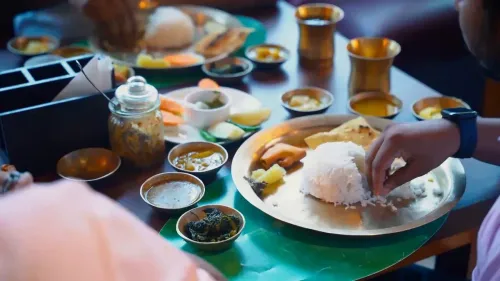
The initiative is expected to benefit Assam's food entrepreneurs, small producers and artisanal food businesses who stand to gain access to markets in all 28 state capitals and 8 Union Territory capitals — a combined footprint spanning the entire country. For consumers and tourists, the common brand identity promises a standardised, authentic experience of dishes such as masor tenga (sour fish curry), pitha (rice cakes) and duck meat curry, which are little-known outside the region.
Cultural diplomacy is also a dimension: the Northeast has historically faced a perception gap with mainland India, and cuisine-led outreach has proven to be one of the more effective bridges for building familiarity and affinity.
What's Next
Key details still to emerge include the exact name of the common brand identity, the selection process for outlet locations in each capital, and any private-sector or central-government tie-ups that may be announced during the formal presentation of the Assam Budget 2026. The roll-out timeline and the mechanism for quality control and brand consistency across geographically dispersed outlets will be closely watched by food entrepreneurs and cultural organisations alike.
If executed at scale, the initiative could set a replicable template for other Northeast states seeking to use culinary branding as an instrument of both economic development and national integration.
Point of View
CM Sarma signals institutional seriousness and ensures a funding line — a common failure point for similar state-level branding exercises. The 'We heard you' framing is also politically astute: it positions a supply-side economic intervention as a citizen-responsive act, broadening its appeal beyond the food sector. If the brand rolls out effectively, it could become a model that other Northeast states replicate, amplifying the region's collective soft-power footprint.
NationPress
9 Oct 2026
Frequently Asked Questions
What did Assam CM Himanta Biswa Sarma announce about Assamese cuisine?
CM Himanta Biswa Sarma announced that authentic Assamese cuisine will soon be available in all state and Union Territory capitals across India under a common brand identity, as part of Assam Budget 2026.
What is the Assam Budget 2026 cuisine initiative?
The Assam Budget 2026 includes a plan to establish a unified brand for Assamese food and make it accessible in every state and UT capital in India, aimed at promoting Assam's culinary heritage nationally.
Which states have done similar regional cuisine branding before Assam?
States such as Kerala, West Bengal and Punjab have previously used budget announcements to create unified branding for their regional cuisines and set up dedicated outlets in other state capitals.
How will Assam's common food brand benefit local entrepreneurs?
Food entrepreneurs, small producers and artisanal food businesses in Assam will gain access to markets in all 28 state capitals and 8 Union Territory capitals, significantly expanding their commercial reach.
What central government schemes support this kind of initiative?
Central schemes like Swadesh Darshan and Ek Bharat Shreshtha Bharat support Northeast states in leveraging cultural assets such as food and handlooms to strengthen ties with the rest of India.