CM Odisha: Urban growth entering new planned era
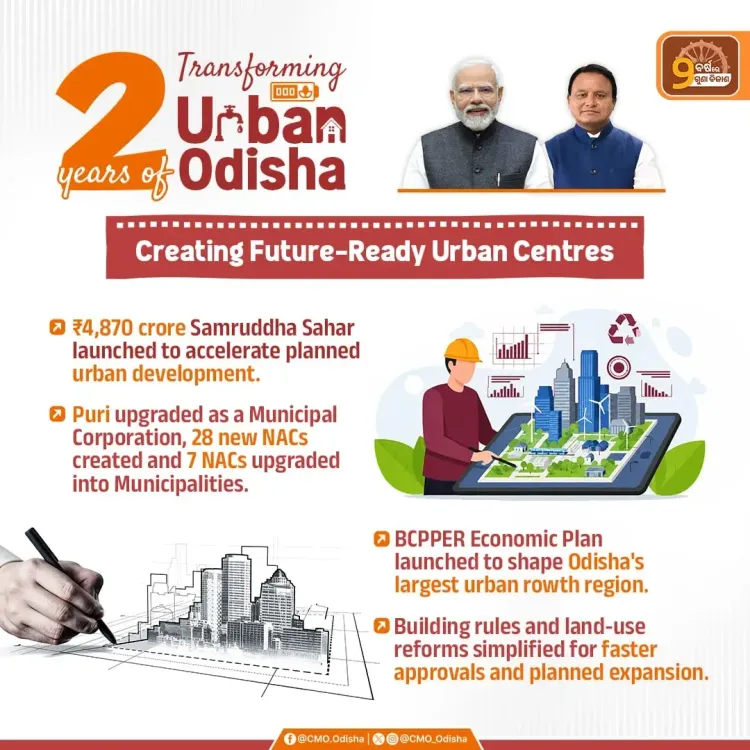
Synopsis
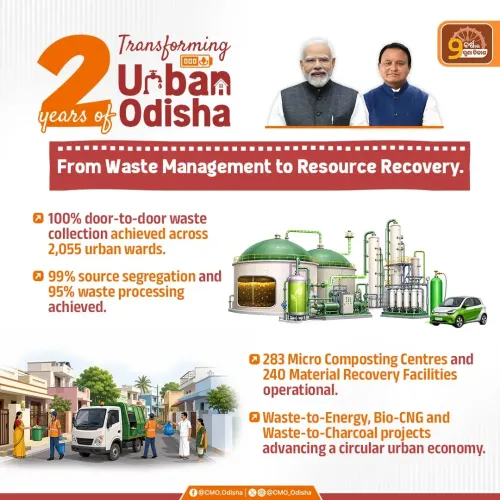
The Chief Minister's Office of Odisha declared on 21 July 2026 that urban Odisha is entering a new era of planned, sustainable growth. Citing landmark investments, urban reforms, and stronger local governance, the CMO signalled alignment with national development missions to build liveable, investment-ready cities.
Key Takeaways
The Chief Minister's Office of Odisha on 21 July 2026 announced urban Odisha is entering a new era of planned and sustainable growth.
Bhubaneswar was among the first cities selected under the Smart Cities Mission launched in June 2015 .
The AMRUT scheme, approved in 2015 , extended urban infrastructure to 500 cities across India, including multiple Odisha towns.
The CMO's post was addressed to PMO India , signalling deliberate alignment between state and Central urban policy.
Key goals cited include making cities more liveable , investment-friendly , and capable of meeting the aspirations of a rapidly growing population.
Stronger urban local body governance is identified as a core pillar alongside infrastructure investment.
The Chief Minister's Office of Odisha on Tuesday, 21 July 2026, declared that urban Odisha is entering a new era of planned and sustainable growth, highlighting landmark investments, progressive urban reforms, and stronger local governance as the pillars of this transformation. The post, addressed to PMO India, signals a deliberate alignment between state urban policy and the national government's development agenda.
The CMO stated that these efforts are creating 'future-ready cities that are more liveable, investment-friendly and equipped to meet the aspirations of a rapidly growing state,' underscoring the dual goals of quality of life and economic competitiveness.
Context
Odisha has been part of India's flagship urban development programmes since their inception. Bhubaneswar, the state capital, was among the first cities selected under the Smart Cities Mission when the Central government launched the programme in June 2015, making it an early laboratory for technology-enabled, integrated urban planning. The city's inclusion in that inaugural cohort gave Odisha a head start in building urban infrastructure frameworks that other tier-2 cities in the state could later replicate. The reference to PMO India in the post is a clear signal that the state views its urban agenda as continuous with — and supported by — national policy priorities, rather than as a standalone state initiative.Policy Backdrop
Odisha's urban push rests on a layered policy architecture. The Atal Mission for Rejuvenation and Urban Transformation (AMRUT), approved in 2015, extended water supply, sewerage, and drainage infrastructure to 500 cities across India, including multiple urban centres in Odisha. Alongside it, the Swachh Bharat Mission (Urban), rolled out from 2014, addressed solid waste management and sanitation in Odisha towns, forming the baseline of liveability improvements. State-level governance reforms — including strengthening urban local bodies and municipal corporations — have been layered on top of these centrally sponsored schemes. This mirrors a broader national pattern in which states use Central mission funding as a foundation and then build additional reform incentives to attract private investment into urban infrastructure.Stakeholders and Impact
Urban residents across Odisha stand to benefit most directly from improved liveability — better roads, water supply, drainage, and waste management. Municipal corporations gain institutional capacity through governance reforms that accompany mission funding, enabling them to plan and execute projects with greater accountability. Private investors are the third key stakeholder: the CMO's explicit reference to cities being 'investment-friendly' signals that the state is positioning its urban centres as destinations for real-estate, logistics, and services-sector capital. The framing of cities as meeting 'the aspirations of a rapidly growing state' also points to demographic pressure — Odisha's urban population is expanding, and the state is signalling that infrastructure planning is keeping pace with that growth rather than lagging behind it.What's Next
The immediate indicators to watch are state budget allocations for urban local bodies in the coming fiscal cycle and progress reports on ongoing Smart City and AMRUT projects in Bhubaneswar and other Odisha towns. The CMO's public communication to PMO India suggests the state may be positioning itself for enhanced Central funding tranches or policy recognition. If the governance reforms cited translate into measurable improvements in ease-of-doing-business rankings for Odisha's cities, the state could emerge as a benchmark for urban transformation among India's eastern states.Point of View
A move that often precedes requests for enhanced mission funding or policy recognition. The language of 'future-ready cities' and 'investment-friendly' governance tracks a well-established post-2014 template in which states compete for Central urban mission resources by showcasing reform credentials. For Odisha specifically, this signals that the ruling dispensation is keen to demonstrate urban governance dividends ahead of future electoral cycles. The broader implication is that eastern India's tier-2 cities are increasingly being drawn into the same urbanisation narrative that has dominated western and southern Indian growth stories for the past decade.
NationPress
21 Jul 2026
Frequently Asked Questions
What did the Odisha Chief Minister's Office say about urban development in July 2026?
The CMO Odisha stated on 21 July 2026 that urban Odisha is entering a new era of planned and sustainable growth, driven by landmark investments, progressive urban reforms, and stronger local governance aimed at creating liveable and investment-friendly cities.
What is the Smart Cities Mission and how does it relate to Odisha?
The Smart Cities Mission is a Central government programme launched in June 2015 to promote technology-enabled, sustainable urban planning across 100 Indian cities. Bhubaneswar, Odisha's capital, was among the first cities selected in the inaugural round.
What is AMRUT and which Odisha cities benefit from it?
AMRUT, or the Atal Mission for Rejuvenation and Urban Transformation, was approved in 2015 to improve water supply, sewerage, and drainage infrastructure in 500 cities across India, including multiple urban centres in Odisha.
Why did the Odisha CMO tag PMO India in the urban development post?
Tagging PMO India signals that Odisha is aligning its urban development agenda with national policy priorities under Central missions such as Smart Cities and AMRUT, and may indicate the state is seeking recognition or enhanced support from the Central government.
What are the key goals of Odisha's urban development push?
The stated goals include making Odisha's cities more liveable, investment-friendly, and equipped with stronger local governance to meet the aspirations of the state's rapidly growing urban population.