CM Bhupendra Patel pays tribute to Lala Lajpat Rai on death anniversary
Synopsis
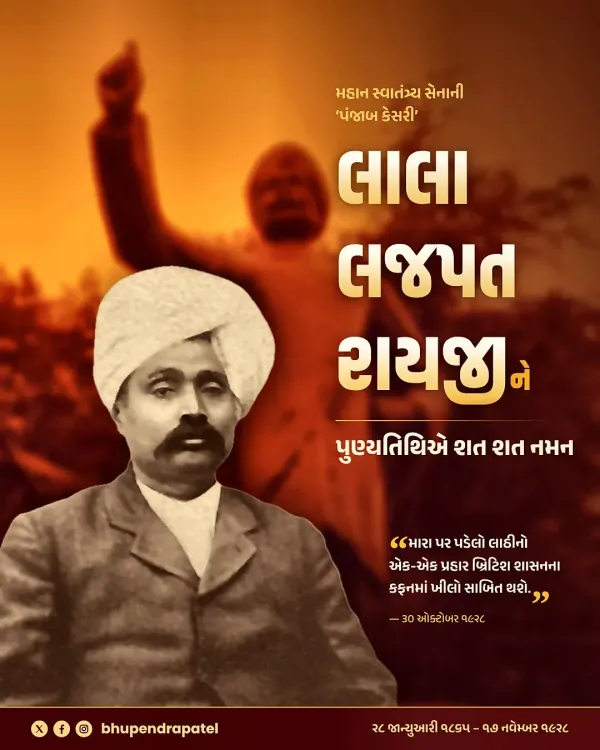
On 17 November 2026, Gujarat Chief Minister Bhupendra Patel honoured Lala Lajpat Rai — 'Punjab Kesari' — on his death anniversary, recalling the freedom fighter's defiance during the 1928 Simon Commission protests and his ultimate sacrifice for India's independence.
Key Takeaways
Gujarat CM Bhupendra Patel paid tribute to Lala Lajpat Rai on his death anniversary, 17 November 2026 .
Lala Lajpat Rai, known as 'Punjab Kesari' , was part of the celebrated 'Lal-Bal-Pal' triumvirate of the Indian independence movement.
He led protests against the Simon Commission in Lahore on 30 October 1928 and was struck by British police lathi blows during the march.
He died on 17 November 1928 , aged 63 , from injuries sustained in the police assault, eighteen days after the baton charge.
CM Patel's tribute links Lajpat Rai's sacrifice to the value of placing the nation first — a recurring theme in BJP leaders' anniversary posts.
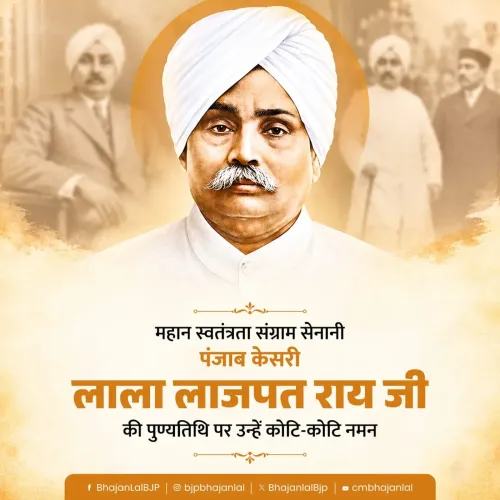
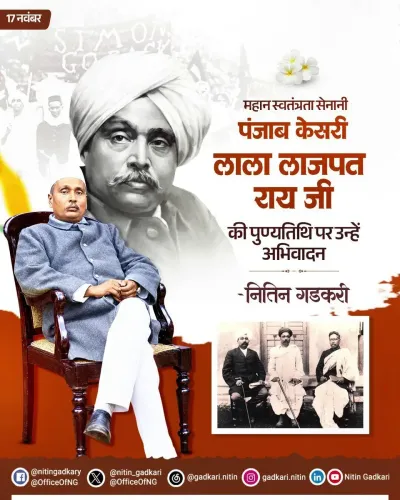
A freedom fighter who absorbed lathi blows without flinching — and whose wounds ultimately cost him his life — is remembered today, 17 November 2026, on his death anniversary. Gujarat Chief Minister Bhupendra Patel paid solemn tribute to Lala Lajpat Rai, the towering independence activist revered as 'Punjab Kesari' (the Lion of Punjab), honouring his sacrifice in the struggle against British rule.
Writing in Gujarati, CM Patel offered a hundredfold salute — 'shat shat naman' — to the great freedom fighter. He recalled how Lala Lajpat Rai absorbed brutal lathi strikes during the protest against the Simon Commission, yet never let the cry for independence waver. 'His supreme sacrifice for the motherland,' Patel wrote, 'will forever inspire the people of this country to put the nation first.'
The lathi blows that shook a nation
Lala Lajpat Rai was one of the most consequential figures of India's freedom movement — a firebrand orator, writer, and organiser who, alongside Bal Gangadhar Tilak and Bipin Chandra Pal, formed the legendary 'Lal-Bal-Pal' triumvirate that radicalised the independence cause in the early twentieth century. It was his final act of defiance that sealed his place in national memory.
In 1927, the British government appointed the Simon Commission — a seven-member parliamentary body tasked with reviewing constitutional reforms in India. It had one fatal flaw: not a single Indian member. The insult ignited nationwide protests. On 30 October 1928, Lajpat Rai led a silent, non-violent march against the Commission in Lahore. British police Superintendent James Scott ordered a baton charge; Lajpat Rai bore the blows directly. His reported words rang out: 'Every blow struck on me is a nail in the coffin of British imperialism.'
He died on 17 November 1928 — just eighteen days later — from injuries widely attributed to the assault. He was 63 years old. His death convulsed the independence movement and directly inspired younger revolutionaries, most notably Bhagat Singh, who vowed revenge. The episode became a turning point in how a generation of Indians understood the costs and urgency of freedom.
A tribute pattern rooted in BJP's political culture
CM Patel's post is part of a consistent practice among BJP leaders — including state chief ministers — of marking the birth and death anniversaries of independence-era figures on social media. These tributes routinely draw a line between pre-1947 sacrifice and contemporary themes of national pride and 'nation first' values, reinforcing the party's ideological positioning as custodian of that legacy.
Lala Lajpat Rai, as a symbol of unyielding resistance to colonial arrogance, fits naturally into that framework. His story — peaceful protest met with state violence, sacrifice rewarded with immortality in public memory — carries an enduring resonance that transcends any single political moment.
Ninety-eight years after the lathi charge on the streets of Lahore, the Lion of Punjab's roar still echoes through the republic he helped build.
Point of View
Connecting their sacrifice to a 'nation first' ethos that the party consistently foregrounds. By specifically invoking the Simon Commission episode — colonial arrogance, peaceful protest, state violence, and ultimate sacrifice — the message resonates beyond ritual remembrance. It is also worth noting that tributes to figures like Lajpat Rai, whose legacy is shared across political traditions, signal a broader competition over the symbolic ownership of India's freedom struggle, one that plays out reliably on death and birth anniversaries every year.
NationPress
17 Nov 2026
Frequently Asked Questions
Why is 17 November significant for Lala Lajpat Rai?
17 November 1928 is the date Lala Lajpat Rai died from injuries sustained when British police carried out a lathi charge on protesters demonstrating against the Simon Commission in Lahore. It is observed annually as his death anniversary.
Who was Lala Lajpat Rai and why is he called Punjab Kesari?
Lala Lajpat Rai was a prominent Indian independence activist, writer, and orator. He earned the title 'Punjab Kesari' — meaning 'Lion of Punjab' — for his fierce leadership and unyielding stand against British colonial rule, particularly in the Punjab region.
What was the Simon Commission and why was it protested?
The Simon Commission was a British parliamentary body appointed in 1927 to review constitutional reforms in India. It was widely boycotted and protested because it had no Indian members, which was seen as a profound insult to India's right to self-determination.
What happened at the Lahore protest against the Simon Commission in 1928?
On 30 October 1928 , Lala Lajpat Rai led a peaceful march against the Simon Commission in Lahore . British police ordered a lathi charge, and Lajpat Rai personally received severe blows. He died 17 days later on 17 November 1928 from his injuries.
What did Gujarat CM Bhupendra Patel say about Lala Lajpat Rai?
CM Bhupendra Patel posted a tribute in Gujarati on 17 November 2026 , offering a 'hundredfold salute' to Lajpat Rai and stating that his supreme sacrifice for the motherland will forever inspire the people of India to put the nation first.