CM Revanth Reddy pays tribute to Pledge author Pydimarri
Synopsis
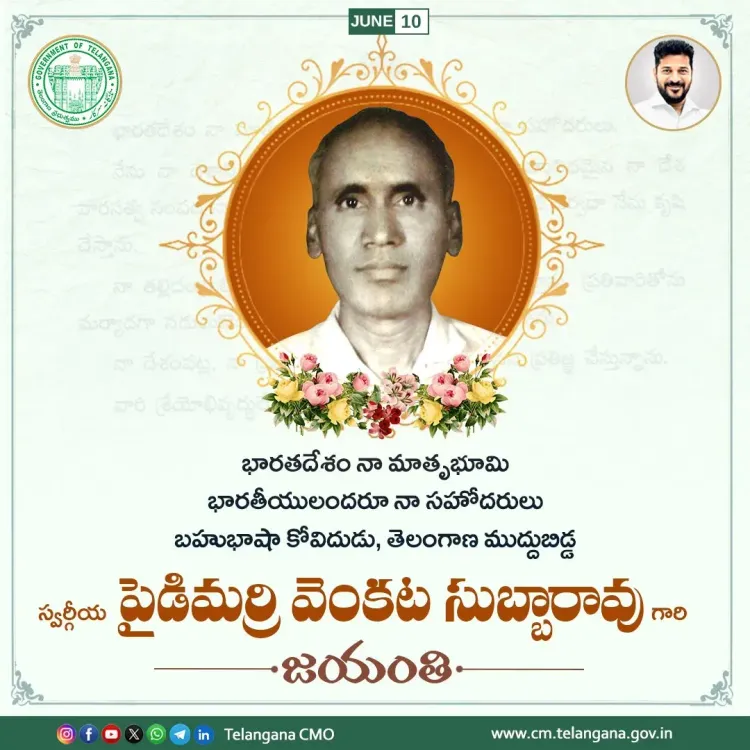
Chief Minister A. Revanth Reddy paid tribute to Pydimarri Venkata Subba Rao, the Telangana-born scholar who authored the Indian National Pledge in 1962, on his birth anniversary, calling his legacy of unity, discipline and patriotism invaluable to every Indian student.
Key Takeaways
Revanth Reddy paid tribute to Pydimarri Venkata Subba Rao on his birth anniversary on 10 June 2026 .
Pydimarri Venkata Subba Rao authored the Indian National Pledge in 1962 , which begins 'India is my motherland.' The pledge was formally adopted in Indian schools in the mid-1960s and is recited daily by millions of students.
CM Revanth Reddy described Pydimarri as a multilingual scholar, litterateur and patriot whose services are 'eternally memorable.' Telangana regards Pydimarri as a source of regional and national pride, with the state government consistently marking his legacy.
The tribute highlighted the pledge's role in nurturing unity, discipline, responsibility and human values among Indian students.
The Chief Minister's Office of Telangana on Wednesday, 10 June 2026 shared a tribute by Chief Minister A. Revanth Reddy honouring Pydimarri Venkata Subba Rao, the scholar credited with authoring the Indian National Pledge, on the occasion of his birth anniversary.
Context
The post quotes CM Revanth Reddy paying homage to Pydimarri Venkata Subba Rao, opening with the pledge's iconic first line — 'Bharat desh naa maathrubhoomi. Bharateeyulandu naa sahodarulu' ('India is my motherland. All Indians are my brothers and sisters') — to underscore the late scholar's enduring contribution to national consciousness. The Chief Minister described him as a 'mahaneeyudu' (great soul) who planted the seeds of national unity and patriotism in the hearts of crores of Indians.
Revanth Reddy stated: 'As a multilingual scholar, litterateur and patriot, the services he rendered are eternally memorable. The inspiration Pydimarri provided through the Indian National Pledge to nurture unity, discipline, responsibility and human values in every student across the country is invaluable. On the occasion of this great son of Telangana's birth anniversary, let us recall his ideals.'
Policy Backdrop
The Indian National Pledge was authored by Pydimarri Venkata Subba Rao in 1962, in the immediate post-independence era when national integration was a pressing priority for the newly formed republic. The pledge was formally introduced in schools across India in the mid-1960s and has since been recited daily by millions of schoolchildren, beginning with the declaration that India is their motherland.
The pledge's emphasis on unity, discipline, and human values made it a cornerstone of civic education in Indian schools. Telangana, as the state from which Pydimarri hailed, has consistently recognised his contribution to this pan-Indian institution of patriotism and learning.
Stakeholders and Impact
The tribute resonates most directly with students and educators across India who recite the pledge daily, and with Telangana residents who regard Pydimarri as a source of regional and national pride. State governments across India routinely commemorate local figures who shaped national symbols, and Telangana has been consistent in highlighting such contributions.
For the broader public, the anniversary serves as a reminder of the pledge's origins in Telangana and its role in shaping generations of citizens' relationship with national identity, discipline and civic responsibility.
What's Next
The commemoration may prompt follow-up discussion on how the values enshrined in the Indian National Pledge are integrated into Telangana's school curricula in the coming academic year. State-level events or educational initiatives marking Pydimarri's legacy could be announced in the days ahead, reinforcing the government's commitment to civic and patriotic education.
Point of View
CM Revanth Reddy connects Telangana's cultural heritage directly to the foundations of post-independence civic education — a politically resonant move that positions the state as a cradle of national unity. The tribute also signals the government's interest in keeping civic and patriotic values at the centre of public discourse around education. Watch for whether this anniversary translates into concrete curricular or commemorative initiatives in Telangana schools.
NationPress
26 Oct 2026
Frequently Asked Questions
Who wrote the Indian National Pledge?
The Indian National Pledge was authored by Pydimarri Venkata Subba Rao , a Telangana-born multilingual scholar and patriot, in 1962 .
What is the Indian National Pledge?
The Indian National Pledge is a daily school recitation beginning with 'India is my motherland,' introduced in Indian schools in the mid-1960s to foster national unity, discipline and human values among students.
Why did CM Revanth Reddy pay tribute to Pydimarri Venkata Subba Rao?
CM A. Revanth Reddy paid tribute on the occasion of Pydimarri Venkata Subba Rao's birth anniversary on 10 June 2026 , honouring his contribution as the author of the Indian National Pledge and his legacy as a multilingual scholar and patriot.
What is Pydimarri Venkata Subba Rao's connection to Telangana?
Pydimarri Venkata Subba Rao hailed from Telangana , and the state regards him as a source of regional and national pride for his role in authoring the Indian National Pledge, which is recited in schools across India.
When was the Indian National Pledge introduced in schools?
The Indian National Pledge was authored in 1962 and formally introduced in schools across India in the mid-1960s , becoming a cornerstone of civic education in the country.