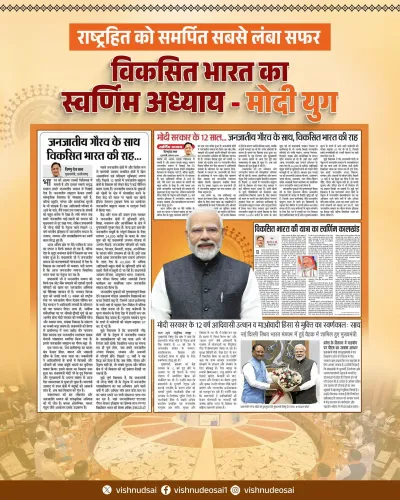
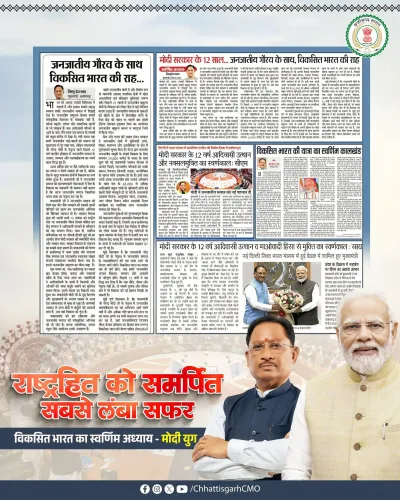
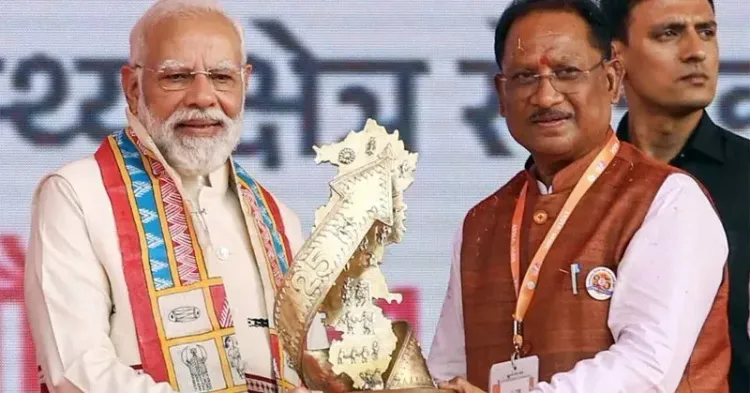
CM Vishnu Deo Sai credits PM Modi's 12 years for Chhattisgarh growth
Synopsis
Chief Minister Vishnu Deo Sai has credited Prime Minister Narendra Modi's 12-year tenure with shaping Chhattisgarh's development story, continuing a BJP pattern of linking state progress to central governance principles on the PM's milestone anniversary.
Key Takeaways
The Chhattisgarh CMO posted a reflection by CM Vishnu Deo Sai on 10 June 2026 marking PM Modi's 12 years in office.
Narendra Modi has served as Prime Minister since May 2014 , introducing the 'Sabka Saath, Sabka Vikas' cooperative federalism framework.
Vishnu Deo Sai became Chief Minister of Chhattisgarh in December 2023 following the BJP's state assembly election victory.
The statement aligns Chhattisgarh's development narrative with central government governance principles and flagship schemes.
Such milestone messaging is part of a broader BJP pattern of projecting unified governance achievements across Centre and state.
Further policy announcements or scheme progress reports from Chhattisgarh are expected in the coming fiscal cycle.
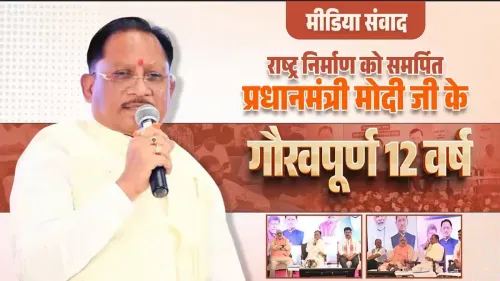
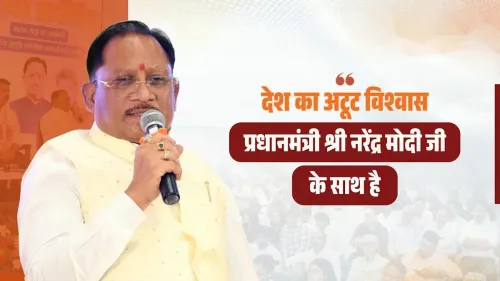
The Chief Minister's Office of Chhattisgarh shared a reflection by Chief Minister Vishnu Deo Sai on Wednesday, 10 June 2026, crediting Prime Minister Narendra Modi's 12 years of leadership for shaping the state's development trajectory. The post highlights how principles of good governance adopted at the Centre have, in the state government's view, directly influenced Chhattisgarh's growth story.
Context
Narendra Modi completed 12 years as Prime Minister in May 2026, having first assumed office in May 2014 under the 'Sabka Saath, Sabka Vikas' governance framework. The milestone has prompted BJP-ruled state governments across India to publicly acknowledge the impact of central leadership on state-level outcomes. CM Vishnu Deo Sai's statement follows this pattern, framing Chhattisgarh's recent development as a product of convergence between state administration and national policy direction.
Policy Backdrop
Vishnu Deo Sai became Chief Minister of Chhattisgarh in December 2023 after the BJP's victory in the state assembly elections, ending a period of Congress rule. Since assuming office, his administration has aligned state programmes with flagship central schemes spanning infrastructure, welfare delivery, and digital governance. The 'Sabka Saath, Sabka Vikas' framework introduced by the Modi government in 2014 set the ideological and administrative foundation that states like Chhattisgarh have cited in their own progress narratives — particularly around cooperative federalism, where central and state priorities are presented as unified.
Chhattisgarh, a mineral-rich, heavily forested state with a substantial tribal population, has historically been a focal point for welfare-oriented central schemes. The BJP government in Raipur has, since late 2023, positioned the state as an active beneficiary and implementer of national development goals.
Stakeholders and Impact
The statement is directed at Chhattisgarh's residents, particularly communities that have been the target beneficiaries of centrally sponsored programmes in areas such as housing, rural connectivity, and social welfare. For the state's large tribal population, alignment with central schemes has carried particular significance given the constitutional provisions and special programmes directed at Scheduled Tribes (tribal communities). Political observers note that such public acknowledgements serve to reinforce the BJP's narrative of seamless governance continuity from New Delhi to state capitals.
The broader BJP ecosystem — party workers, elected representatives, and allied organisations — also forms a key audience for such milestone messaging, which reinforces internal party cohesion around the central leadership's legacy.
What's Next
Attention will now turn to whether the Chhattisgarh government follows up the anniversary messaging with concrete policy announcements or progress reports on centrally sponsored scheme implementation in the state. Economic surveys, development index releases, or new state-level initiatives tied to the 12-year governance milestone could be expected in the coming fiscal cycle. The pattern of anniversary-linked development communication suggests further rollout updates on infrastructure and welfare delivery are likely in the weeks ahead.
Point of View
Where state leaders publicly anchor local development to central leadership on high-visibility anniversaries. It reinforces the party's unified governance narrative heading into what could be a politically active period in Chhattisgarh, a state that only returned to BJP rule in late 2023. The messaging also serves a dual purpose: consolidating the new state government's credibility by associating it with the Modi brand, while projecting Chhattisgarh as a model implementer of national schemes. For political analysts, the timing and framing are less about specific policy outcomes and more about narrative alignment ahead of future electoral cycles.
NationPress
19 Sept 2026
Frequently Asked Questions
Why is CM Vishnu Deo Sai praising PM Modi's 12 years of governance?
CM Vishnu Deo Sai's statement marks PM Narendra Modi's 12-year milestone as Prime Minister, crediting his governance principles for Chhattisgarh's development. BJP-ruled states routinely issue such acknowledgements on significant anniversaries of the central government.
When did Vishnu Deo Sai become Chief Minister of Chhattisgarh?
Vishnu Deo Sai became Chief Minister of Chhattisgarh in December 2023 after the BJP won the state assembly elections, ending the previous Congress government's tenure.
What is the 'Sabka Saath, Sabka Vikas' framework mentioned in the context of Modi's governance?
'Sabka Saath, Sabka Vikas' — meaning 'Together with all, development for all' — is the governance slogan introduced by the Modi government in 2014, emphasising inclusive development and cooperative federalism between the Centre and states.
How has PM Modi's central government influenced Chhattisgarh's development?
Since 2014, centrally sponsored schemes on housing, rural connectivity, digital delivery, and tribal welfare have been implemented in Chhattisgarh. The BJP state government since December 2023 has aligned its administration closely with these national programmes.
What is cooperative federalism and how does it relate to Chhattisgarh?
Cooperative federalism refers to a governance model where the Centre and states work in alignment on policy and scheme delivery. Chhattisgarh under CM Vishnu Deo Sai has positioned itself as an active partner in implementing central government flagship programmes, reinforcing this model.