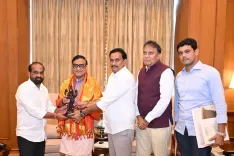
CM Sai congratulates Ajay Jamwal on Maharashtra BJP role
Synopsis
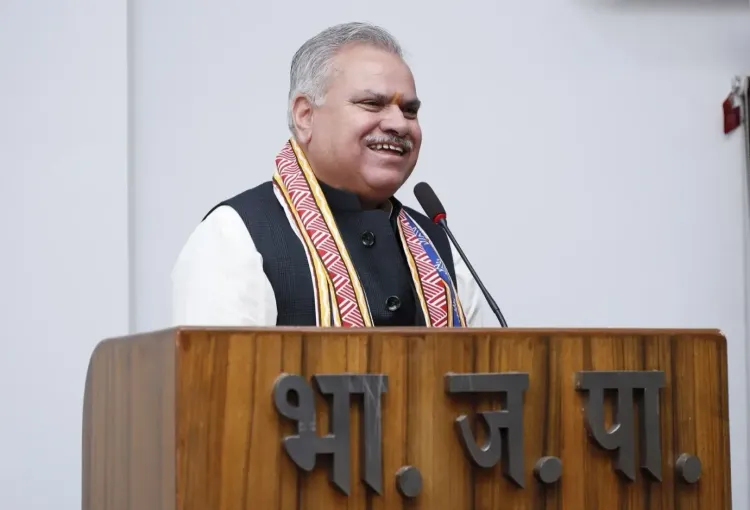
Chhattisgarh Chief Minister Vishnu Deo Sai congratulated Ajay Jamwal on his new role as Maharashtra BJP's state organisational general secretary, crediting their shared work in Chhattisgarh and expressing confidence in Jamwal's ability to strengthen the party's Maharashtra unit.
Key Takeaways
CM Vishnu Deo Sai publicly congratulated Ajay Jamwal on being appointed Maharashtra BJP Pradesh Sangathan Mahamantri on 24 September 2026 .
Jamwal previously served as BJP regional sangathan mahamantri in Chhattisgarh , where he worked closely with CM Sai and the state's party cadre.
Sai credited Jamwal's guidance and far-sighted leadership with giving 'new energy and strength' to the Chhattisgarh party unit.
The appointment reflects the BJP's established strategy of deploying experienced organisational secretaries across states to transfer proven ground-level tactics.
Maharashtra is one of India's most politically contested states, making the role a high-stakes assignment for Jamwal .
A warm word from Chhattisgarh's top office — and a quiet signal about how India's ruling party moves its best organisational minds across the map. Chhattisgarh Chief Minister Vishnu Deo Sai on Thursday, 24 September 2026, congratulated Ajay Jamwal on being entrusted with the responsibility of Maharashtra BJP's state organisational general secretary (Pradesh Sangathan Mahamantri), calling the appointment a moment of pride for those who worked alongside him.
Writing in Hindi, CM Sai recalled a shared chapter: 'Chhattisgarh mein kshetriya sangathan mahamantri ke roop mein aapke saath karya karne ka avsar mila' — 'I had the opportunity to work with you as regional organisational general secretary in Chhattisgarh.' He credited Jamwal's guidance, far-sighted leadership, and dedication to the organisation for continuously inspiring cadres and infusing 'new energy and strength' into the unit.
From Chhattisgarh's organisational machinery to Maharashtra's front line
Ajay Jamwal built his BJP reputation as a behind-the-scenes architect — the kind of party functionary whose work rarely makes headlines but whose fingerprints are everywhere in booth-level mobilisation and cadre management. His stint as regional sangathan mahamantri in Chhattisgarh placed him at the nerve-centre of the party's organisational activity in the state, working in close coordination with leaders including Sai himself.
The BJP's permanent organisational machinery — staffed by full-time sangathan secretaries who are distinct from elected representatives — is a defining feature of the party's durable electoral strength. Cross-state deployments of seasoned organisers are a deliberate strategy: proven methods travel with the person. Maharashtra, one of India's most politically contested and electorally consequential states, represents a significant new stage for Jamwal's career.
Why BJP's cadre-rotation strategy matters
The BJP has long deployed this playbook — moving experienced organisational secretaries from states where the party is entrenched to battlegrounds where it seeks to consolidate. Each such transfer carries institutional memory, tested ground-level tactics, and personal networks built over years. CM Sai's own political journey — from tribal-belt MP to Chief Minister — is itself a product of this same organisational culture.
'I am fully confident,' Sai wrote, 'that your extensive organisational experience and able leadership will help take the organisation to new heights in Maharashtra.' That is more than a pleasantry — it is a public endorsement, from a sitting Chief Minister to a party operative, that carries weight inside BJP's internal ecosystem.
With Maharashtra's political landscape under constant flux, the arrival of a battle-hardened organisational hand could matter precisely when the party needs its ground machinery to be at its sharpest.
Point of View
But deeply intertwined with, elected governance. Ajay Jamwal's transfer from Chhattisgarh to Maharashtra follows a recognisable BJP template: reward capability with bigger arenas. For the Maharashtra unit, the infusion of an organiser with recent ground experience in a BJP-governed state could prove consequential in tightening booth-level preparedness. CM Sai's personal endorsement adds political capital to Jamwal's new mandate, signalling continuity of trust from the party's leadership tier.
NationPress
24 Sept 2026
Frequently Asked Questions
Who is Ajay Jamwal in BJP?
Ajay Jamwal is a BJP organisational functionary who served as regional sangathan mahamantri in Chhattisgarh and has now been appointed as Maharashtra BJP's Pradesh Sangathan Mahamantri , a key full-time party organiser role.
What is a BJP Sangathan Mahamantri?
A BJP Sangathan Mahamantri (organisational general secretary) is a full-time party official — separate from elected representatives — responsible for managing the party's ground machinery, cadre training, and booth-level coordination at the state level.
Why did Vishnu Deo Sai congratulate Ajay Jamwal?
Chhattisgarh CM Vishnu Deo Sai congratulated Ajay Jamwal because the two worked together when Jamwal served as the BJP's regional organisational general secretary in Chhattisgarh, and Sai credited him with strengthening the state unit.
What is BJP's strategy of transferring organisational secretaries across states?
The BJP routinely rotates experienced sangathan secretaries across states to transfer proven organisational methods, strengthen weaker units, and deploy cadre expertise where it is most needed — a key pillar of the party's long-term expansion strategy.
What is Ajay Jamwal's new role in Maharashtra BJP?
Ajay Jamwal has been appointed as the Maharashtra BJP Pradesh Sangathan Mahamantri (state organisational general secretary), one of the most operationally significant roles within the party's Maharashtra unit.