CM Sai launches Srot Mahotsav 2026 for river conservation

Synopsis
Chhattisgarh CM Vishnu Deo Sai launched Srot Mahotsav 2026 in Raipur on 19 August, unveiling a five-pillar river conservation framework and signing MoUs with the National Water Academy and Antrix Corporation to map and protect the state's river catchments.
Key Takeaways
Srot Mahotsav 2026 was inaugurated by CM Vishnu Deo Sai in Raipur on 19 August 2026 to drive river source and catchment conservation across Chhattisgarh.
A five-pillar framework — mapping, protection, recharge, public participation, and a concrete action plan — will guide the programme on a scientific, time-bound basis.
MoUs were signed with the National Water Academy, Pune and Antrix Corporation, Bengaluru for capacity building and satellite-based geospatial catchment mapping.
The initiative aims to make river conservation a jan andolan (people's movement) by integrating modern technology, traditional knowledge, and community involvement.
Chhattisgarh's upland catchment areas are critical headwaters for rivers sustaining farmers and tribal communities across central India.
The programme aligns with the national Jal Shakti Abhiyan (2019) and the National River Conservation Plan (1995) policy lineage.
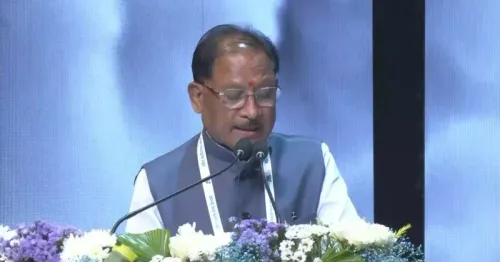
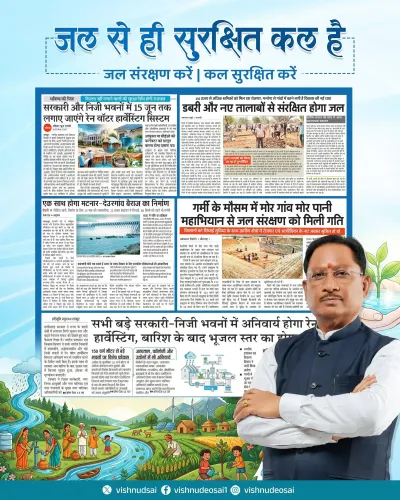
Rivers are dying quietly across central India — and Chhattisgarh Chief Minister Vishnu Deo Sai moved to answer that crisis on Wednesday, 19 August 2026, inaugurating 'Srot Mahotsav 2026' and a state-level workshop in Raipur dedicated entirely to protecting the origin points and catchment zones of the state's rivers.
Posting on X, CM Sai framed the mission in the plainest possible terms: 'Nadi bachegi toh jal bachega aur jal bachega toh jeevan bachega' — 'If the river survives, water survives; if water survives, life survives.' The sentiment is simple. The machinery being put in motion is not.
Five pillars and two powerful partners
The state has announced a five-pillar framework to drive river and catchment conservation: mapping, protection, recharge, public participation, and a concrete action plan — all to be executed through scientific, time-bound methods. Each pillar targets a specific failure point that has historically plagued river conservation efforts: vague mandates, absent communities, and no measurable timelines.
To power the mapping and capacity-building work, the Chhattisgarh government signed MoUs with two central institutions. The National Water Academy, Pune — the Ministry of Jal Shakti's dedicated training institute — will anchor technical capacity building. Antrix Corporation, Bengaluru, the commercial arm of ISRO, brings satellite-based remote sensing and geospatial tools to track catchment health from above. Together, they give the state both the human expertise and the orbital eyes the mission needs.
Chhattisgarh's rivers and what is at stake
Chhattisgarh's upland catchment areas are the headwaters for rivers that sustain agriculture and tribal communities across a vast swath of central India. Degradation of these source zones — through deforestation, mining pressure, and encroachment — directly translates into erratic flows, failing wells, and crop losses downstream. The farmers and tribal communities in these catchments are the first to bear the cost.
The state's push fits within a broader national arc. India's National River Conservation Plan, launched in 1995, established the structural template for catchment protection. The Jal Shakti Abhiyan, launched in 2019, added the emphasis on source protection and community participation — including in water-stressed Chhattisgarh districts. Srot Mahotsav 2026 is, in many ways, the state-level operationalisation of that decade-long policy build-up.
Science, tradition, and a people's movement
CM Sai articulated an explicit ambition: to make river conservation a jan andolan — a people's movement — by weaving together modern technology, traditional ecological knowledge, and grassroots participation. That combination is increasingly the template for durable water security programmes across Indian states, where top-down engineering alone has repeatedly fallen short.
The MoUs with National Water Academy and Antrix Corporation are the clearest near-term markers to watch. Their deliverables — catchment maps, recharge plans, trained district-level officials — will determine whether Srot Mahotsav 2026 becomes a landmark programme or another well-intentioned launch. The rivers will keep score.
Point of View
It also serves a political purpose: demonstrating environmental stewardship in a state where tribal and agrarian communities depend directly on river health. The five-pillar framework with explicit timelines signals a deliberate move away from the vague conservation resolutions that have historically produced little. Whether the MoU deliverables translate into measurable catchment outcomes will be the real test of whether this is governance or optics.
NationPress
3 Oct 2026
Frequently Asked Questions
What is Srot Mahotsav 2026?
Srot Mahotsav 2026 is a state-level festival and workshop inaugurated by Chhattisgarh CM Vishnu Deo Sai in Raipur on 19 August 2026, focused on the conservation of river source points and catchment areas across Chhattisgarh through mapping, recharge, and community participation.
What MoUs did Chhattisgarh sign at Srot Mahotsav 2026?
The Chhattisgarh government signed MoUs with the National Water Academy in Pune and Antrix Corporation in Bengaluru to strengthen technical capacity building and satellite-based geospatial mapping for river catchment conservation.
What is Antrix Corporation and why is it involved?
Antrix Corporation is the commercial arm of ISRO based in Bengaluru, specialising in remote sensing and geospatial applications. It has been partnered to provide satellite-based catchment mapping and monitoring for Chhattisgarh's river conservation programme.
What are the five pillars of Chhattisgarh's river conservation plan?
The five pillars announced at Srot Mahotsav 2026 are mapping, protection, recharge, public participation, and a concrete time-bound action plan for river source and catchment areas in Chhattisgarh.
How does Srot Mahotsav 2026 relate to the Jal Shakti Abhiyan?
Jal Shakti Abhiyan, launched nationally in 2019, promoted source protection, recharge, and community participation in water-stressed districts including those in Chhattisgarh. Srot Mahotsav 2026 builds on that framework at the state level with dedicated institutional partnerships and a structured action plan.