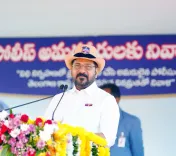
CM Vishnu Deo Sai Marks Jana Sangh's 75th Foundation Day
Synopsis
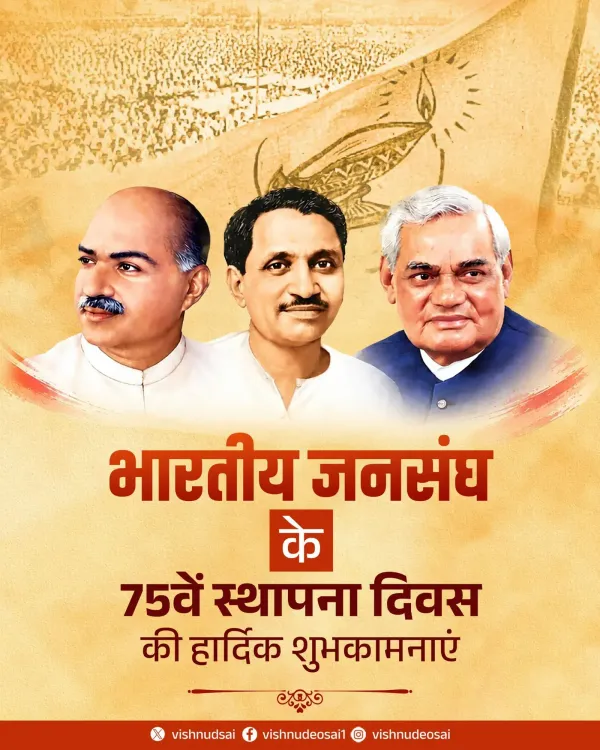
On the 75th foundation day of the Bharatiya Jana Sangh, Chhattisgarh CM Vishnu Deo Sai pays tribute to founder Dr. Shyama Prasad Mukherjee, linking the 1951 party's vision of national unity to the BJP's current agenda of good governance and Antyodaya-driven welfare.
Key Takeaways
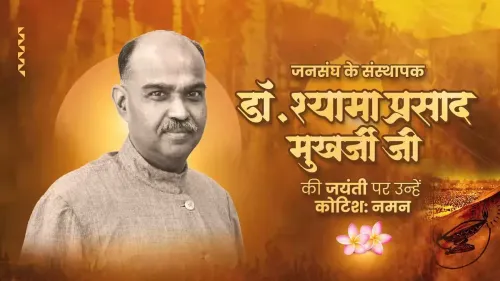
The Bharatiya Jana Sangh was founded on 21 October 1951 by Dr.
Shyama Prasad Mukherjee , marking its 75th anniversary in 2026.
Chhattisgarh CM Vishnu Deo Sai hailed the Jana Sangh as the ideological and organisational foundation of the Bharatiya Janata Party .
The Jana Sangh merged into the Janata Party in 1977 ; its cadre re-formed the BJP on 6 April 1980 .
Sai invoked Antyodaya , suśāsan (good governance), and jan kalyān (public welfare) — the core triad of BJP's post-2014 governance messaging.
Mukherjee resigned from Nehru's cabinet over the Nehru-Liaquat Pact and championed full integration of Jammu and Kashmir ; he died in detention in Srinagar in 1953 .
Vishnu Deo Sai became Chhattisgarh's first tribal Chief Minister in December 2023 .
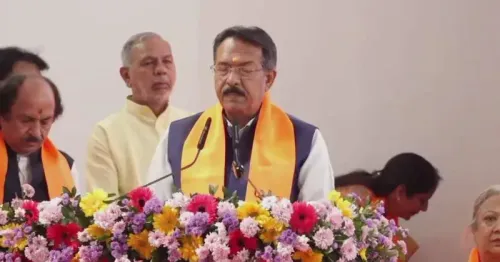
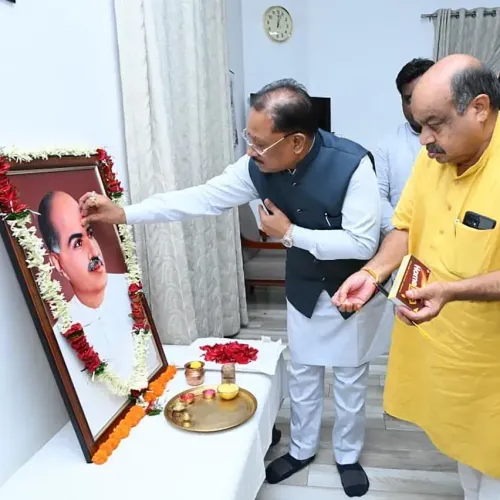
Seventy-five years ago on 21 October 1951, a Bengali scholar-politician walked out of Nehru's cabinet and planted a political idea that would, three decades later, become the ruling force of modern India. On that anniversary, Chhattisgarh Chief Minister Vishnu Deo Sai offered greetings on the 75th foundation day of the Bharatiya Jana Sangh, drawing a direct line from Dr. Shyama Prasad Mukherjee's founding vision to the BJP's present governance agenda.
From Mukherjee's resignation to a 75-year legacy
The Bharatiya Jana Sangh was founded on 21 October 1951 under Dr. Shyama Prasad Mukherjee, who had resigned from Prime Minister Jawaharlal Nehru's cabinet in protest against the Nehru-Liaquat Pact and championed the full integration of Jammu and Kashmir into the Indian Union. CM Sai, posting in Hindi, described the party as a 'symbol of national service' — rashtra seva ka pratik — that gave 'a powerful foundation to the ideas of national interest and national unity.'
The Jana Sangh's journey was not linear. It merged into the Janata Party in 1977 in the aftermath of the Emergency, and its core cadre re-emerged as the Bharatiya Janata Party on 6 April 1980. The BJP has since positioned itself explicitly as the ideological heir to that 1951 founding moment.
Antyodaya to welfare delivery: the ideological thread BJP pulls today
What makes CM Sai's message more than a routine commemorative note is its specific vocabulary. He invoked 'suśāsan' (good governance), 'antyodaya' (uplift of the last person in the queue), and 'jan kalyān' (public welfare) — the same triad that anchors BJP's post-2014 governance narrative, from PMAY housing to the Ujjwala clean-cooking scheme.
This language is deliberate and institutional. The BJP formally adopted Antyodaya as a core welfare principle in its 1980s organisational documents, and state leaders routinely deploy it on the Jana Sangh's foundation day to signal continuity between historical nationalism and present-day delivery. In Chhattisgarh, a state with a large tribal population where Sai became the first tribal Chief Minister in December 2023, that framing carries particular weight.
Why the 75th milestone matters inside BJP's organisational calendar
A diamond jubilee is not incidental. State-level tributes like Sai's are part of a coordinated pattern across BJP-governed states, amplifying a founding narrative ahead of what observers expect to be significant organisational events and resolutions marking the October 2026 anniversary. The message positions the party's welfare record as the living fulfilment of Mukherjee's original compact with the nation — not a departure from it.
The founding father himself never saw the party grow. Dr. Mukherjee died in detention in Srinagar in June 1953, arrested while protesting the permit system that restricted entry into Jammu and Kashmir. His death turned him into an enduring martyr-symbol for the Jana Sangh and its successor. Seventy-five years on, his name anchors the BJP's claim that governance is inseparable from national purpose.
Point of View
Invoking this lineage in a tribal-majority state carries added resonance — it frames his own elevation as the culmination of a 75-year arc of national inclusion. The diamond jubilee also signals that the party's internal messaging ahead of any winter organisational events will lean heavily on historical legitimacy rather than purely contemporary performance.
NationPress
21 Oct 2026
Frequently Asked Questions
When was the Bharatiya Jana Sangh founded and by whom?
The Bharatiya Jana Sangh was founded on 21 October 1951 by Dr. Shyama Prasad Mukherjee , a Bengali educationist and politician who had resigned from Prime Minister Nehru's cabinet.
What is the connection between Jana Sangh and the BJP?
The Jana Sangh merged into the Janata Party in 1977 after the Emergency. Its core cadre re-organised as the Bharatiya Janata Party on 6 April 1980 , which explicitly positions itself as the Jana Sangh's ideological successor.
Who is Vishnu Deo Sai and why is he significant?
Vishnu Deo Sai is the Chief Minister of Chhattisgarh, appointed in December 2023 . He is notable as the state's first tribal Chief Minister and previously served as Union Minister of State for Steel and Tribal Affairs.
What is 'Antyodaya' and why does BJP invoke it?
'Antyodaya' means the uplift of the last person in society — a principle BJP formally adopted in its 1980s organisational documents and has since linked to flagship welfare schemes like PMAY and Ujjwala .
How did Dr. Shyama Prasad Mukherjee die?
Dr. Mukherjee died in detention in Srinagar in June 1953 after being arrested while protesting the permit system restricting entry into Jammu and Kashmir, a cause he had championed since founding the Jana Sangh.