CM Saini Greets Journalists on Hindi Journalism Day
Synopsis
Haryana Chief Minister Nayab Singh Saini marked Hindi Journalism Day on 30 May by honouring the press fraternity for their dedication, impartial reporting, and role in strengthening democracy — recalling the 1826 launch of India's first Hindi newspaper, Udant Martand.
Key Takeaways
Haryana CM Nayab Singh Saini posted greetings on Hindi Journalism Day, 30 May .
Hindi Journalism Day marks the launch of Udant Martand on 30 May 1826 , India's first Hindi newspaper.
Saini credited journalists with strengthening the 'fourth pillar of democracy' through dedication and impartial reporting.
He highlighted the press's role in spreading social awareness and empowering the voice of justice.
The message is part of a broader pattern of BJP-led state governments engaging with regional Hindi media on commemorative days.
Haryana Chief Minister Nayab Singh Saini extended warm greetings to journalists across the country on Hindi Journalism Day, observed annually on 30 May, marking the historic launch of India's first Hindi newspaper. In a post on X, Saini honoured the press fraternity for strengthening democracy and amplifying the voice of justice through dedicated reporting.
Context
Hindi Journalism Day is observed every year on 30 May to commemorate the publication of Udant Martand on 30 May 1826 — India's first Hindi-language newspaper, launched during the British colonial period. The day serves as an annual occasion for the nation to reflect on the contributions of the Hindi press to public discourse and democratic life.
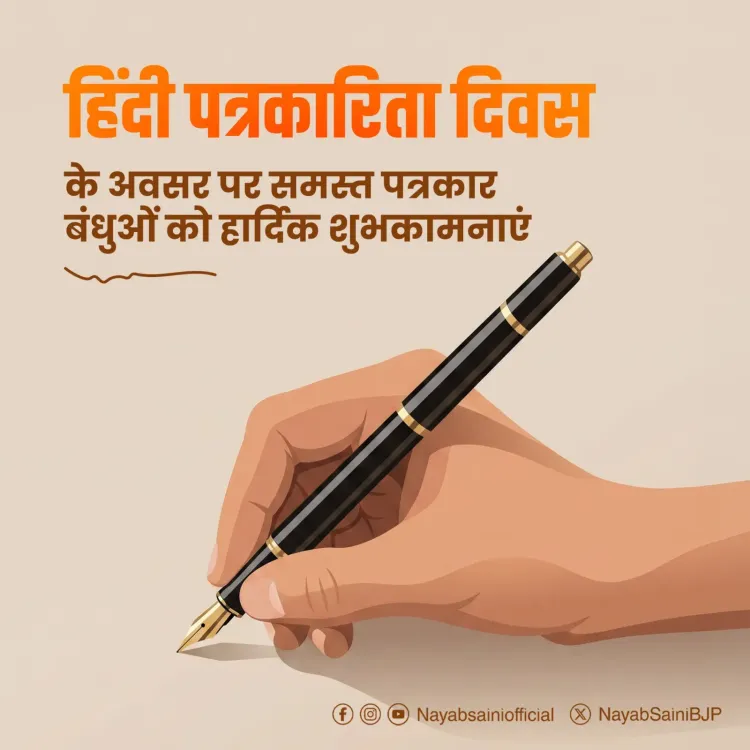
CM Saini wrote, 'हिंदी पत्रकारिता दिवस' ['Hindi Journalism Day'] par sabhi patrakar bandhuo ko hardik badhai ('Heartfelt congratulations and best wishes to all journalist brethren on Hindi Journalism Day'). He added that journalists have strengthened the fourth pillar of democracy through their dedication and impartial perspective.
Policy Backdrop
The recognition of Hindi journalism carries particular resonance given long-standing official policy in India to promote Indian languages in public communication and governance. State governments, including those in Haryana, have consistently aligned their public messaging with this emphasis on regional-language media.
Saini's message noted that 'your pen has not only spread awareness in society but has continuously empowered the voice of justice' — a formulation that echoes the constitutional ideal of a free press as the fourth estate. Indian political leaders across the spectrum routinely issue such greetings on journalism commemorative days, affirming the press's democratic role.
Stakeholders and Impact
The primary audience for the message is the community of Hindi-language journalists and regional media professionals, particularly those based in Haryana and the broader Hindi belt. For working journalists, public recognition from a sitting chief minister carries symbolic weight regarding the government's stated commitment to press freedom and media welfare.
The broader Hindi journalism ecosystem — spanning print, digital, and broadcast — forms a critical pillar of public information in states where Hindi is the dominant language. Saini's outreach signals the Haryana government's continued engagement with this constituency.
What's Next
Observers of Haryana state politics will watch whether the government follows ceremonial greetings with substantive announcements — such as media awards, welfare schemes, or training programmes for Hindi journalists in the state. Such steps would translate symbolic recognition into policy action for the press community.
Point of View
Where elected leaders use press commemorations to publicly affirm the fourth-estate ideal. For a BJP-governed state like Haryana, such outreach also serves a practical purpose: maintaining goodwill with the Hindi-language regional media ecosystem that shapes opinion across the Hindi belt. The emphasis on 'impartial perspective' is notable — it implicitly sets a standard the government invites journalists to uphold, while simultaneously positioning the ruling dispensation as a champion of press values. Whether ceremonial goodwill translates into concrete support structures for working journalists remains the measure that matters.
NationPress
14 Oct 2026
Frequently Asked Questions
Why is Hindi Journalism Day celebrated on 30 May?
Hindi Journalism Day is celebrated on 30 May every year to mark the publication of Udant Martand on 30 May 1826 , which was India's first Hindi-language newspaper.
Who is Nayab Singh Saini?
Nayab Singh Saini is the Chief Minister of Haryana and a senior BJP leader who took office in 2024 , succeeding Manohar Lal Khattar.
What did Haryana CM Saini say on Hindi Journalism Day?
CM Saini congratulated all journalists, saying they have strengthened democracy's fourth pillar through dedication and impartial reporting, and that their work has spread awareness and empowered the voice of justice.
What was Udant Martand?
Udant Martand was India's first Hindi-language newspaper, launched on 30 May 1826 , and its founding is commemorated annually as Hindi Journalism Day .
What is the fourth pillar of democracy in India?
In Indian political discourse, the press or media is widely referred to as the 'fourth pillar of democracy,' alongside the legislature, executive, and judiciary.