CM Samrat Choudhary warns against destabilising India, backs Modi
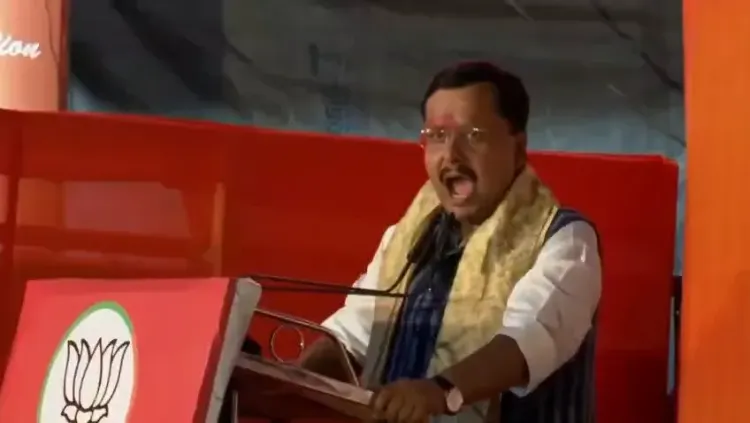
Synopsis
Bihar Chief Minister Samrat Choudhary amplified a statement by BJP National President Nitin Nabin on November 2, 2026, warning against attempts to destabilise India, invoking Bangladesh and Nepal, and contrasting PM Modi's constitutional governance with Congress's dynastic structure.
Key Takeaways
Bihar CM Samrat Choudhary posted on November 2, 2026 quoting BJP National President Nitin Nabin .
The statement frames PM Narendra Modi as constitution-driven and nation-centric against Congress's perceived family-first leadership.
The post warns that those attempting to destabilise India — as happened in Bangladesh (2024) and Nepal — will face a response from every BJP worker.
The hashtag #SaveDemocracyRemoveAnarchy signals a coordinated national BJP messaging campaign.
The BJP has consistently deployed the dynastic-politics critique against Congress since the 2014 general election cycle.
Bihar Chief Minister Samrat Choudhary sharpened the BJP's political edge on Monday, November 2, 2026, delivering a pointed warning to those he says are attempting to destabilise India — and framing Prime Minister Narendra Modi as the constitutional antidote to dynastic politics.
Quoting BJP National President Nitin Nabin, Choudhary posted: 'Mananeeya Pradhan Mantri ji desh ke Samvidhan ko poojte hain' — 'The honourable Prime Minister worships the country's Constitution and works with the same inspiration.' The message set up a hard contrast: Congress, the post argues, is a party where 'ek parivaar hi party hai' — one family is the entire party — while for Modi, the whole nation is his family.
Bangladesh and Nepal as cautionary mirrors
The sharpest line in the statement reaches beyond India's borders. Choudhary — citing Nabin — warned that those who believe they can destabilise India the way Bangladesh and Nepal have experienced political turbulence will face a firm response from 'BJP ka har karyakarta' — every single BJP worker. The reference to Bangladesh carries clear resonance: the country witnessed a dramatic political change in 2024 that upended a long-standing government. Nepal's recurring political volatility adds to the imagery of regional fragility.
By invoking those examples, the BJP message does something deliberate — it elevates a domestic political rivalry into a sovereignty argument. The implicit charge: the opposition is not merely an electoral competitor but an agent of the kind of instability that has rocked India's neighbours. That is a serious rhetorical escalation, and one the party's ground machinery is clearly being asked to amplify.
The 'nation as family' frame — BJP's long-running contrast
This is not new territory for the BJP. Since 2014, the party has consistently weaponised the dynastic-politics critique against the Congress — a party whose leadership has remained within the Gandhi-Nehru family for most of its post-independence history. The 'nation as family' framing positions Modi as a leader without dynastic stakes, and therefore, the argument goes, free to serve every citizen equally.
What is notable here is the #SaveDemocracyRemoveAnarchy hashtag anchoring the post — a campaign-ready slogan that signals coordinated messaging rather than a spontaneous comment. Bihar, as a state with its own complex coalition politics and a Chief Minister who is a senior BJP figure, becomes a natural launchpad for such national-level political narratives.
Choudhary's role in amplifying party messaging from Bihar
As Chief Minister of one of India's most populous states, Samrat Choudhary carries institutional weight when he relays party-level statements. His post does not merely retweet — it endorses and regionalises a national message. Bihar has been a bellwether for BJP's alliance politics and a testing ground for its 'sabka saath, sabka vikas' outreach to communities historically outside its base.
With opposition parties watching closely and state electoral cycles on the horizon across India, expect this 'democracy vs anarchy' register to grow louder — and expect every BJP Chief Minister to be part of the chorus.
Point of View
The party attempts to reframe electoral competition as a national-security and sovereignty question — a framing that tends to favour incumbents. The hashtag-driven delivery suggests this is a top-down campaign rollout rather than organic commentary, with Chief Ministers acting as state-level amplifiers. Ahead of any electoral cycle, this kind of coordinated message discipline is worth tracking for how far it travels beyond the BJP's existing base.
NationPress
3 Nov 2026
Frequently Asked Questions
What did Bihar CM Samrat Choudhary post about PM Modi?
Samrat Choudhary quoted BJP National President Nitin Nabin, saying PM Modi worships the Constitution and works for the entire nation as his family, contrasting him with the Congress party's dynastic politics.
Why did BJP mention Bangladesh and Nepal in the post?
The post used Bangladesh's 2024 political upheaval and Nepal's ongoing volatility as cautionary examples, warning that any attempt to create similar instability in India will be firmly countered by BJP workers.
What is the #SaveDemocracyRemoveAnarchy hashtag about?
It is a BJP campaign hashtag used in the post to signal coordinated party messaging that frames the BJP as a defender of democracy against what it characterises as anarchic opposition politics.
Who is Nitin Nabin in BJP?
Nitin Nabin is a Bihar BJP leader whom Samrat Choudhary quotes in the post; he is identified in the statement as BJP National President.
How long has BJP been using the dynastic politics argument against Congress?
The BJP has consistently deployed the dynastic-politics critique against the Congress since at least the 2014 general election, framing its own leadership model as nation-centric rather than family-driven.