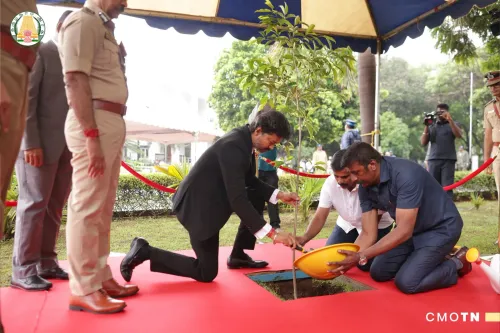
CM Vijay honours fallen police on Commemoration Day
Synopsis
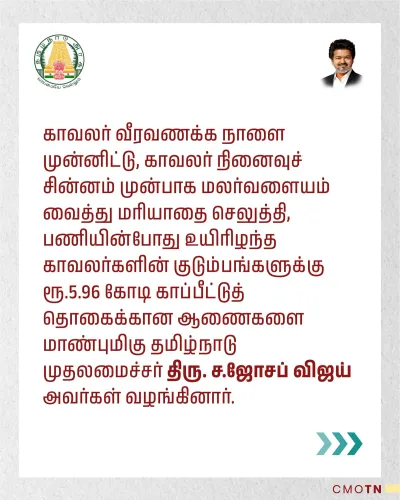
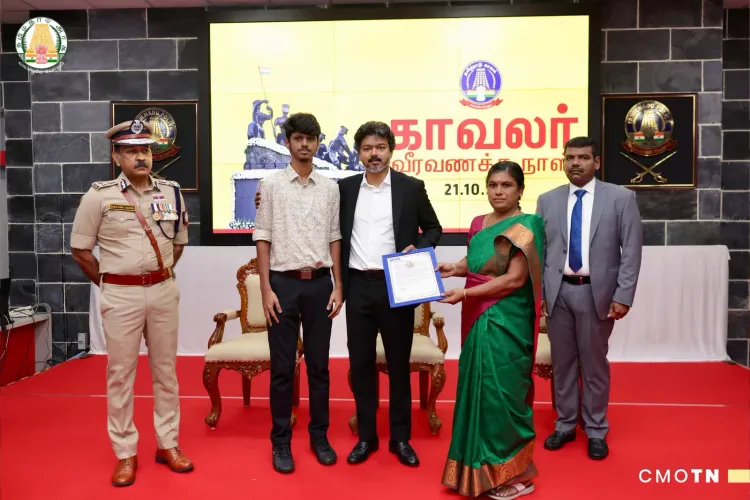
On Police Commemoration Day, Tamil Nadu CM C. Joseph Vijay laid a wreath at the Chennai Police Memorial and distributed Rs. 5.96 crore in personal accident insurance orders to the families of six personnel killed in the line of duty and one officer in a coma.
Key Takeaways
Police Commemoration Day was observed on 21 October 2026 at the Tamil Nadu Police Headquarters in Chennai .
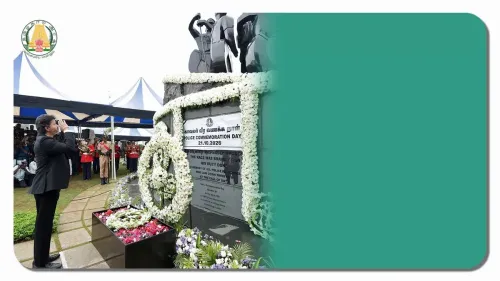
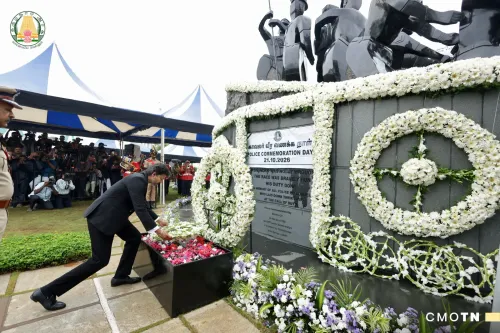
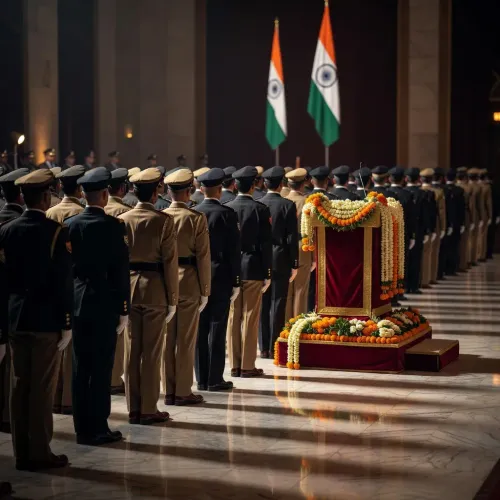
Joseph Vijay laid a wreath at the Police Memorial to honour personnel who died in the line of duty.
Insurance payment orders totalling Rs.
5 crore 96 lakh were handed over to seven families — six of slain officers and one of an officer currently in a coma.
Payments were made under the Tamil Nadu Government Salary Package Scheme as personal accident insurance.
Police Commemoration Day is observed nationally on 21 October each year to remember police personnel who made the ultimate sacrifice on duty.
On Police Commemoration Day, 21 October 2026, Tamil Nadu Chief Minister C. Joseph Vijay stood before the Police Memorial at the state's Police Headquarters in Chennai and laid a wreath — a solemn act of acknowledgment for the men and women of the Tamil Nadu Police who never came home from duty. The gesture was followed by something concrete: cheques.
The Chief Minister's Office of Tamil Nadu announced that CM Vijay handed over insurance payment orders worth a combined Rs. 5.96 crore to the families of seven Tamil Nadu Police personnel — six who died in the line of duty and one currently in a coma — under the state government's Salary Package Scheme. The disbursements are classified as personal accident insurance payouts, providing direct financial relief to households that lost an earning member, or whose breadwinner remains critically incapacitated.
A national day, a state's reckoning
Police Commemoration Day falls on 21 October every year across India, tracing back to a 1959 ambush in Ladakh in which ten Indian Police Service personnel were killed by Chinese forces. Since then, the date has anchored a national ritual of remembrance — wreath-laying at police memorials, roll calls of the fallen, and public acknowledgment of sacrifice. Tamil Nadu, like other states, observes the day with ceremony at its headquarters, this year presided over by the Chief Minister himself.
The setting — the Police Headquarters complex in Chennai — carried its own weight. State police forces across India maintain memorial structures listing the names of personnel who died on duty; standing before such a monument and laying flowers is, in the grammar of state ceremony, the highest acknowledgment a government can offer short of legislation.
Rs. 5.96 crore for seven families
Beyond the ceremonial, the financial dimension of Wednesday's event is significant. The Tamil Nadu Government's Salary Package Scheme bundles personal accident insurance as part of the broader service conditions for state employees, including police personnel. When an officer dies or is permanently incapacitated in the line of duty, the scheme triggers insurance payouts to the family.
Wednesday's disbursement covered six families of personnel killed on duty and one family of an officer in a coma — a detail that underscores how the scheme accounts not just for death but for the prolonged, often devastating limbo of critical injury. The total payout of Rs. 5 crore 96 lakh works out to roughly Rs. 85 lakh per family on average, though individual amounts likely vary by service tenure and specific policy terms.
For families that have already borne the irreversible cost of a loved one's service, the formal handing over of orders by the Chief Minister — rather than a bureaucratic transfer — carries both practical and symbolic weight.
Point of View
Which means the political signal lies in the visibility of delivery rather than a legislative push. Across India, state governments have faced criticism for delays in settling line-of-duty insurance claims; a public handover by the CM short-circuits that narrative. The inclusion of a coma-state officer in the disbursement batch is also worth noting — it suggests the scheme's eligibility criteria are being read broadly, a precedent that may matter for future claims.
NationPress
21 Oct 2026
Frequently Asked Questions
What is Police Commemoration Day and when is it observed?
Police Commemoration Day is observed on 21 October every year across India to honour police personnel who died in the line of duty. The date marks a 1959 incident in Ladakh in which several Indian police personnel were killed.
How much insurance money did Tamil Nadu CM Vijay give to police families?
CM C. Joseph Vijay handed over insurance payment orders worth Rs. 5 crore 96 lakh (Rs. 5.96 crore) to the families of seven Tamil Nadu Police personnel on 21 October 2026.
Which scheme covers Tamil Nadu police accident insurance?
The payouts are made under the Tamil Nadu Government's Salary Package Scheme , which includes personal accident insurance for state government employees, including police personnel.
Who received the insurance orders on Police Commemoration Day 2026?
The families of six police personnel who died in the line of duty and one officer currently in a coma received the insurance orders — seven families in total.
Where was the Police Commemoration Day 2026 event in Tamil Nadu held?
The event was held at the Tamil Nadu Police Headquarters premises in Chennai , where CM Vijay laid a wreath at the Police Memorial.