CM Yogi Launches Cashless Medical Scheme for UP Teachers
Synopsis
Chief Minister Yogi Adityanath launched the Mukhyamantri Shikshak Cashless Chikitsa Yojana in Agra on 26 July 2026, extending cashless health coverage to over 7.50 lakh Uttar Pradesh Higher Education Department teachers and their dependent family members.
Key Takeaways
Chief Minister Yogi Adityanath launched the Mukhyamantri Shikshak Cashless Chikitsa Yojana in Agra on 26 July 2026 .
The scheme covers more than 7.50 lakh teachers and staff under the Uttar Pradesh Higher Education Department .
Dependent family members of eligible teachers are also included as beneficiaries under the scheme.
The cashless model eliminates upfront out-of-pocket payments at empanelled hospitals for covered employees.
The initiative extends Uttar Pradesh 's pattern of layering state-level health schemes on top of the central Ayushman Bharat framework.
Implementation details including district-wise enrolment and hospital empanelment will determine the scheme's effective reach across all 75 districts .
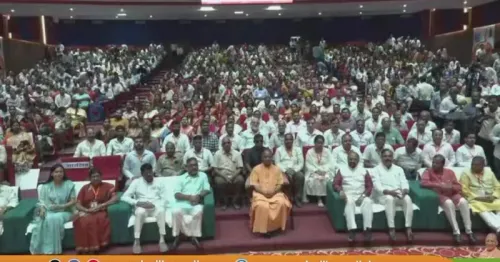
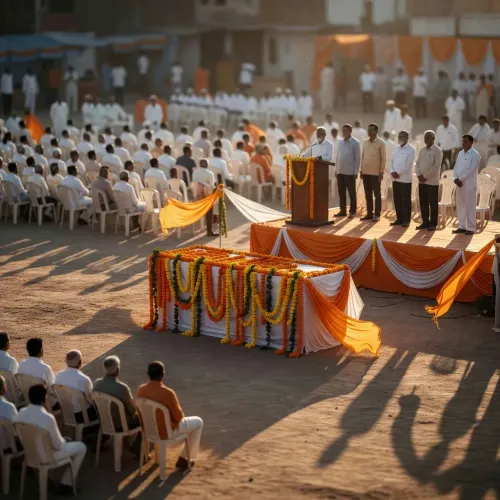
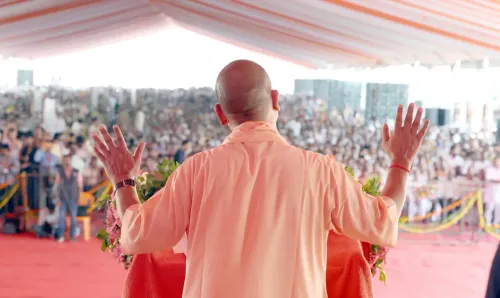
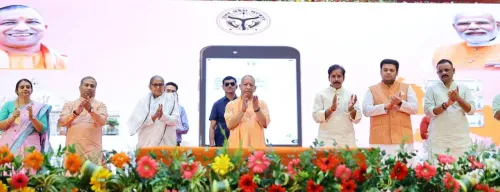
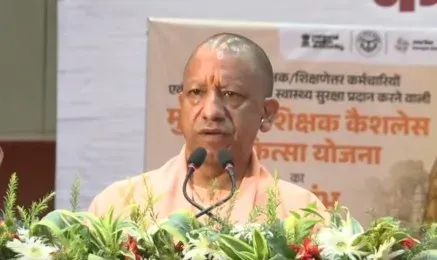
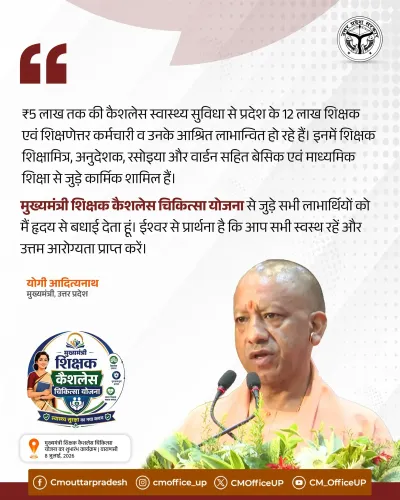
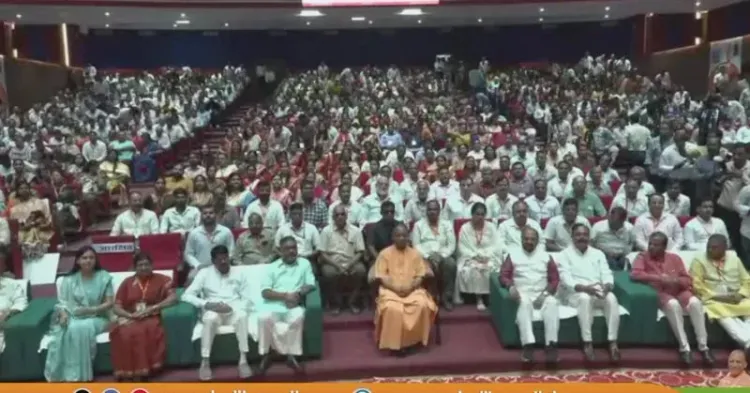
Uttar Pradesh Chief Minister Yogi Adityanath on Sunday, 26 July 2026, launched the Mukhyamantri Shikshak Cashless Chikitsa Yojana — a dedicated cashless health coverage scheme for teachers and their dependent family members under the state's Higher Education Department — at an official event held in Agra. The scheme is designed to extend health-security benefits to more than 7.50 lakh teachers and their dependents across Uttar Pradesh.
In his post on X, Chief Minister Adityanath announced his participation in the launch event in Agra, describing the scheme as one aimed at providing 'swasthya-suraksha' (health security) to over 7.50 lakh teachers and their families employed in the Higher Education Department. The scheme enables cashless medical treatment, eliminating the need for teachers to pay out-of-pocket at empanelled hospitals and later seek reimbursement.
Context
The Mukhyamantri Shikshak Cashless Chikitsa Yojana targets a specific occupational group — faculty and staff under the Uttar Pradesh Higher Education Department — providing them structured access to medical care without upfront financial burden. The announcement in Agra, one of Uttar Pradesh's major administrative and cultural centres, signals the scheme's state-wide scope from the outset.
Higher education teachers in Uttar Pradesh, including those at government-aided colleges and universities, have historically relied on general state employee health provisions, which have often been limited in scope. This scheme represents a dedicated, department-specific health safety net for that workforce and their families.
Policy Backdrop
The launch builds on Uttar Pradesh's broader health coverage expansion strategy, which has run alongside the central government's Ayushman Bharat Pradhan Mantri Jan Arogya Yojana since 2018. The Yogi Adityanath government has progressively layered state-level schemes on top of the central framework to extend cashless and subsidised healthcare to segments not fully covered by the national programme.
The administration has also pursued large-scale teacher recruitments across the state over recent years, and this scheme can be read as a complementary measure to improve overall service conditions for the education workforce. Similar occupational-group-focused health and insurance schemes have been rolled out across multiple state departments under the current government.
Stakeholders and Impact
The primary beneficiaries are the more than 7.50 lakh teachers and staff under the Higher Education Department, along with their dependent family members, who will now be able to access cashless treatment at empanelled hospitals. For many educators posted in smaller cities and towns across Uttar Pradesh, the removal of upfront payment requirements is a significant practical relief.
Dependent family members — including spouses, children, and parents — are explicitly covered under the scheme, broadening the effective beneficiary base well beyond the direct employee count. The scheme's administration and claim-processing infrastructure will be a key determinant of how effectively benefits reach teachers across all 75 districts of the state.
What's Next
Attention will now turn to the rollout mechanics: district-wise enrolment processes, the list of empanelled hospitals, and the speed of claim settlement. Stakeholders in the education sector will also watch whether the government moves to extend a similar cashless health framework to school-level teachers and other state employee categories in subsequent phases. The scheme's implementation progress is likely to feature in the government's welfare outreach ahead of future electoral cycles in Uttar Pradesh.
Point of View
The administration signals an intent to take the scheme's optics directly to the field rather than limiting it to a capital-city announcement. The scheme also reflects the broader national pattern of state governments supplementing central health architecture with targeted top-ups for politically significant constituencies such as teachers. Whether the cashless infrastructure can deliver seamlessly across Uttar Pradesh's vast geography will be the real test of the policy's impact.
NationPress
26 Jul 2026
Frequently Asked Questions
What is the Mukhyamantri Shikshak Cashless Chikitsa Yojana?
The Mukhyamantri Shikshak Cashless Chikitsa Yojana is a state government health scheme in Uttar Pradesh that provides cashless medical treatment to teachers and staff under the Higher Education Department and their dependent family members, removing the need for upfront payment at empanelled hospitals.
How many teachers benefit from the UP teacher cashless health scheme?
More than 7.50 lakh teachers and staff under the Uttar Pradesh Higher Education Department, along with their dependent family members, are covered under the scheme.
Where was the Mukhyamantri Shikshak Cashless Chikitsa Yojana launched?
The scheme was launched at an official event held in Agra, Uttar Pradesh, on 26 July 2026, with Chief Minister Yogi Adityanath in attendance.
Who is eligible for the UP teacher cashless medical scheme?
Teachers and staff employed under the Uttar Pradesh Higher Education Department are eligible, and their dependent family members — including spouses, children, and parents — are also covered under the scheme.
Is the UP teacher health scheme linked to Ayushman Bharat?
The scheme is a state-level initiative that complements the existing Ayushman Bharat Pradhan Mantri Jan Arogya Yojana framework; Uttar Pradesh has progressively added such state-specific health coverage layers since 2018 for groups not fully covered by the central programme.