CM Yogi Pays Tribute to Kanshi Ram on Death Anniversary
Synopsis
UP Chief Minister Yogi Adityanath honoured BSP founder Kanshi Ram on his death anniversary, paying tribute to his work for social justice and the empowerment of deprived communities in India.
Key Takeaways
CM Yogi Adityanath posted a tribute to Kanshi Ram on his death anniversary, 9 October 2026 .
Kanshi Ram founded the Bahujan Samaj Party in 1984 , transforming Dalit political mobilisation in India.
The tribute specifically honoured his work for social justice, equality, and the rights of marginalised communities.
Kanshi Ram passed away on 9 October 2006 ; this marks the 20th anniversary of his death.
The tribute carries political resonance in Uttar Pradesh , where Dalit and OBC votes remain decisive in national elections.
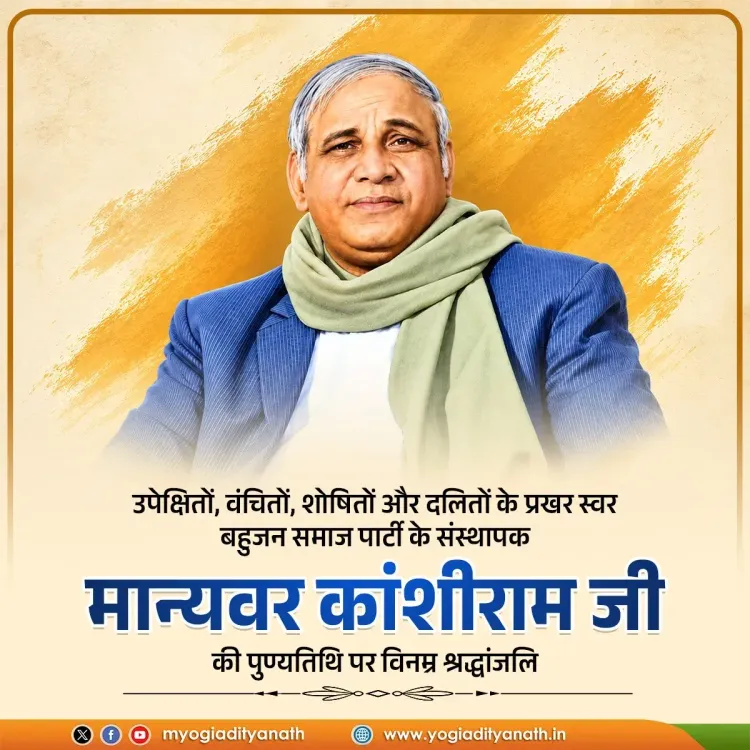
Twenty years after his passing, Kanshi Ram's legacy as the architect of Dalit political assertion continues to command respect across the ideological spectrum — including from those his movement once challenged. On Friday, 9 October 2026, Uttar Pradesh Chief Minister Yogi Adityanath offered a solemn tribute to the BSP founder on his death anniversary, invoking the ideals of social justice, equality, and the empowerment of marginalised communities.
Posting on X, CM Yogi wrote: 'सामाजिक न्याय, समानता और वंचित समाज के अधिकारों को सशक्त स्वर देने वाले मान्यवर कांशीराम जी की पुण्यतिथि पर विनम्र श्रद्धांजलि।' — translated: 'Humble tribute on the death anniversary of Manyavar Kanshi Ram ji, who gave a powerful voice to social justice, equality, and the rights of deprived sections of society.'The Legacy CM Yogi Chose to Honour
Kanshi Ram, born on 15 March 1934 in Punjab, founded the Bahujan Samaj Party (BSP) in 1984 with a singular mission: to consolidate the political strength of Dalits, OBCs, minorities, and other marginalised groups — the 'Bahujan' — against entrenched upper-caste dominance. His organisational genius transformed Dalit politics from a moral aspiration into an electoral force, culminating in the BSP's remarkable rise in Uttar Pradesh.
His chosen successor, Mayawati, went on to become Chief Minister of UP four times, a direct product of the movement he built. Kanshi Ram passed away on 9 October 2006 in New Delhi, leaving behind a transformed political landscape.
A Cross-Party Salute and What It Signals
CM Yogi's tribute is notable in its framing. He specifically cited 'सामाजिक भागीदारी और वंचित वर्गों के सशक्तीकरण' — 'social participation and the empowerment of deprived sections' — as an inspiration for building 'a society equipped with equal opportunity, dignity, and rights.' That language aligns Kanshi Ram's struggle with the BJP government's own stated welfare agenda, a rhetorical bridge that reflects the intense competition for Dalit and OBC votes in India's most populous state.
Uttar Pradesh, with its 80 Lok Sabha seats, remains the most consequential electoral battleground in India, and the Bahujan vote bloc is central to any winning coalition. Tributes like this one are never purely ceremonial — they are a statement of intent about whose history a government claims to honour.
Point of View
Framing the BSP founder's legacy in terms that resonate with the BJP's own welfare and social justice narrative. In a state where Dalit and OBC communities constitute a decisive electoral plurality, honouring Bahujan icons is a well-established BJP tactic to widen its social coalition beyond its traditional base. The language of 'equal opportunity and dignity' maps Kanshi Ram's movement onto the ruling party's stated agenda, blurring ideological lines. It reflects how thoroughly the politics of social justice have permeated every corner of Uttar Pradesh's electoral calculus.
NationPress
9 Oct 2026
Frequently Asked Questions
When did Kanshi Ram die?
Kanshi Ram passed away on 9 October 2006 in New Delhi, after years of ill health. The date is now observed as his death anniversary ( punyatithi ).
Who was Kanshi Ram and what did he do?
Kanshi Ram was a social reformer and politician who founded the Bahujan Samaj Party (BSP) in 1984 . He dedicated his life to mobilising Dalits, OBCs, and minorities into a unified political force in India.
Why is Yogi Adityanath paying tribute to Kanshi Ram?
CM Yogi Adityanath offered the tribute on Kanshi Ram's death anniversary to honour his contributions to social justice and the empowerment of deprived communities, reflecting cross-party recognition of his legacy in Uttar Pradesh .
What is Kanshi Ram's connection to Mayawati?
Kanshi Ram mentored Mayawati and groomed her as his political successor. She went on to lead the BSP and serve as Chief Minister of Uttar Pradesh four times.
What does 'Manyavar' mean in reference to Kanshi Ram?
' Manyavar ' is an honorific in Hindi meaning 'respected' or 'honourable.' It became closely associated with Kanshi Ram as a mark of reverence for his work among Bahujan communities.