Did Congress Neglect the Nation's Defence Priorities?
Click to start listening
Synopsis
Union Finance Minister Nirmala Sitharaman has launched a fierce critique of the Congress party, accusing them of failing to prioritize the nation's defence during their tenure. With strong references to former leaders and current government advancements, Sitharaman emphasizes the critical need for robust military funding and domestic production.
Key Takeaways
- Finance Minister Nirmala Sitharaman criticizes Congress for neglecting defence.
- Former Defence Minister A.K. Antony cited budget constraints for equipment purchases.
- Current government prioritizes defence spending and domestic production.
- New cess aims to bolster health and military funding.
- Significant changes in GST related to demerit goods.
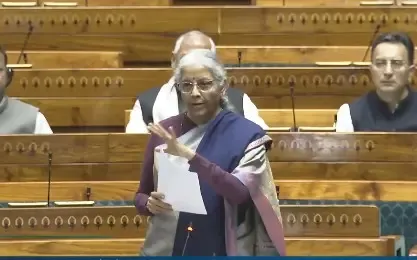
New Delhi, Dec 8 (NationPress) Union Finance Minister Nirmala Sitharaman fiercely criticized the Congress party during a session in the Rajya Sabha on Monday, accusing them of neglecting defence funding during their time in power.
While addressing the Upper House, she referenced A.K. Antony, the former Defence Minister, who stated in Parliament, 'I can't procure these defence items due to budget constraints.'
'This was the mindset of the Congress party. Defence funding was clearly not a priority for them,' she emphasized.
Continuing her strong remarks, Finance Minister Sitharaman declared, 'Our soldiers lacked essential snow boots for operations in high-altitude regions,' highlighting the inadequacies faced by the armed forces during the previous Congress administration.
She pointed out that the Army was short on ammunition, capable of sustaining only 17 days of intense combat.
Referring to a CAG report from 2013, she revealed that 'in some ammunition categories, the Army had dwindled to merely 10 days' worth of supplies needed for a rigorous conflict.'
In stark contrast, she praised the current government under Prime Minister Narendra Modi for prioritizing defence spending, stating that the administration has significantly increased the procurement of ammunition and replaced outdated supplies.
'We've also ensured that our soldiers receive bullet-proof vests,' she remarked.
Additonally, Finance Minister Sitharaman noted that PM Modi has taken proactive steps to bolster domestic military hardware production, reducing reliance on imports and enabling India to export approximately Rs 25,000 crore worth of defence equipment.
During her response to the debate on the 'Health Security to National Security Cess Bill, 2025' in the Upper House, she asserted that this cess provides a viable method to enhance both citizen health and military readiness.
She clarified that the cess would only apply to demerit goods, excluding essentials.
The Union Minister highlighted the need for a dedicated revenue stream to support robust defence capabilities in a rapidly evolving security landscape.
Modern warfare, she explained, is characterized by precision weaponry, autonomous systems, and space technology, all of which demand significant, ongoing financial investment.
Moreover, she acknowledged that health is primarily a state responsibility, and thus, proceeds from the cess will be shared with the states.
She elaborated on the previous GST regime, where sin goods or demerit goods incurred GST alongside a compensation cess, leading to a cumulative rate as high as 88% in certain instances, always exceeding 40%.
With the introduction of the next-generation GST, the compensation cess has been eliminated, and GST now maintains a cap of 40%.
Point of View
It is essential to recognize the ongoing discourse about defence spending in India. Sitharaman's remarks underscore the necessity for consistent investment in our armed forces, particularly in the context of evolving security challenges. The focus on domestic production is commendable, reflecting a shift towards self-reliance in defence capabilities, aligning with national interests.
NationPress
09/12/2025
Frequently Asked Questions
What did Nirmala Sitharaman accuse Congress of?
Nirmala Sitharaman accused Congress of failing to prioritize defence funding during their time in power, highlighting inadequate resources for the armed forces.
What changes has the current government implemented in defence spending?
The current government has increased defence spending, ordered more ammunition, and replaced expired stocks, while also focusing on domestic production of military hardware.
What is the Health Security to National Security Cess Bill, 2025?
This bill aims to create a revenue stream for enhancing both citizen health and military preparedness by levying a cess on demerit goods.