Delhi CM Rekha Gupta Thanks Sikkim CM Tamang for Wishes
Synopsis
Delhi Chief Minister Rekha Gupta on 19 July 2026 responded to warm wishes from Sikkim Chief Minister Prem Singh Tamang, expressing hope that Sikkim would scale new heights of progress and prosperity under his leadership — a gesture illustrating routine cross-party courtesy in India's federal system.
Key Takeaways
Delhi CM Rekha Gupta publicly thanked Sikkim CM Prem Singh Tamang on 19 July 2026 via X.
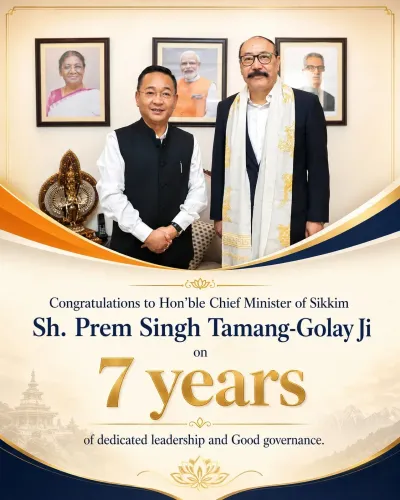
Tamang , who leads the Sikkim Krantikari Morcha , has governed Sikkim since 2019 and was re-elected in 2024 .
Sikkim is India's first fully organic state, with a development focus on organic agriculture, hydropower, and tourism.
The exchange reflects India's cooperative federal framework, where chief ministers across party lines maintain cordial relations.
Potential areas for Delhi–Sikkim collaboration include organic food supply chains, tourism, and environmental coordination.
Delhi Chief Minister Rekha Gupta on Sunday, 19 July 2026, responded to warm wishes extended by Sikkim Chief Minister Prem Singh Tamang, expressing hope that Sikkim would continue to prosper under his leadership.
Context
In her post on X, Rekha Gupta addressed Tamang — referred to by his popular handle @PSTamangGolay — with a note of gratitude: 'Thank you for your warm wishes. May Sikkim continue to scale new heights of progress and prosperity under your leadership.' The exchange reflects the routine but meaningful courtesy that chief ministers across party lines extend to one another within India's federal framework.
Rekha Gupta leads the Bharatiya Janata Party government in Delhi, while Prem Singh Tamang, also known as Golay, heads the Sikkim Krantikari Morcha government in Gangtok — two administrations from different political formations maintaining cordial inter-governmental relations.
Policy Backdrop
Tamang has led Sikkim since 2019, when the Sikkim Krantikari Morcha swept to power ending a long period of single-party dominance. His government was returned to office again in 2024, with a mandate centred on sustainable development, organic agriculture, hydropower expansion, and tourism promotion.
Sikkim is widely recognised as India's first fully organic state and has positioned itself as a model for environment-sensitive governance in the Himalayan region. These development priorities make the state a point of interest for inter-state dialogue on ecology, disaster management, and mountain tourism.
Stakeholders and Impact
Exchanges of this nature between state governments — regardless of political affiliation — help sustain the cooperative federal architecture that underpins India's governance structure. Formal platforms such as NITI Aayog Governing Council meetings provide structured space for such bilateral engagement, supplemented by informal diplomatic courtesies like this one.
For Delhi and Sikkim, potential areas of inter-state collaboration could include tourism promotion, organic food supply chains, and coordination on environment and disaster preparedness — sectors where both administrations have expressed active interest.
What's Next
Observers will watch for any formal bilateral engagements between Delhi and Himalayan states, including possible memoranda of understanding on organic farming or mountain tourism at upcoming NITI Aayog Governing Council sessions. Such courtesy exchanges sometimes precede or accompany structured policy cooperation between state governments.
The interaction underscores a broader pattern in Indian politics where chief ministers across party lines maintain working relationships, signalling that cooperative federalism continues to function alongside electoral competition.
Point of View
Where the ruling BJP in Delhi and the regional Sikkim Krantikari Morcha operate in separate political ecosystems yet choose visible cordiality. Such public gestures reinforce the norm of cooperative federalism at a time when centre-state and inter-state relations are frequently contested along political lines. For Tamang, acknowledgement from a BJP chief minister may also carry value in navigating New Delhi's administrative corridors, given the central government's role in funding and approving projects for small Himalayan states. The post, while routine, is a small data point in the larger pattern of how India's chief ministers manage relationships across the political divide.
NationPress
20 Jul 2026
Frequently Asked Questions
Why did Delhi CM Rekha Gupta thank Sikkim CM Prem Singh Tamang?
Rekha Gupta thanked Prem Singh Tamang in response to warm wishes he had extended to her, expressing hope for Sikkim's continued progress and prosperity under his leadership.
Who is Prem Singh Tamang and which party does he lead?
Prem Singh Tamang , also known as Golay, is the Chief Minister of Sikkim and heads the Sikkim Krantikari Morcha . He has governed the state since 2019 and was re-elected in 2024 .
What is the relationship between Delhi and Sikkim governments?
The Delhi and Sikkim governments are led by different political parties — BJP and Sikkim Krantikari Morcha respectively — but maintain cordial inter-governmental relations as part of India's cooperative federal framework.
What is Sikkim known for in terms of governance?
Sikkim is widely recognised as India's first fully organic state and has built a governance model focused on sustainable development, organic agriculture, hydropower, and eco-friendly tourism.
What platforms do Indian chief ministers use for inter-state cooperation?
Indian chief ministers engage through formal platforms like NITI Aayog Governing Council meetings, as well as informal diplomatic exchanges on social media and bilateral meetings to coordinate on sectors such as tourism, environment, and disaster management.