Gadkari pays tribute to Padma Vibhushan Lakshman Shastri Joshi
Synopsis
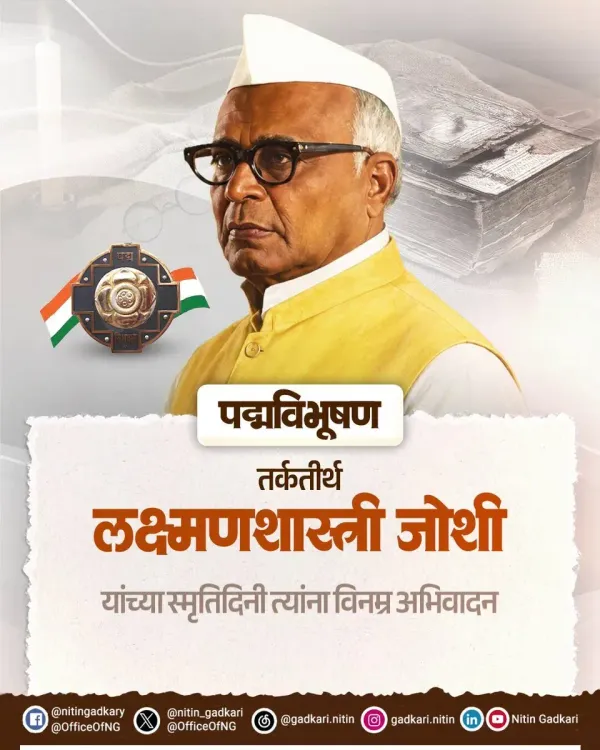
Union Minister Nitin Gadkari on 27 May 2026 paid tribute to Padma Vibhushan Tarkateerth Lakshman Shastri Joshi on his death anniversary, honouring the eminent Marathi writer, lexicographer, and Sanskrit scholar best known for compiling the Marathi Vishwakosh.
Key Takeaways
Union Minister Nitin Gadkari posted a tribute on 27 May 2026 marking the death anniversary of Padma Vibhushan Tarkateerth Lakshman Shastri Joshi .
Joshi was a celebrated Marathi writer, lexicographer, and Sanskrit scholar of the twentieth century.
He is best known for compiling the Marathi Vishwakosh , a comprehensive Marathi-language encyclopaedia.
The Government of India honoured him with the Padma Vibhushan , the country's second-highest civilian award.
The tribute reflects the BJP 's broader pattern of publicly recognising contributors to regional languages and classical studies.
Gadkari's post included a video , signalling a substantive commemorative gesture beyond a routine text tribute.
Union Road Transport and Highways Minister Nitin Gadkari on Wednesday, 27 May 2026 paid homage to Padma Vibhushan Tarkateerth Lakshman Shastri Joshi, a towering figure in Marathi literature, lexicography, and Sanskrit scholarship, on the occasion of his death anniversary.
Context
Gadkari posted a tribute on X in Marathi, writing: 'श्रेष्ठ मराठी लेखक, कोशकार व संस्कृत पंडित पद्मविभूषण तर्कतीर्थ लक्ष्मणशास्त्री जोशी यांच्या स्मृतिदिनी त्यांना विनम्र अभिवादन' — translated as 'Humble salutations to the eminent Marathi writer, lexicographer and Sanskrit scholar Padma Vibhushan Tarkateerth Lakshman Shastri Joshi on his death anniversary.' The post was accompanied by a video, indicating a more substantive commemorative intent beyond a routine text post.
Gadkari, himself a senior leader from Maharashtra and former national president of the BJP, has consistently acknowledged figures who shaped Marathi intellectual and cultural life. The tribute carries added resonance given his roots in the state's public life.
Who Was Lakshman Shastri Joshi?
Lakshman Shastri Joshi, honoured with the title Tarkateerth — denoting mastery in logic and philosophy — was one of Maharashtra's most distinguished scholars of the twentieth century. He is best remembered as the principal architect of the Marathi Vishwakosh, a comprehensive Marathi-language encyclopaedia that remains a landmark reference work in Indian regional scholarship.
His contributions spanned Marathi creative writing, Sanskrit textual studies, and the compilation of lexicons that standardised and enriched the Marathi literary tradition. The Government of India recognised his lifetime of scholarship with the Padma Vibhushan, the country's second-highest civilian honour.
Policy Backdrop
Union ministers and senior political leaders routinely mark the death anniversaries of Padma awardees, classical scholars, and regional literary icons through official social media channels. These tributes serve a dual purpose: preserving public memory of cultural contributors and signalling the government's commitment to regional language promotion.
The BJP has made the recognition of classical languages and regional literary heritage a visible part of its cultural outreach, particularly in states like Maharashtra where Marathi identity holds strong electoral and social salience. Tributes to figures like Joshi align with that broader pattern.
Stakeholders and Impact
The tribute is significant for Marathi scholars, Sanskrit academics, and literary institutions across Maharashtra and the wider Marathi-speaking diaspora. The Marathi Vishwakosh, Joshi's most enduring contribution, continues to be consulted by researchers, educators, and students, making his legacy an active rather than merely historical one.
State-level literary bodies and universities in Maharashtra periodically hold commemorative events on Joshi's death anniversary. A ministerial tribute from the Union government adds national visibility to such observances.
What's Next
Attention will turn to whether Maharashtra's state government or its cultural institutions organise formal commemorations, and whether any new edition or digital expansion of the Marathi Vishwakosh is announced in connection with the anniversary. The Union government's continued recognition of regional scholars through such tributes also feeds into the broader policy conversation around the promotion and documentation of India's classical and regional language traditions.
Point of View
Particularly those with deep roots in Maharashtra. For Gadkari, a Nagpur-based leader with a long history in Maharashtrian public life, such acknowledgements carry authentic cultural weight rather than appearing purely performative. The tribute also fits into the Union government's broader push to foreground classical and regional language heritage as a pillar of national identity. Whether it catalyses any institutional action — such as a new edition of the Marathi Vishwakosh or a central grant to Marathi literary bodies — remains the more substantive question to watch.
NationPress
27 Sept 2026
Frequently Asked Questions
Who was Lakshman Shastri Joshi?
Lakshman Shastri Joshi, known by the title Tarkateerth, was a prominent twentieth-century Marathi writer, lexicographer, and Sanskrit scholar who compiled the Marathi Vishwakosh and was honoured with the Padma Vibhushan by the Government of India.
What is the Marathi Vishwakosh?
The Marathi Vishwakosh is a comprehensive Marathi-language encyclopaedia compiled under the principal guidance of Lakshman Shastri Joshi. It remains one of the most significant reference works in the Marathi intellectual tradition.
Why did Nitin Gadkari pay tribute to Lakshman Shastri Joshi?
Gadkari paid tribute on the occasion of Lakshman Shastri Joshi's death anniversary on 27 May 2026, honouring his contributions to Marathi literature, lexicography, and Sanskrit scholarship.
What does Tarkateerth mean?
Tarkateerth is an honorary title in the Sanskrit scholarly tradition denoting mastery in tarka, meaning logic or reasoning, and is conferred on scholars of exceptional standing in classical Indian philosophy and Sanskrit studies.
What is the Padma Vibhushan award?
The Padma Vibhushan is India's second-highest civilian honour, awarded by the Government of India to individuals for exceptional and distinguished service to the nation across various fields including arts, literature, science, and public affairs.