Is the Government’s Multi-Pronged Strategy Enhancing Consumption and Growth?
Click to start listening
Synopsis
On December 8, Finance Minister Nirmala Sitharaman outlined a comprehensive approach by the government designed to stimulate consumption and economic growth. The combination of demand-supporting and supply-side strategies aims to positively impact GDP and household incomes. This article delves into the details and implications of these initiatives.
Key Takeaways
- Multi-faceted strategy to enhance consumption is in effect.
- New income tax exemptions and GST rate cuts are key measures.
- Focus on balanced growth between rural and urban areas.
- Programs like PM-KISAN and PM Awas Yojana support rural income.
- GDP is projected to grow by 8.2% in the upcoming quarter.
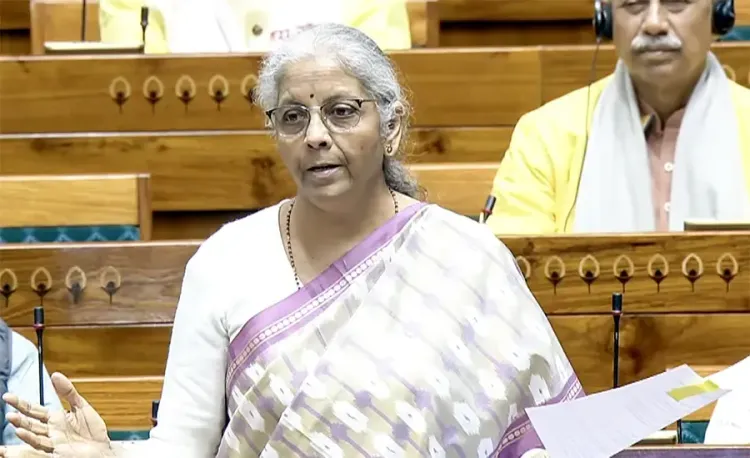
New Delhi, Dec 8 (NationPress) Finance Minister Nirmala Sitharaman announced in Parliament on Monday that the government is implementing a multi-faceted strategy aimed at enhancing consumption within the economy. This approach combines demand-boosting initiatives, supply-side income-enhancing measures, and structural reforms, all contributing to the overall growth of GDP.
In a written answer to a Lok Sabha inquiry, she detailed various policy measures, including the new income tax exemption for individuals earning up to Rs 12 lakh, recent reductions in GST rates, ongoing efforts to simplify business operations, promote skilling, generate employment, and develop infrastructure. Additionally, expanded access to credit through schemes like MUDRA and PMSVANidhi is anticipated to further stimulate economic consumption.
The Finance Minister also highlighted that the government is focused on achieving balanced growth between rural and urban consumption.
Programs aimed at urban livelihoods and skill development, combined with tax incentives and the expansion of digital payments in city areas, are enhancing consumption in these regions. Simultaneously, significant programs such as PM-KISAN, the Mahatma Gandhi National Rural Employment Guarantee Scheme, PM Awas Yojana (Gramin), agricultural productivity missions, and Self Help Group initiatives are driving income growth across rural sectors.
This boost in consumption demand is expected to positively influence overall economic activity by supporting household incomes, fostering private investment, and strengthening economic growth, according to Sitharaman.
She further noted that data compiled by the National Statistics Office (NSO) shows an increase in the share of Private Final Consumption Expenditure in GDP from 62.2 percent in Q2 of 2024-25 to 62.5 percent in Q2 of 2025-26, with growth in constant price terms rising from 6.4 percent to 7.9 percent during the same period.
Moreover, the GDP at constant prices is projected to grow by 8.2 percent in the second quarter (Q2) of 2025-26, compared to 5.6 percent in Q2 of 2024-25 and 7.8 percent in the first quarter (Q1) of 2025-26, indicating an accelerating growth trend in the economy, she added.
Point of View
The government's strategic approach to enhancing consumption is a vital step in stimulating economic growth. By targeting both urban and rural sectors, these initiatives reflect a comprehensive understanding of the diverse economic landscape of the country. NationPress stands firm in its commitment to providing insights that contribute to informed discussions on national economic policies.
NationPress
09/12/2025
Frequently Asked Questions
What is the government's strategy for boosting consumption?
The government is adopting a multi-pronged strategy that includes demand-support measures, income-enhancing supply-side strategies, and structural reforms to stimulate consumption and drive GDP growth.
What are some key initiatives mentioned by the Finance Minister?
Key initiatives include new income tax exemptions for incomes up to Rs 12 lakh, GST rate cuts, and schemes like MUDRA and PMSVANidhi aimed at expanding access to credit.
How is the government addressing rural and urban consumption?
The government is focusing on balanced growth by implementing programs tailored for urban livelihoods and rural income enhancement through various flagship initiatives.
What impact is expected from these measures?
These initiatives are expected to boost consumption demand, support household incomes, encourage private investment, and reinforce overall economic growth.
What does recent data show about GDP growth?
According to the National Statistics Office, the GDP at constant prices is projected to grow by 8.2% in Q2 of 2025-26, reflecting a significant acceleration in economic growth.