Great Nicobar project balances growth and green safeguards, says Centre
Synopsis
The Centre is defending one of India's most ambitious and contested infrastructure projects — the Great Nicobar Island development — against Rahul Gandhi's charge that it is a "crime against natural and tribal heritage." With 7.11 lakh trees set to be felled and compensatory afforestation shifted to Haryana, the government's green credentials on this ₹72,000-crore-scale project face their sharpest scrutiny yet.
Key Takeaways
The Union Environment Ministry on 1 May defended the Great Nicobar Island project, citing a regulated EIA framework with 42 compliance conditions .
Key components include an ICTT with 14.2 million TEU capacity, a greenfield airport for 4,000 PHP , a 450 MVA power plant, and a township of 16,610 hectares .
The project will divert 1.82% of island forest cover; up to 7.11 lakh trees may be felled across 49.86 sq km .
Compensatory afforestation of 97.30 sq km is planned in Haryana since local replanting is not feasible.
No displacement is proposed for Shompen and Nicobarese communities; project is aligned with the Shompen Policy 2015 and Jarawa Policy 2004 .
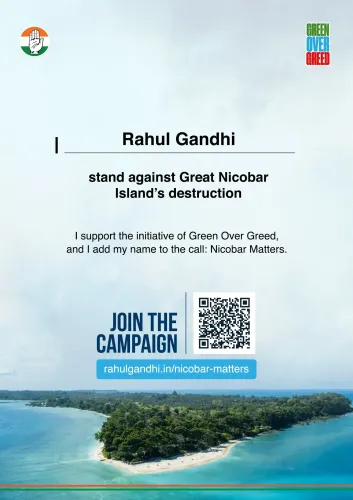
Rahul Gandhi called the project "one of the biggest scams and gravest crimes" against India's natural and tribal heritage.
The Union Environment Ministry on Friday, 1 May reiterated that the proposed Great Nicobar Island development project strikes a balance between port-led economic growth, national security imperatives, and calibrated environmental protections — dismissing concerns raised by opposition leaders and environmentalists.
The clarification came days after Leader of Opposition Rahul Gandhi visited the Andaman and Nicobar Islands and launched a sharp attack on the project, calling it "one of the biggest scams and gravest crimes against this country's natural and tribal heritage in our lifetime."
What the Project Entails
The Union government's stated objective is to transform Great Nicobar into a strategic maritime and economic hub by exploiting its proximity — approximately 40 nautical miles — to the East–West international shipping route, while reducing India's dependence on foreign transshipment ports.
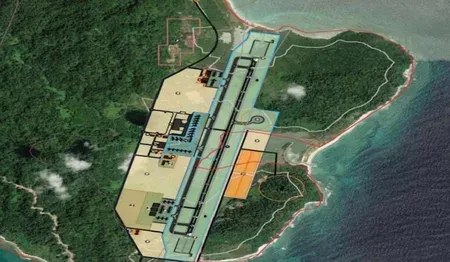
Key infrastructure components include an International Container Transhipment Terminal (ICTT) with a capacity of 14.2 million TEU (Twenty-Foot Equivalent Units), a greenfield International Airport designed to handle 4,000 Peak Hour Passengers (PHP), a 450 MVA gas and solar-based power plant, and a new township spanning 16,610 hectares.
The project is being implemented across three phases: Phase I (2025–35, 72.12 sq km); Phase II (2036–41, 45.27 sq km); and Phase III (2042–47, 48.71 sq km), covering a total area of 166.1 sq km, comprising 35.35 sq km of revenue land and 130.75 sq km of forest land.
Environmental Framework and Tree Felling
The Centre said the project operates under a regulated environmental framework, backed by clearance under the Environmental Impact Assessment (EIA) Notification, 2006, and the Island Coastal Regulation Zone (ICRZ) Notification, 2019, along with 42 compliance conditions.
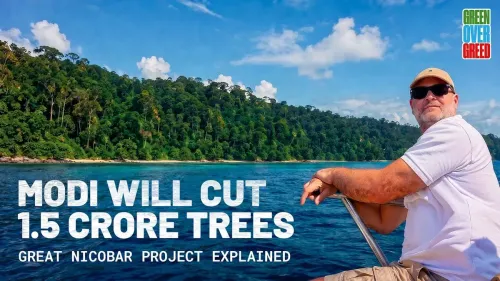
According to the official statement, the project will divert 1.82 per cent of the total forest cover of the Andaman and Nicobar Islands. The estimated number of trees in the affected area is 18.65 lakh, though the maximum number expected to be felled is 7.11 lakh within 49.86 sq km of forest.
"Importantly, 65.99 sq km of land will be preserved as green zones with no tree felling, ensuring ecological balance," the statement said. Since the islands already have more than 75 per cent forest cover, compensatory afforestation cannot be carried out locally. Instead, afforestation is planned in Haryana, with 97.30 sq km of land identified to compensate for Phase I's diversion of 48.65 sq km of forest. Additionally, under the 'Ek Ped Maa Ke Naam' initiative, 24 lakh trees have reportedly been planted across the Andaman and Nicobar Islands.
Tribal Welfare at the Centre
The government maintained that tribal welfare remains a non-negotiable component of the project. No displacement has been proposed for the Shompen and Nicobarese communities, and a net increase in notified tribal reserve area is planned through re-notification measures.
"The Great Nicobar Project is fully aligned with the Shompen Policy of 2015 and the Jarawa Policy of 2004, which mandate that large-scale development proposals prioritise the welfare and integrity of Particularly Vulnerable Tribal Groups (PVTGs) and follow a structured consultation process," the official statement noted.
Political Flashpoint
The government's rebuttal directly targets criticism from Congress leader and Lok Sabha Leader of Opposition Rahul Gandhi, who, in a two-minute video posted on social media platform X, alleged that the Bharatiya Janata Party (BJP)-led Centre plans to "destroy" the island's rich forest assets by felling thousands of trees. Gandhi described the initiative as a threat to both natural heritage and tribal communities.
This is not the first time the project has faced political and environmental scrutiny. Critics, including independent environmental groups, have previously raised concerns about the ecological sensitivity of the region, which is home to rare species and fragile coastal ecosystems. Notably, the Centre's phased approach and compliance conditions are being cited as its primary defence against such allegations.
What Comes Next
With Phase I slated to run through 2035, the immediate focus will be on whether the 42 compliance conditions are enforced rigorously and whether the compensatory afforestation in Haryana delivers measurable ecological outcomes. Independent monitoring of tribal welfare commitments will also be closely watched by civil society groups and the judiciary.
Point of View
42 conditions, phased timelines — but process and outcome are not the same thing. Shifting compensatory afforestation to Haryana while felling 7.11 lakh trees in one of the world's most biodiverse island ecosystems is an ecological substitution that scientists have repeatedly flagged as inadequate. The tribal welfare assurances, while formally anchored in the Shompen and Jarawa policies, lack an independent monitoring mechanism. And with Phase I running until 2035, there is a decade-long window where enforcement will matter far more than the promises made today. Rahul Gandhi's political intervention raises legitimate questions, even if the framing of 'scam' risks oversimplifying a genuinely complex infrastructure-versus-ecology debate.
NationPress
18 Sept 2026
Frequently Asked Questions
What is the Great Nicobar Island development project?
The Great Nicobar Island development project is a large-scale infrastructure initiative aimed at transforming the island into a strategic maritime and economic hub. Key components include an International Container Transhipment Terminal (ICTT) with 14.2 million TEU capacity, a greenfield international airport, a 450 MVA power plant, and a new township spanning 16,610 hectares, implemented across three phases from 2025 to 2047.
How many trees will be felled under the Great Nicobar project?
According to the Union government, the estimated number of trees in the affected area is 18.65 lakh, with a maximum of 7.11 lakh trees expected to be felled within 49.86 sq km of forest. The project will divert 1.82 per cent of the total forest cover of the Andaman and Nicobar Islands.
What environmental clearances does the Great Nicobar project have?
The project has received clearance under the EIA Notification, 2006, and the Island Coastal Regulation Zone (ICRZ) Notification, 2019, along with 42 compliance conditions. Compensatory afforestation of 97.30 sq km has been planned in Haryana to offset Phase I's forest diversion of 48.65 sq km.
Will tribal communities be displaced by the Great Nicobar project?
The Union government has stated that no displacement is proposed for the Shompen and Nicobarese communities. The project is said to be aligned with the Shompen Policy of 2015 and the Jarawa Policy of 2004, and a net increase in notified tribal reserve area is planned through re-notification measures.
Why did Rahul Gandhi criticise the Great Nicobar project?
Leader of Opposition Rahul Gandhi, after visiting the Andaman and Nicobar Islands, described the project as 'one of the biggest scams and gravest crimes against this country's natural and tribal heritage in our lifetime.' He alleged the BJP-led Centre plans to destroy the island's rich forest assets by felling thousands of trees.