What is the significance of Haryana's first District Human Development Report?
Synopsis
Discover the transformative impact of Haryana's inaugural District Human Development Report, released by Chief Minister Nayab Singh Saini. This groundbreaking initiative aims to enhance evidence-based policymaking, addressing pressing challenges and fostering inclusive growth in the state.
Key Takeaways
Sonipat Human Development Report 2026 is the first of its kind in Haryana.
The report supports evidence-based policy-making in the state.
It addresses critical issues such as air pollution and public health.
Collaboration between universities and government is emphasized.
The initiative aims for inclusive and sustainable growth in Haryana.
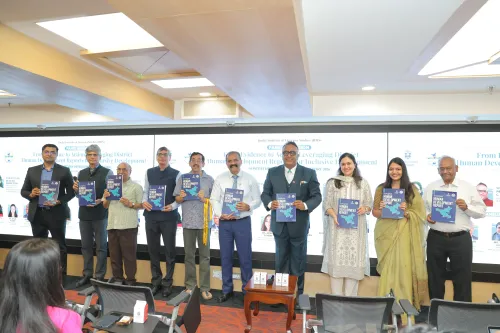
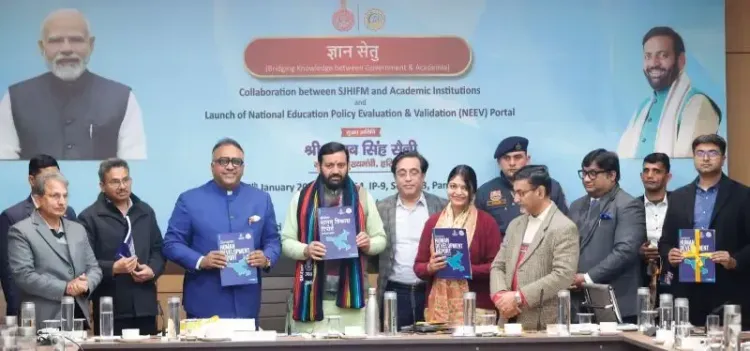
Sonipat, Jan 10 (NationPress) In a groundbreaking initiative aimed at enhancing evidence-driven policy-making in Haryana, Chief Minister Nayab Singh Saini unveiled the inaugural district human development report (HDR) for Sonipat, titled the Sonipat Human Development Report 2026.
This document, meticulously crafted by the Jindal Institute of Haryana Studies (JIHS) at O.P. Jindal Global University, signifies a pivotal achievement in the realm of district-level development planning within the state.
CM Saini praised the contributions of the Jindal Institute and extended his congratulations to the entire team for their dedication. He emphasized the critical role of Higher Education, Research, Policy-making, and Good Governance in driving development in Haryana, aligning with the vision of Viksit Bharat @2047.
The District HDRs initiative launched by JIHS represents a timely and transformative approach to capturing the lived experiences of Haryana’s residents through detailed, data-informed analysis. While District HDRs are globally recognized as essential tools for understanding disparities and advancements in human development, Haryana has previously lacked systematic assessments at the district level.
This initiative addresses a significant gap by providing nuanced insights that can guide targeted policy actions throughout the state. The importance of this effort is highlighted by the current challenges facing Haryana, particularly regarding environmental stress.
Alongside Punjab, the state is under increasing scrutiny due to air pollution issues in the Delhi-NCR region. Escalating degradation of air and water quality directly impacts public health, productivity, and overall quality of life, underscoring the necessity for comprehensive human development evaluations that extend beyond aggregate statistics.
Expressing support for the initiative, Naveen Jindal, Chancellor of O.P. Jindal Global University, remarked, “I take immense pride in the release of the Sonipat Human Development Report 2026, the first district-level report of its kind in Haryana, produced by the Jindal Institute of Haryana Studies (JIHS). This report embodies our unwavering commitment to advancing human development and enhancing Haryana’s prosperity. It also illustrates the vital collaboration between universities, governmental entities, and civil society in formulating evidence-based public policy initiatives. By integrating rigorous academic research with practical policy relevance, we aim to ensure that our work fosters tangible social progress. I commend the University and the JIHS team for their visionary and diligent efforts that will inform future policymaking and development strategies in Haryana.”
The District HDRs project is both ambitious and future-focused. It seeks not only to generate Human Development Reports for all districts in Haryana but also to regularly update them, allowing policymakers to monitor progress, recognize emerging challenges, and adjust development strategies accordingly.
This report emphasizes Sonipat’s intra-district dynamics, showcasing its advancements over time while elucidating the nuances and obstacles to human development within communities.
--Enhance decentralized governance by fortifying block- and panchayat-level capabilities for participatory planning, budgeting, and monitoring.
--Focus on legal education, access to justice, and the expansion of alternative dispute resolution mechanisms to address case backlogs, reduce crime, and improve responsiveness for vulnerable groups.
--Encourage inclusive representation and leadership among women, Scheduled Castes, minorities, and youth within local governance frameworks.
--Utilize technology platforms for transparency, direct beneficiary engagement, grievance redressal, and real-time monitoring of service delivery.
--Partner with universities and civil society to establish district “observatories” for human development—tracking progress, facilitating dialogue, and amplifying citizen voices.
Highlighting the overarching vision behind this initiative, Prof (Dr) C Raj Kumar, Founding Vice Chancellor of JGU, stated, “This report offers a multifaceted understanding of human development that transcends conventional economic metrics, merging quantitative analysis with community perspectives. Sonipat exists at the intersection of Haryana’s agrarian heritage and its swift urban and industrial evolution. In alignment with the United Nations Development Programme’s vision, this report reaffirms that meaningful progress is assessed not solely by income or infrastructure, but by the enhancement of human freedoms, opportunities, and well-being. This initiative represents a stride towards evidence-driven governance and a collective pursuit of a more inclusive, equitable, and sustainable future for Sonipat, Haryana, and India.”
The initial report centers on Sonipat district, an emerging national hub for higher education, home to several of India’s most esteemed universities.
According to Prof (Dr) Mrinalini Jha, Director of the Jindal Institute of Haryana Studies, “The Sonipat HDR chronicles advancements in education, health, livelihoods, environmental conditions, spatial transformation, access to basic services, and governance, while also identifying structural challenges and proposing actionable, constructive strategies to address them. By providing district-specific insights and pathways for action, this project has the potential to redefine development planning in Haryana and establish a pioneering standard for the region.”
The event also featured the signing of a Memorandum of Understanding (MoU) between the Swarna Jayanti Haryana Institute of Fiscal Studies (SJHIFS) and O.P. Jindal Global University in the esteemed presence of the Chief Minister. SJHIFS serves as Haryana’s premier institution for economic research, fiscal policy advisory services, Sustainable Development Goals (SDG) integration, and capacity building.
The objective of this MoU is to forge a collaborative partnership to promote joint research, evidence-based policy development, economic and social impact assessments, fiscal management studies, SDG integration research, capacity building, and internship opportunities for students.
This partnership aims to bolster knowledge exchange and institutional collaboration to advance policy-relevant research and support the State Government’s governance and development agenda. The Government of Haryana has articulated a long-term development vision through Haryana Vision @2047, which seeks to position the State as a leading growth engine for Viksit Bharat.
The Vision emphasizes inclusive prosperity, human capital advancement, climate-smart growth, and institutional enhancement. It aspires, among other goals, to -- expand the State economy beyond USD 1 trillion, create 5 million new jobs, achieve 100% female literacy and improved health outcomes, ensure access to piped drinking water and quality services for all, transition towards 70% renewable energy, promote climate-resilient agriculture and modern skills, and transform Haryana into a center for innovation, green finance, and industry.
The MoU is envisioned as a practical, outcome-oriented partnership that will not only elevate academic engagement but also help address real governance challenges and local issues. The launch of the Human Development Report 2026 signifies a new chapter in Haryana’s development narrative, grounded in comprehensive research, institutional collaboration, and a shared commitment to inclusive and sustainable growth.
Point of View
The release of Haryana's first District Human Development Report is a crucial step towards evidence-based governance. It highlights the need for systematic assessments at the district level to address social disparities and promote inclusive development. Such initiatives are essential for achieving the broader goals outlined in Haryana Vision @2047, aiming for a prosperous, equitable future.
NationPress
23 Sept 2026
Frequently Asked Questions
What is the main focus of the Sonipat Human Development Report?
The Sonipat Human Development Report focuses on various aspects such as education, health, livelihoods, environmental conditions, and governance, providing insights that can inform targeted policy interventions.
Who prepared the Sonipat Human Development Report?
The report was prepared by the Jindal Institute of Haryana Studies at O.P. Jindal Global University.
Why is this report significant for Haryana?
This report is significant as it fills a critical gap in understanding human development at the district level, enabling informed policy-making to address contemporary challenges.
What is the vision behind the Haryana Vision @2047?
Haryana Vision @2047 aims to position the state as a leading growth engine by emphasizing inclusive prosperity, human capital development, and sustainable growth.
What collaborative efforts are being made through the MoU signed during the event?
The MoU is aimed at promoting joint research, evidence-based policy formulation, and capacity building between the Swarna Jayanti Haryana Institute of Fiscal Studies and O.P. Jindal Global University.